
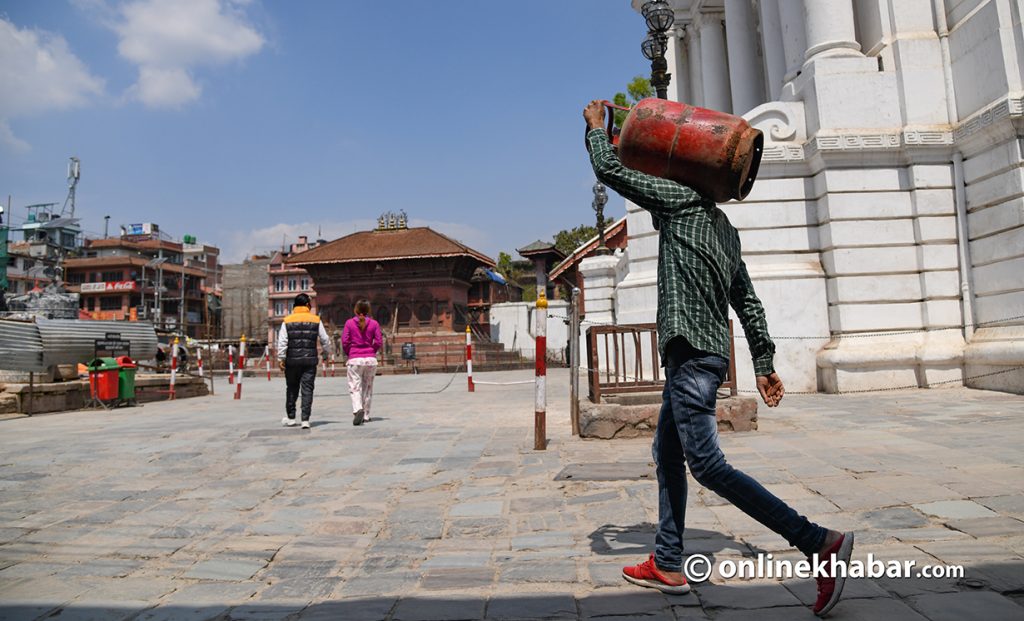
A shortage of cooking liquefied petroleum gas (LPG) has intensified across the Kathmandu Valley over the past 10 days, leaving consumers scrambling for cylinders despite claims by the Nepal Oil Corporation that supply is sufficient.
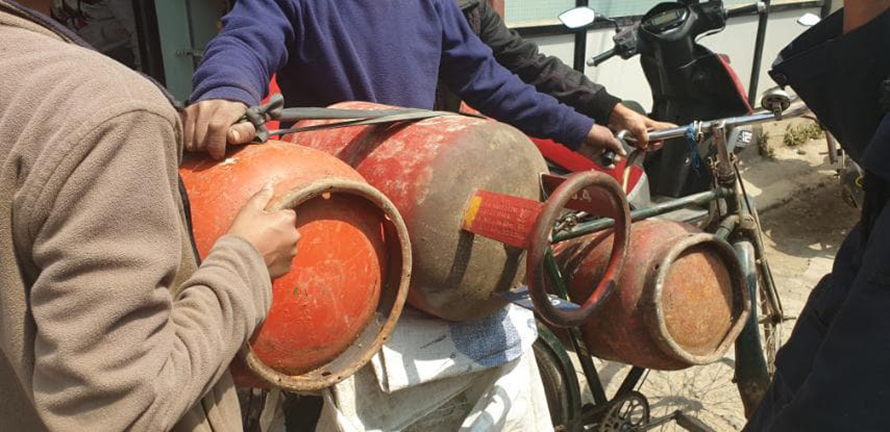
Consumers are seen wandering from one shop to another carrying empty cylinders, while dealers continue to respond that gas has not been supplied by the companies. As a result, consumers have been forced to endure prolonged hardship.
The shortage has become particularly severe in Kirtipur, Kathmandu, where a large number of Tribhuvan University students live in rented accommodation. Students complain that even when gas is available at some shops or dealers, it is being sold on the black market.
Suresh Badal, a Tribhuvan University student living in rented housing, said the lack of gas over the past 10 days has caused serious difficulties. “It has been nine or ten days since gas became unavailable in Kirtipur,” he said. “The government keeps saying there is enough gas, but traders here have been unable to supply it, and even when they have it, they hide it and sell it illegally.”
He also alleged that government agencies responsible for monitoring have remained silent spectators despite the black-marketing of a commodity directly linked to household kitchens.
Gyanhari Basnet of Kalanki has been searching for cooking gas for the past three days. When he inquired at his regular shop, the seller told him that dealers had not supplied gas. Basnet then visited all nearby gas outlets, but each responded that there was a shortage in the market.
“This is not just my problem,” said Ramesh Thapa of Balaju Raniban. “Earlier, gas would be delivered to our homes with a phone call. Now, even after carrying the cylinder to the shop, we have to return empty-handed.”
Thapa, a Nepal Gas consumer, said the dealer has taken his name and given him a small slip marked number 27, promising to call once gas arrives, but with no certainty on when that will happen.
Gas sellers say they are unable to supply consumers because dealers themselves have not received gas from depots. Suman Gautam, a gas seller in Kalanki, said limited supply from dealers has forced them to turn customers away.
According to consumers, the shortage has hit hardest those with only one cylinder, particularly students and low-income families. While households with multiple cylinders face fewer problems, those dependent on a single cylinder risk having their kitchens completely shut down.
Gas shortage exists: Gas Dealers’ Federation
Gas consumption in the Kathmandu Valley increases by 20–25 per cent during winter compared to normal periods. Nepal requires around 47,000–48,000 tonnes of gas per month, but imports this month are estimated to be limited to 42,000–43,000 tonnes.
The Gas Dealers’ Federation Nepal says LPG consumption rises with the onset of winter, and increased demand has led to shortages in the market. Senior Vice-President Bishnu Dulal said winter demand naturally increases, and problems arise when industries fail to load sufficient quantities of gas.
He said discussions have already been held with the Managing Director of the Nepal Oil Corporation and the LPG division. According to the federation, seasonal demand, technical problems in industries and consumer behaviour are the main causes of the shortage.
Dulal said some industries avoid lifting gas from distant depots and prefer nearby ones, leading to supply imbalances. He added that panic buying and the tendency of consumers to refill and hold cylinders after hearing shortage rumours have created an artificial scarcity.
The federation said it is in continuous dialogue with the Oil Corporation and gas industries, and a tripartite meeting will be held within a few days to strengthen supply management. Dulal also said maintenance work at some gas industries has caused delays, but the market is expected to normalise fully within the next seven to ten days.
Shortage to end in 4–5 days: LPG Industry Association
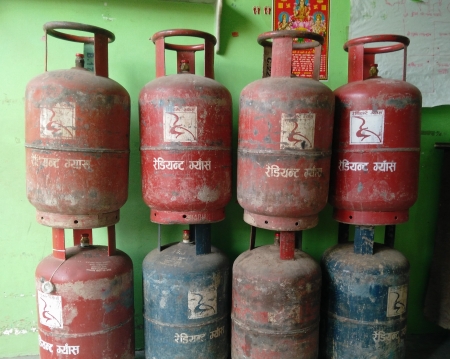
The Nepal LPG Industry Association has claimed that the gas shortage will be completely resolved within four to five days. Association President Diwan Chand said supply problems have persisted for about 15 days, but as some obstructions have now been removed, the market will return to normal soon.
He attributed delays to technical issues and maintenance at India’s Barauni refinery. “There was a minor defect in around 10,000 tonnes coming from Barauni, but that has been fixed, and gas has started arriving,” he said.
Chand said additional time was required to reroute transport vehicles for supply management, but gas inflow has increased significantly in recent days. “Nepal Gas has started arriving. On one day alone, 10 trucks carrying about 12,000 cylinders arrived, and the same number came the next day,” he said, adding that 30,000–35,000 cylinders have already entered the market.
He also blamed panic hoarding by consumers for prolonging the problem, saying factories are now operating normally. According to Chand, while import issues have existed for about a month, their impact on the market became visible only over the past two weeks. He urged consumers not to panic, claiming supply would be fully smooth within three to four days.
Problem resolved: Oil Corporation
The Nepal Oil Corporation has claimed that problems in LPG supply have been resolved and that distribution is now regular. Spokesperson Manoj Thakur said shortages were felt due to transportation issues at a few gas industries, including Nepal Gas, Saibaba Gas and Everest Gas, but these have now been addressed.
He said disruptions in the rotation of Nepal Gas cylinders, which have the largest consumer base, had a greater impact on the market. Thakur added that gas consumption rises in both Nepal and India during the winter months (Poush–Magh), and improper transportation during this period led to the problem.
However, he clarified that the corporation has been providing product delivery orders (PDOs) as demanded by industries. He said discussions have been held with gas producers and that gas loading is currently higher than demand.
“Our winter consumption is around 75 to 80 bullets, but at present nearly 90 to 100 bullets are being loaded,” Thakur said, adding that there is no need for consumers to panic. He acknowledged, however, that consumers with only one cylinder may still face some difficulties due to rotation issues.