Kathmandu, February
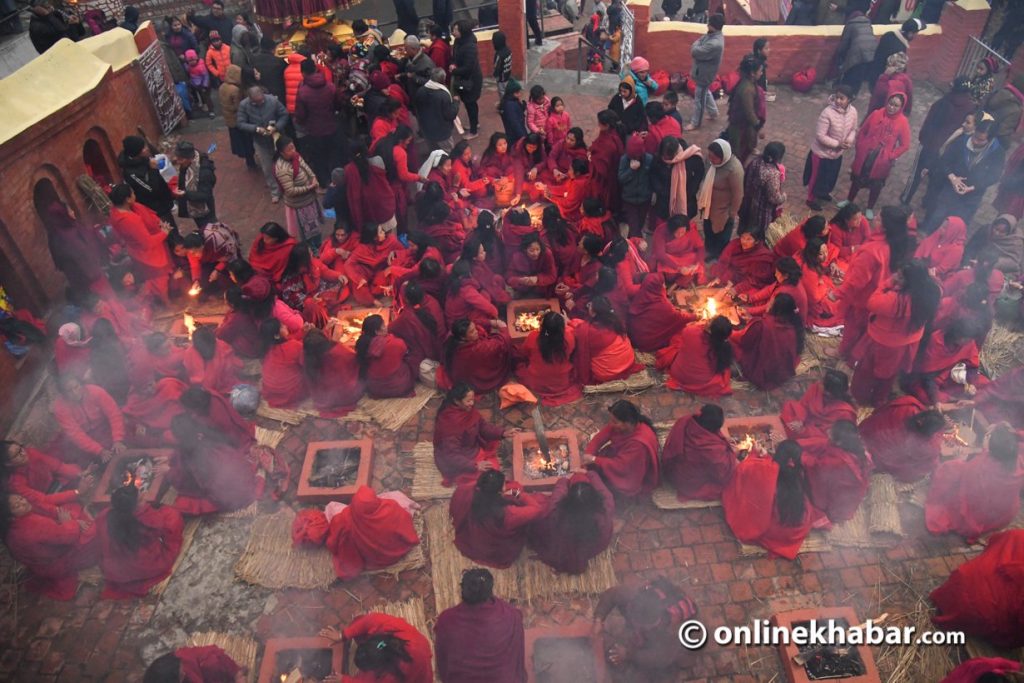
The month-long Swasthani Brata Katha is being formally concluded today on the day of Magh Shukla Purnima.
The one-month fast, observed in households by followers of the Vedic Sanatan Hindu tradition since Poush Shukla Purnima, is being completed today in accordance with prescribed rituals. Devotees across the country who began the Swasthani fast with proper rites and worshipped Lord Mahadev along with Goddess Parvati daily at midday are concluding the observance today.
With this, the recitation and listening of the Swasthani Katha, based on the Magh Mahatmya of the Kedarkhand section of the Skanda Purana, which narrates a dialogue between Kumar and Agastya, also comes to an end today.
Those who observed the month-long fast perform the concluding rituals on Magh Shukla Purnima by offering 108 sacred threads (janai), 108 betel nuts, 108 betel leaves, 108 flowers, 108 breads, 108 akshata (unbroken rice), various fruits, incense, lamps, offerings, sandalwood paste, red sandalwood, vermilion, clothes, and donations.
Devotees then offer arghya to the Goddess, praying for the fulfilment of their wishes. According to tradition, portions of the offerings are given to the husband, or to the son if there is no husband, or to an adopted son; if none are available, the offerings are immersed in a nearby sacred river to fulfil wishes.
After observing a fruit-only fast, devotees keep a night vigil, during which the glory of the Goddess is recited and heard. It is believed that observing the vigil fulfils devotees’ wishes. The literal meaning of “Swasthani” is the goddess of one’s own place, and Swasthani worship signifies the worship of the deity of the place where one resides.
There is also a belief that the period after Uttarayan is suitable for meditation and spiritual practice, and Swasthani represents communion with one’s inner self. The period from Poush Shukla Purnima to Magh Shukla Purnima is considered auspicious for this observance.
Swasthani is described as a golden-complexioned, three-eyed goddess with a serene expression, seated on a lotus throne, with four arms holding a blue lotus, a sword, a shield, and displaying the gesture of blessing.
It is believed that observing the Swasthani fast with devotion reunites separated couples, cures illnesses, and fulfils desires for a suitable life partner. The Swasthani Katha narrates that in the Satya Yuga, Parvati, the daughter of the Himalayas, observed the Swasthani fast as instructed by Lord Vishnu to attain Mahadev as her husband. The story also mentions the reunion of Nag and Nagin after the fast is completed.
Historian Prakash Shrestha ‘Sakva’, who researches the historical, religious, archaeological, cultural, and tourism aspects of Sankhu, said the Swasthani Katha also mentions that Goma Brahmani was freed from the sorrow of separation from her son by observing the fast as taught by the Saptarishis, and that her son Navaraj later became the king of Lavanya Desh, present-day Sankhu.
According to Prof Dr Devmani Bhattarai, head of the Department of Dharma Shastra at Balmiki Bidyapeeth, Nepal Sanskrit University, and a member of the Nepal Panchanga Nirnayak Development Committee, the fast is concluded today after midday rituals, followed by a night vigil, and immersion of floral offerings in the river on Thursday morning.
Meanwhile, the month-long Madhav Narayan Brata, which began at Shalinadi in the eastern part of the Kathmandu Valley from Poush Shukla Purnima, is also being concluded today with the performance of the Ashwamedha Yagya. Around 162 women and 15 men observed the rigorous Madhav Narayan fast this year. The Newa community celebrates the day as Si Punhi.
—RSS