
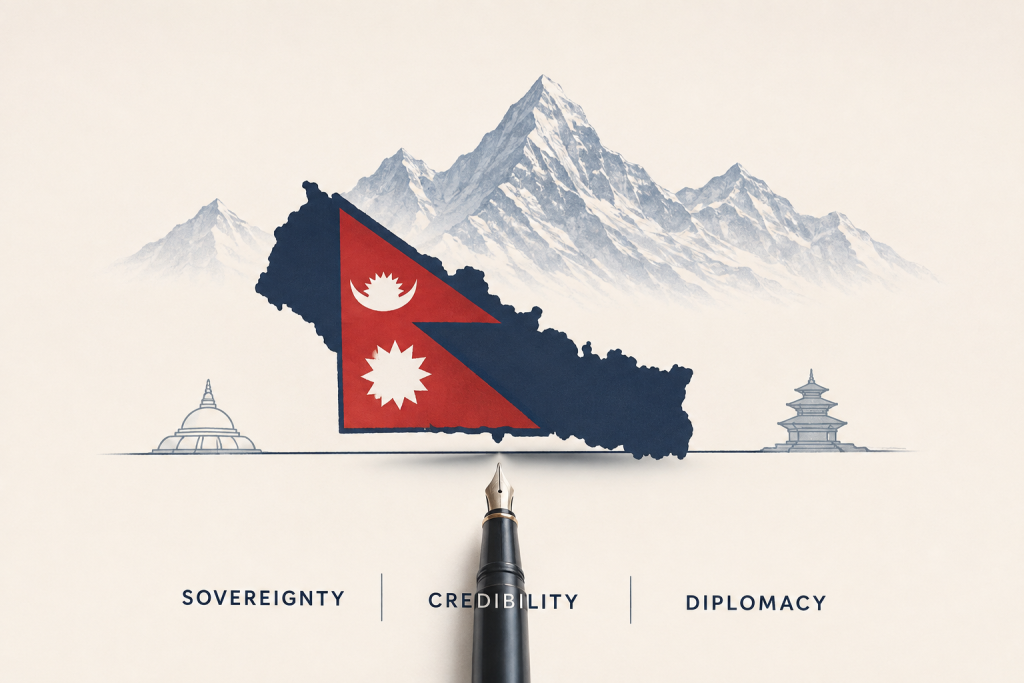
For generations, Nepal has proudly told the world a simple story: We were never colonised, and we never colonised others. In a world shaped by empires, occupations, annexations and territorial expansion, Nepal’s place in history has been different. We defended our sovereignty fiercely, but we never built our national identity around taking somebody else’s land. This is not merely a historical fact; it is one of the foundations of modern Nepal and one of the few narratives that unite Nepalis across political, ethnic, regional and ideological lines.
It is also central to Nepal’s international identity. When foreigners think of Nepal, they think of the birthplace of the Buddha, the Himalayas, peacekeeping troops, and a nation that has preserved its sovereignty while navigating the interests of two Asian giants. Nepal has long projected itself as a bridge between India and China rather than a battleground between them, and as a country that respects others’ sovereignty because it deeply values its own. Countries spend centuries building such a reputation. Sometimes, however, a single statement can cast doubt on one of the very principles on which that reputation rests.
Recent remarks suggesting that Nepal has also encroached on a neighbour’s territory have done precisely that. The issue is no longer about who made the statement. The issue is what it communicated, how it was interpreted and what it means for Nepal’s credibility.
The Government subsequently clarified that the remarks referred to cross-border occupation and technical boundary-management issues rather than a formal admission that Nepal had encroached on another state’s sovereign territory. That clarification deserves acknowledgement because it distinguishes between complex boundary issues and sovereign territorial claims. Yet the episode also exposes a broader lesson in public administration and diplomacy: statements concerning sovereignty should be precise before they are delivered, not clarified afterwards. In international affairs, the first message often becomes the lasting message, while the clarification rarely receives equal attention.
If the original statement were interpreted literally, it would raise uncomfortable questions. What exactly have we been defending all this time? Nepalis have long supported institutions responsible for protecting national sovereignty, maintaining borders, producing official maps and representing Nepal’s interests internationally. If Nepal has indeed encroached on another country’s territory, the public deserves to know where, how, under what legal basis and since when. If that was never the Government’s position, as its subsequent clarification suggests, then the public deserves an equally clear explanation of how such an interpretation arose in the first place.
The implications extend well beyond domestic politics. Nepal has consistently advocated sovereignty, territorial integrity, non-interference, international law and the peaceful settlement of disputes. For smaller countries, these are not simply diplomatic principles; they are strategic assets. Unlike major powers, Nepal cannot rely on military or economic dominance to shape international opinion. It relies on something far more valuable: credibility.
Credibility gives small states influence disproportionate to their size. When Nepal speaks about sovereignty, it does so from a position built over generations. That moral authority carries obligations. A country cannot credibly condemn encroachment while appearing uncertain about its own position. Nor can it effectively defend international law if its own official messaging creates ambiguity about the principles it seeks to uphold.
If Nepal has indeed encroached upon another country’s territory, the response should be guided by evidence, law and diplomacy rather than emotion. The facts should be established, the legal position clarified, and any necessary corrective measures taken. If, however, Nepal has not encroached upon another country’s territory, as the Government’s clarification indicates, then equal effort should be devoted to correcting the public record and ensuring that no ambiguity remains.
This is where the issue moves beyond politics and enters the realm of national credibility. If we were uncertain about something as fundamental as territorial sovereignty, what else might become uncertain? Maps? Treaties? Diplomatic positions? Parliamentary resolutions? National security policies? Historical narratives? These are uncomfortable questions, but they are legitimate ones.
Nepal has spent decades arguing that maps matter, treaties matter and history matters.
If that is true, words matter too. Maps define territory. Treaties define rights. But words shape narratives. And narratives influence diplomacy.
The consequences of ambiguous statements extend far beyond the day they are made. Statements concerning borders enter the diplomatic record. They become future references, negotiation material, academic citations and political talking points. Future diplomats may one day be asked why a statement requiring clarification was made in the first place.
Small countries cannot afford strategic ambiguity on matters of sovereignty. Great powers may survive contradictory statements because their influence rests on military, economic and geopolitical weight. Countries like Nepal rely on something far more fragile: credibility. Once uncertainty enters the national narrative, restoring confidence becomes considerably harder than creating confusion in the first place.
History shows that words often outlive the circumstances in which they were spoken. A statement may later be clarified, corrected or withdrawn, but the original remark survives in public memory and diplomatic records. Negotiations, media reports and political debates can continue to refer to the original statement long after the clarification has faded from public attention.
Nepal itself offers a powerful reminder of this reality. More than a decade after the disruptions along the Nepal–India border following the 2015 earthquake and the promulgation of Nepal’s Constitution, public discourse continues to be shaped by the dominant narrative of a blockade, notwithstanding differing explanations and interpretations that have followed. Whether one agrees with that characterisation or not, the broader lesson is clear: first impressions often outlast subsequent clarifications.
This is why careful communication matters. Sensitive issues concerning sovereignty should not depend solely on political rhetoric. They should be informed by legal analysis, historical evidence, diplomatic consultation and technical expertise before they reach Parliament or the public. Governments invest in institutions precisely so that statements carrying diplomatic consequences are carefully prepared and rigorously scrutinised.
International experience demonstrates that even longstanding border disputes need not become permanent sources of tension. The peaceful implementation of the India–Bangladesh Land Boundary Agreement showed that complex territorial questions can be resolved through political courage, technical expertise, evidence-based negotiations and mutual respect. Advances in satellite imagery, geospatial technologies and jointly verified digital mapping now provide tools that previous generations could only imagine. Nepal and India should continue strengthening technical cooperation so that outstanding boundary questions are resolved through evidence rather than ambiguity.
Nepal’s future does not lie in territorial rhetoric. It lies in economic transformation, education, innovation, connectivity, trade and regional cooperation. As a country strategically located between two rising powers, Nepal’s greatest comparative advantage has never been confrontation but credibility. It has long sought to serve as a bridge rather than a fault line.
Ultimately, this debate should not be remembered for one controversial statement. It should be remembered as a reminder that sovereignty demands precision. Governments have a responsibility not only to defend national interests but also to communicate them with clarity, consistency and care. When clarification becomes necessary on matters as sensitive as territorial sovereignty, institutions should ask not only whether the clarification is sufficient, but also why it became necessary in the first place.
Nepal has spent generations building a reputation as a nation that values sovereignty, its own and that of others. That reputation deserves to be protected with the same care that we devote to protecting our borders.
Because maps define territory. Treaties define rights. But words shape diplomacy. And for a country like Nepal, credibility may be the most valuable capital of all.