
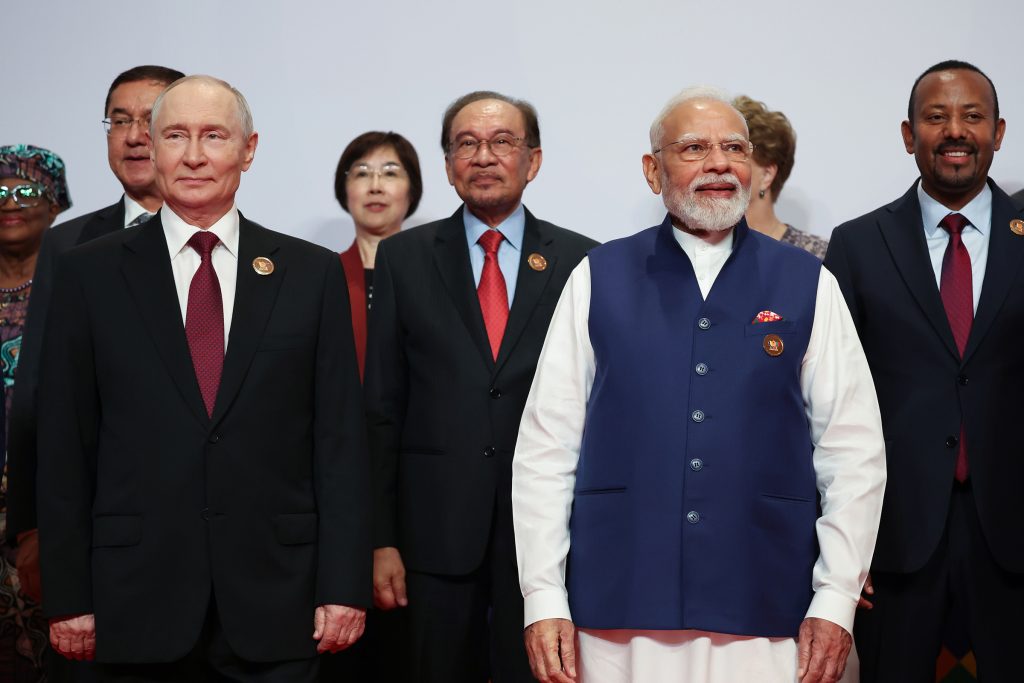
India hosted the 18th BRICS Summit in New Delhi on September 12 and 13. Leaders from Brazil, Russia, India, China, South Africa, several newer members and partner countries came together under the theme “Building for Resilience, Innovation, Cooperation and Sustainability.”
It was a significant event. BRICS now represents more than half of the world’s population and accounts for almost 40 percent of global GDP, while its share of the global economy continues to grow. When such a group meets in our own neighbourhood, in a country with which we share a border and deep cultural ties, it is not a small event to watch from a distance. Yet Nepal was not part of the gathering.
In this brief article, I examine what Nepal’s absence means, why it happened, and what Nepal could have done differently.
BRICS started small, as a name for four fast-growing economies. Over the years, it has grown into something much bigger: a platform where countries outside the traditional Western-led system discuss trade, technology, development finance and global rules that affect their daily lives and the livelihoods of their people.
It now includes new full members and a widening circle of partner countries. Alongside the main summit, the host country often invites guest nations to an “outreach” session, allowing neighbouring and other relevant countries to have a seat at the table even if they are not members.
This is exactly what happened in 2016, when India hosted BRICS in Goa. At that time, India invited the leaders of BIMSTEC countries, including Nepal, to a special outreach meeting alongside the BRICS leaders. The then Nepali prime minister travelled to Goa and sat in the same room as leaders of some of the world’s major emerging economies.
It was a chance to be seen, to be heard and to raise Nepal’s concerns directly.
During the recent BRICS meeting on September 12 and 13, however, India chose a different guest list for its outreach segment. Nepal was not included this time. That is the real story behind the question of what Nepal has lost.
Many people may ask why Nepal’s absence from a major event in Delhi matters. Some may argue that since Nepal is not a BRICS member, there is little reason for its non-participation to be significant.
The answer is simple. Big international gatherings are not only about formal membership. They are also about visibility, relationships and the quiet diplomacy that takes place on the sidelines.
When leaders from member and partner countries sit together for two days, many smaller meetings take place outside the main hall. Ministers talk to ministers. Officials exchange views on trade and investment. Journalists from around the world report on which countries were present and what their leaders said.
A country that is present gets noticed. A country that is absent can easily be forgotten, at least for that news cycle.
For Nepal, situated between India and China, the two most powerful BRICS members, this matters even more. Both of Nepal’s neighbours were in New Delhi discussing issues that could influence trade routes, investment, connectivity and regional cooperation.
Nepal’s economy depends heavily on both countries for trade, transit, remittances, tourism and infrastructure projects. When the countries that shape Nepal’s economic future are discussing new opportunities and rules in the same city, it is natural for Nepal to want a voice in that room, even if it is a small one.
There is also a symbolic cost.
Nepal has long tried to present itself as an active and independent voice in South Asian and Asian diplomacy, rather than simply a country that reacts to decisions made by its neighbours. Being left out of a major regional gathering, particularly one held so close to home, does not help that image.
It raises a question that Nepali commentators have already started asking: has Nepal lost some of its diplomatic energy compared with a decade ago?
Many of us are accustomed to the blame game. It would be unfair, however, to blame India alone. Invitations to an outreach summit are the host country’s choice and are based on its political and diplomatic calculations at the time.
But it is also fair to ask whether Nepal did enough from its side.
Diplomacy is not only about waiting for an invitation. It is about building relationships and making a country’s case well before the guest list is finalised, so that its name naturally comes up when the host is deciding whom to invite.
In recent years, Nepal’s foreign policy has been affected by frequent changes in government and shifting political priorities at home. When leadership changes, policy often changes as well, making it harder to maintain steady, long-term engagement with international partners.
The Foreign Ministry, as well as other government ministries, must constantly adjust to new political leadership and priorities. This can leave less time to plan ahead for events such as BRICS outreach meetings, which require engagement months, or even years, in advance.
This is likely part of the reason Nepal was not on the list this time, even though it was included in 2016.
Nepal should have done a number of things.
The present government should have reviewed what previous governments had done, as well as their plans and commitments in the area of foreign policy. Nepal’s Foreign Ministry should have started reaching out to its Indian counterparts as soon as the 2026 BRICS Summit was announced, rather than waiting to see who would be invited.
The government should also have appointed ambassadors to vacant diplomatic posts on time. Early and repeated engagement at the political, diplomatic and official levels could have produced positive results.
Second, Nepal could have used its position as a BIMSTEC member and its close ties with both China and India to make a strong case for inclusion, pointing to the precedent set in Goa in 2016.
Third, even without a seat in New Delhi, Nepal’s leaders could have used the days of the summit to hold their own high-level meetings with visiting leaders passing through South Asia. They could also have issued clear public statements on the trade, connectivity and regional cooperation issues being discussed in Delhi, ensuring that Nepal’s views were at least part of the wider public conversation.
Fourth, and perhaps most importantly in the long run, Nepal needs a foreign policy that does not depend so heavily on which party or leader is currently in government.
Bilateral and multilateral relationships take years to build. They can be weakened when every change of government brings a change in policy and direction.
Despite all this, missing one summit is not, by itself, a disaster. Nepal will have other opportunities to engage with BRICS countries, both bilaterally and through other regional groupings.
But the Delhi summit is a useful reminder.
Neighbourhood diplomacy does not run on its own. It requires steady attention, clear goals and people working on it long before the cameras arrive.
If Nepal wants to participate in such events next time, the work to make that happen should begin now, not when the invitation list is being drawn up.