
Kathmandu, October 2
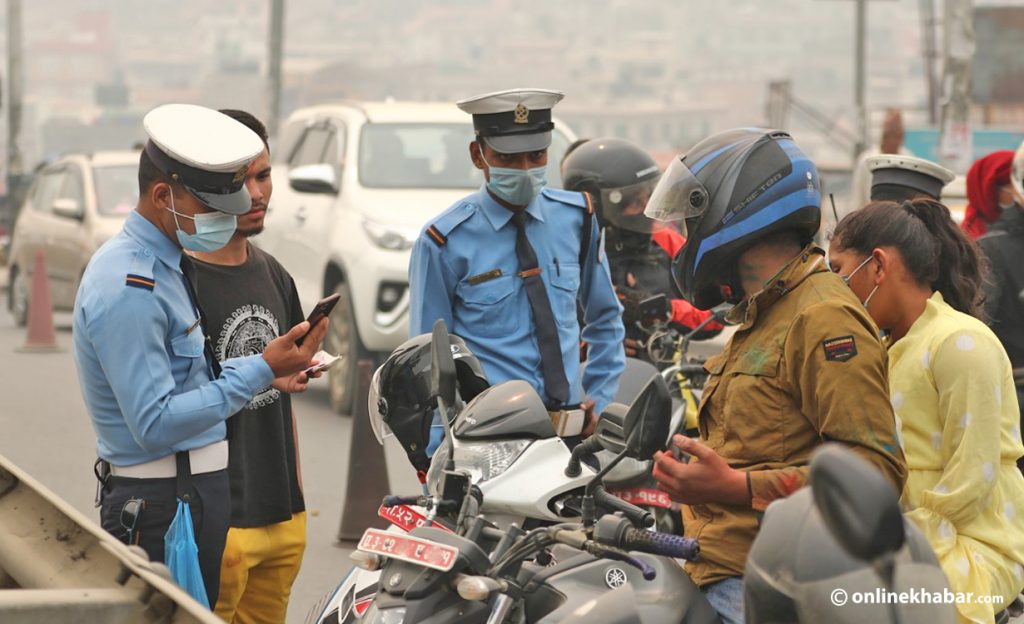
There was an unusual conversation at the Kathmandu Valley Traffic Police Office on Thursday. A traffic police officer sat down with a driver and began asking questions that went far beyond the usual traffic violation.
What do you drive? How long have you been a driver? Where do you usually drive? What do you carry? How do you transport it? Who is in your family?
For nearly half an hour, the officer listened as the driver answered. The reason for the unusual conversation was a number that had caught the traffic police by surprise: 729. That was the number of times the driver had been penalised for traffic violations over the past six years.
The driver was Ram Bahadur Bista from Makwanpur. He drives a goods vehicle with the registration number Ba 16 Cha 8064.
Traffic police had begun noticing Bista because he kept turning up at their office. After learning that the same driver was repeatedly being brought in for violations, Traffic Police Superintendent Naresh Raj Subedi asked his staff about him.
The answer surprised him.
“He is a driver who repeatedly faces action. We were told that he might have been fined 700 or 800 times,” Subedi told Onlinekhabar.
The police checked the records. The figure was not 700 or 800. It was 729.
Subedi then asked Bista to come to the traffic police office at Ramshahpath.
“We were surprised to hear that he had already been penalised 729 times. We wanted to understand how he was driving and why this kept happening, so we called him in and listened to him,” Subedi said.
So, instead of simply issuing another fine, the traffic police decided to talk to him.
Bista was asked about his work, the vehicle he drove, the routes he took and the goods he carried. Officers also asked about his personal and family circumstances.
They wanted to understand the person behind the extraordinary traffic record.
What was he doing wrong?
Bista drives a vehicle used to transport hardware materials, particularly metal goods. According to traffic police, most of his violations were related to the way he transported those goods. He would sometimes carry metal rods and other materials beyond the vehicle’s body. At times, the rear side of the vehicle would be left open so that the goods could extend outside. His number plate was also found to have been covered while carrying goods.
Most of his traffic tickets were issued for operating a public goods vehicle without displaying the required identifying signs properly. He was also penalised for other offences, including running red lights and crossing lanes. But there was another reason Bista apparently did not take the repeated fines particularly seriously. His company usually paid them.
Bista had paid fines ranging from Rs 500 to Rs 1,000 over the years, but fines related to transporting hardware goods improperly were generally paid by the company.
As a result, he had not realised that repeatedly breaking traffic rules could eventually have consequences for him personally.
By Thursday, however, the message was clear. Police told him that continuing to accumulate violations could eventually put his driving licence at risk.
“He was not aware that repeated traffic violations could affect his professional record,” Subedi said. “We explained the traffic rules to him and told him not to repeat such offences.”
One violation every three days
The numbers make the record even more striking. Bista has been penalised 729 times in six years. That means an average of about 122 penalties every year. Or roughly one traffic violation every three days.
He has already paid the fines for 728 of those violations. The latest fine is still outstanding.
Traffic police say there is at least one thing Bista was not doing during those incidents. He was not driving under the influence. Police records show that he has not been found driving after consuming alcohol or drugs. In some periods, however, the records show that he was penalised on consecutive days.
An unusual record
Traffic police officials say they are not aware of another case in Nepal in which a single driver has been penalised as many as 729 times in six years.
For the traffic police, however, Bista’s case is about more than an unusual record.
It also raises a question about what happens when repeated fines fail to change a driver’s behaviour.
Traffic police have continued awareness campaigns and enforcement drives, but Bista’s record suggests that some drivers may require a different approach when repeated violations become a pattern.
For now, Bista has been sent home with a warning that his next mistake could cost much more than a fine.