

When Subin Bhattarai’s novel Summer Love was released in 2012, it was a massive hit. Finding someone who hadn’t read it was rare. Friends discussed it constantly, and those who hadn’t read it felt a clear sense of FOMO. Later, an audio edition expanded its reach even further. For many Gen Z readers, Summer Love was their introduction to Nepali literature, sparking a lifelong habit of reading.
Now, the celebrated book has taken on a new form. Its theatrical adaptation, directed by Samrat Bhujel, is currently running at the Kantipur Theatre in Kathmandu.
The play opens in Norway, introducing the protagonist, Atit, played by Sagar Khanal, alongside the author character, Subin Bhattarai, played by Arpan Thapa. While sharing a cruise ride, Atit learns that Bhattarai is a writer and offers to tell his life story. Though hesitant at first, Bhattarai eventually agrees to listen.
As Atit begins his tale, the setting shifts from Norway back to Kathmandu, specifically Tribhuvan University, where we meet the co-protagonist, Saya, played by Bashana Timilsina. This transition quickly sparks nostalgia for long-time fans of the original novel.
Strengths amid flaws

Beginning with its strengths, the makers have worked smartly to make the setting versatile, quickly taking the audience from a cruise and a room in Norway to Kathmandu and Dhangadhi, Western Nepal. The entire story takes place across these three locations. The set has been designed by Sagar BC and Sushak Acharya.
Similarly, the music, designed and composed by Anup Timilsina, sounds average. Various genres of music are featured in the play. The play has two phases; the first features the protagonists’ college days, while the second focuses on their post-college lives. The first phase mostly features classical music, while the second incorporates blues and EDM, making the musical choices relevant to the context. Meanwhile, certain sound effects, especially the humming used to underscore romantic scenes, feel overly filmy and make the moments awkward rather than romantic.
There are conversations among the friends intended to tease a friend who has fallen for someone within the same circle. To some extent, these conversations sound natural and can feel relatable to anyone who has experienced a similar situation. In some scenes, the humour is also well-timed and succeeds in making the audience laugh.
One such scene comes when Atit and Saya have a phone conversation immediately after beginning their long-distance relationship. From an acting perspective, it is one of the best scenes in the play. Both actors perform so naturally that it feels as if they are genuinely in a long-distance relationship. Anyone who has recently started such a relationship can relate to the scene.
Where it falls short

Despite these strengths, the play falls short in several aspects.
When the play shifts from one scene to another, the transitions are not as smooth as they should be, which slows down the pace and, at times, makes the play tedious for the audience.
In terms of acting, the protagonists’ performances are mediocre. In many parts, their performances feel forced and unconvincing. It is understandable that Summer Love was written more than a decade ago and that the ways of expressing and portraying love were different then. However, adaptation gives creators room for improvisation and reinterpretation, allowing them to make the story more relatable to contemporary audiences. The makers, however, seem to have remained indifferent to this possibility, leaving some of these moments feeling dated and awkward.
In the monologues, Atit struggles to perform the emotional depth it demands, with the excessive loudness instead becoming irritating.
Saya’s performance also feels off the mark. The emotions she expresses often appear unnatural and overdone, which makes some of her scenes less convincing. This is particularly disappointing given Bashana Timilsina’s strong performances in earlier plays such as Dhumdham Ko Ghumgham, Guilty or Not Guilty, Tranzit and Kagtali. Her earlier work has demonstrated her ability to bring nuance and emotional depth to her characters, qualities that seem largely absent here. Whether this is a result of the direction or the performance itself, the portrayal of Saya ultimately fails to leave the expected impression.
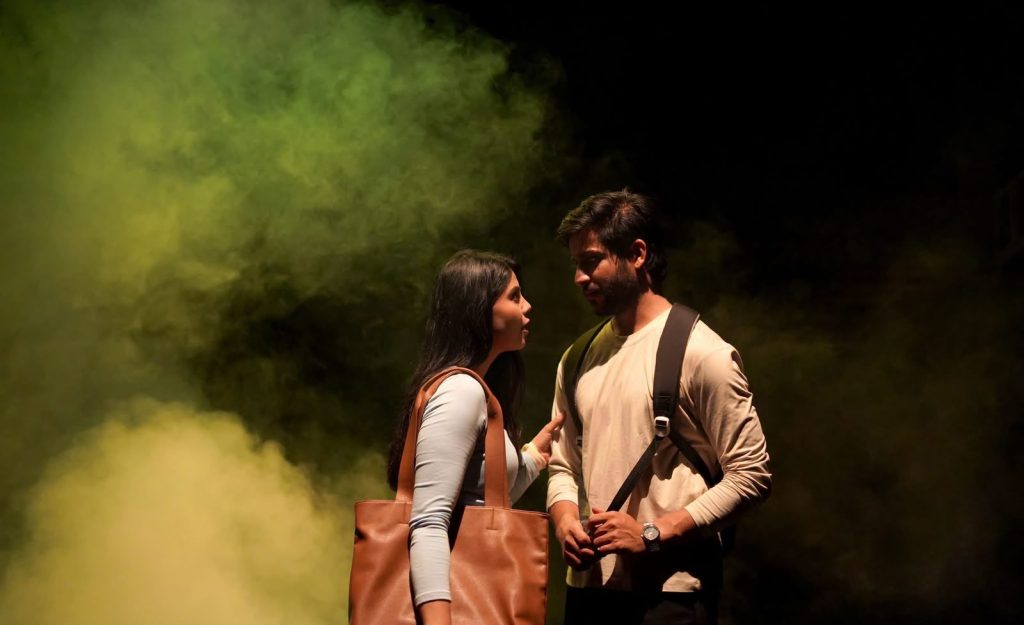
Another disappointing element of the play is the overuse of smoke effects and the chorus actors. The frequent and unnecessary use of smoke is particularly distracting. Smoke in theatre can serve several purposes; it can function as a strong symbol, signal a transition or create a dramatic atmosphere. In Summer Love, however, the smoke adds little to the scenes and instead becomes irritating. The same problem applies to the chorus actors. They frequently appear on stage without contributing significantly to the scene, making their presence feel unnecessary rather than purposeful. At times, it gives the impression that the production is trying to keep the entire ensemble visible rather than using the chorus to strengthen the storytelling.
Adaptation is important to the theatre scene. When there is a good work of literature, bringing it to a wider audience through theatre can be valuable. But an adaptation carries its own responsibility. It should not rely solely on the popularity of the original work; it must find its own language and purpose within the new medium. In Summer Love, however, the familiarity of Bhattarai’s novel often feels like the production’s biggest strength, while the adaptation itself struggles to offer enough reason for the story to be experienced again on stage.
Overall, the play fails to live up to the legacy of Bhattarai’s novel. Summer Love deserved a stage adaptation, but it also deserved one that understood that adaptation is more than simply putting a beloved story under stage lights.
Summer Love will run through September 5 every day (except Wednesdays) at 5:15 pm at Kantipur Theatre, Kathmandu. There will be an additional show on Saturdays at 1:15 pm.