
Imagine someone calling the sun red instead of yellow, or leaves brown instead of green. Similarly, your favourite book might be someone else’s worst read. What is simple to you can be highly complex to another. These mismatches often cause confusion, discomfort, or even anger. Yet, it is simply a matter of “perspective,” the source of different opinions on the same reality.
Perspective is more than a simple point of view or a physical angle. It is the art of decoding meaning from texts, incidents, and the world around us. A person’s perspective is a direct reflection of their creativity and critical thinking skills. Ultimately, having a unique perspective is essential, regardless of whether it aligns with others’ views.
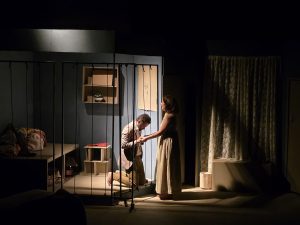
The play A Sweet Apple (Guliyo Syau), currently on stage at the Mandala Theatre, vividly illustrates how everyday objects spark diverse perspectives.
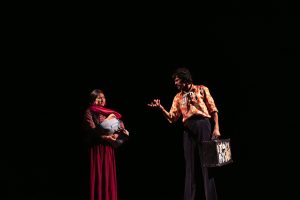
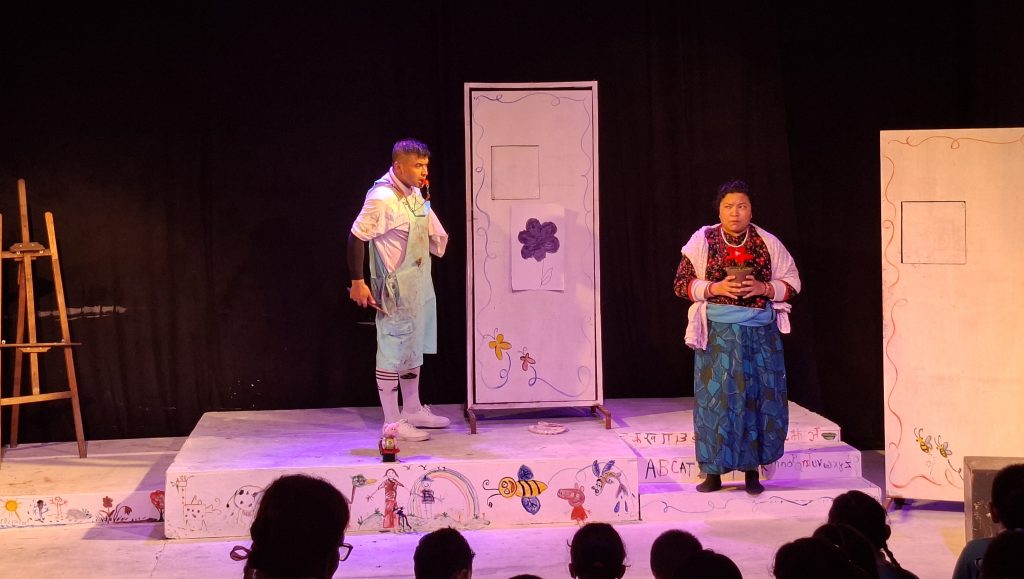
For instance, in one scene, a young boy (played by Manish Byanju) draws a red sun. His mother (played by Elina Nakarmi) insists the sun must be yellow. Despite her persistence, the son stands firm in his choice. When she finally asks how a sun could be red, he replies, “The morning sun is red.”
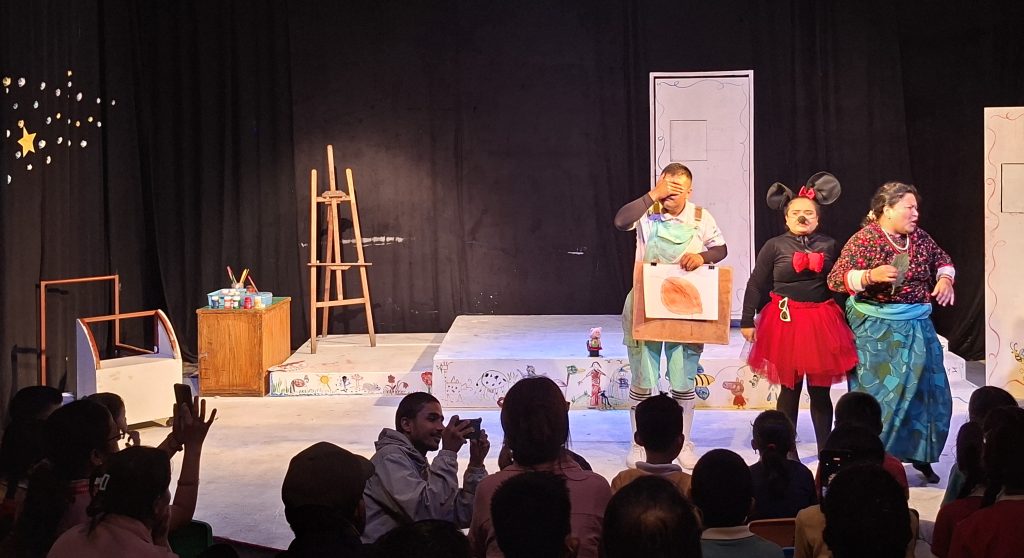
In another scene, the son draws a brown leaf, which his mother immediately questions. To her, a leaf must be green. As she tries to convince him to change it, the son holds his ground. To prove his point, he simply shows her a fallen, dry leaf from the ground, which is, indeed, brown.
Both of these scenes show the audience how an unexpected point of view can transform a simple observation. It also serves as a reminder that a different answer is not automatically an incorrect one; reality is entirely a matter of how we perceive our context.
Written and directed by Kedar Shrestha, A Sweet Apple, presented by Theatre Centre for Children, is an adaptation of his own original story, Guliyo Syau. This semi-non-verbal play captures the quiet conflict between children’s intuitive psychology and the rigid expectations of their parents.
While primarily for children, the play is essential viewing for parents. It serves as a gentle reminder that adults must first listen to and acknowledge a child’s unique point of view. Understanding these early perspectives is the key to building open, effortless family communication.
In just 45 minutes, this play delivers profound life lessons that schools and universities often fail to teach, simply and memorably. Plays like A Sweet Apple not only entertain the children but also help in enhancing problem-solving skills, communication, listening skills and decision-making.
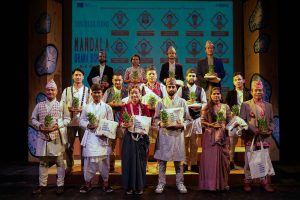
Shrestha wrote the original story in 2015, yet its message remains relevant and universal. The book has sold over 3,00,000 copies in Nepali and has been translated into multiple languages. Recently, the production travelled to a theatre festival in Mongolia, with upcoming tours scheduled for Indonesia and several other countries, proving that international audiences embrace its timeless theme.
Because this story is open-source and copyright-free, it is highly accessible. Schools worldwide can adapt it into plays, short films, or learning modules to teach students about perspective, critical thinking, communication, teamwork, empathy, and kindness.
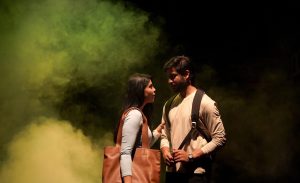
The three-member cast delivers standout performances. Through constant audience interaction and playful activities, they keep the energy high and the viewers fully engaged. Additionally, Sanjita Parajuli’s appearances as a mouse, a bee, and a bird bring bursts of excitement to the stage.
Child-friendly productions remain rare in Nepali theatre. A Sweet Apple proves why more of these plays are necessary. Especially today, when screens dominate children’s lives, live theatre provides the vital inspiration they need to explore their own creativity.
The play runs through July 18 at 10:30 AM and 12:30 PM at Mandala Theatre. Following a brief pause, performances resume from July 27 to 31 at the same times and venue.