

Shram Sanskriti Party Chair Harka Sampang has been touring districts of Karnali Province for the past few days. He has been posting videos and photos of his meetings and conversations with locals on Facebook.
According to party secretary Tikaram Rai, Sampang is visiting as part of a campaign to install a suspension bridge in Humla.
“The chair went there for the bridge campaign, and in the process he is also listening to the grievances of local people,” Rai said.
Since the election on March 5, Shram Sanskriti Party has also stepped up its activities in western Nepal. By building a suspension bridge at Dumling in Darchula, Chair Sampang sent a message that the party wants to spread across the country.
The party’s volunteers have also been mobilised in the affected areas of Rasuwa and Nuwakot after the Bhotekoshi flood. According to General Secretary Aren Rai, volunteers who reached the area the day after the flood have been carrying out rescue, relief and temporary restoration work continuously. Chair Sampang himself also went to the flood-affected areas to contribute voluntary labour.
Party leaders and cadres were mobilised in many ways, from supplying essentials at holding centres in Nuwakot to pulling cable crossings (tuin) over the Bhotekoshi. A photo of Sampang pulling a tuin at Syafrubesi was seen on social media.
The party addresses its cadres as “shramdata” (labour donors) and often links its organisation-expansion programmes with voluntary labour.
“It is not done by making speeches and abusing others. We believe that the country is built through voluntary labour, by standing with people in their sorrow and by helping them,” says party lawmaker Dhruba Rai to Onlinekhabar.
Sampang gained a distinct identity by bringing the water of the Kokaha stream to Dharan through voluntary labour. He has since made labour campaigns the main foundation of party building. Whether in the Kathmandu Valley or as far as western Nepal, he is trying to speed up the party’s expansion through the message of labour.
His wish to spread nationwide is based on the mandate the party received in the latest House of Representatives election. The party led by Sampang, the former mayor of Dharan, won votes from across the country, even though it did not field candidates everywhere. It contested 109 seats, but votes under the proportional representation system came from 165 constituencies. Seeing this, he is expanding the labour campaign with the message of a future prime minister.
Focus on “Hatemalo”
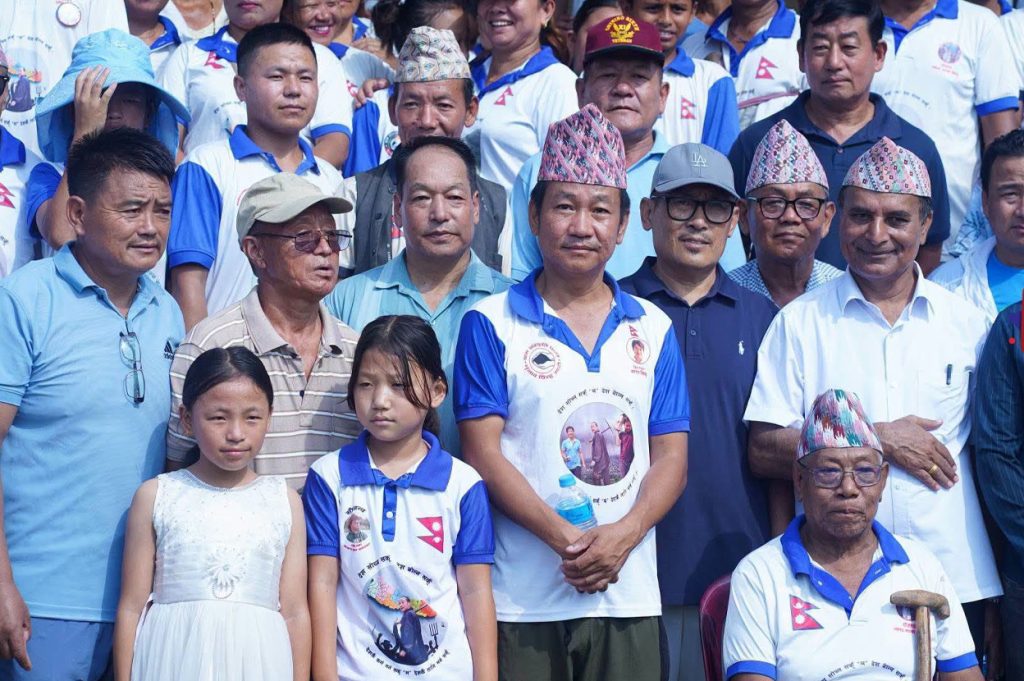
Sampang’s Shram Sanskriti, whose leader has declared his ambition to become prime minister after the Gen Z movement, wants to spread across the country. Even so, its base area remains Koshi Province.
The party’s organisational expansion campaign is aggressive in Koshi, where the results of the last election confirmed its base. It has been carrying out election-focused activities since the third week of September.
On September 20, Shram Sanskriti launched its “Hatemalo” (Hand-in-Hand) campaign from Kachankawal in Jhapa. According to Koshi Province Chair Pratap Rai, 60 programmes have been completed so far under the campaign.
“Volunteers do voluntary labour every Saturday, and programmes in which central leaders take part are also going on,” Rai said. “About 60 big programmes have already been held under Hatemalo.”
The party’s activities are especially dense in the hill districts. According to Province Chair Rai, the organisation has already reached the tole (neighbourhood) level in Khotang, Bhojpur, Panchthar, Ilam and Dhankuta. Activities are under way in the remaining districts as well, to reach every town.
“In the coming elections, we will form all 137 local governments, and we are reaching people’s doorsteps accordingly,” Rai says. Like other parties, Shram Sanskriti also appears to be using festivals as an opportunity to expand its organisation.
Its leaders and cadres are reaching out to people who returned home for the major festivals. Since the Hatemalo campaign began, Sampang himself has visited Bhojpur, Panchthar, Dhankuta and Khotang.
Sunsari is his own constituency. Sampang is pushing to extend his influence in Dharan (Sunsari-1) to the rest of Sunsari.
According to leaders’ analysis, the party has comparatively less influence in southern Sunsari, Morang and Jhapa. Even so, party leaders are encouraged by the votes its candidate received in Jhapa-5, where UML Chair KP Sharma Oli and Prime Minister Balendra Shah both contested.
Prime Minister Shah received 68,348 votes and Oli received 18,734. Shram Sanskriti’s Samir Tamang received 9,233. Having drawn an impressive third-place vote against strong candidates, Shram Sanskriti became the second-largest force in Koshi.
Overtaking parties such as the Congress, UML and NCP in Koshi, Shram Sanskriti won the second-highest number of votes, 292,049. The RSP emerged as the largest force with 853,183 votes. The Congress came third with 290,562 votes, and the UML fourth with 288,186.
Leaders say the party’s appeal has not slowed even after the election result.
“We had no organisation at the time of the March 5 election, but we are getting stronger since then,” says Dhruba Rai, deputy leader of the parliamentary party.
“We will certainly form the provincial government, and the ground is also being prepared for Harka Sampang to become prime minister.”
Sensing the growing appeal of Shram Sanskriti, former minister Sudan Kirati has already joined the party. Kirati, a leader with a Maoist background. His mission now is the post of chief minister.
According to sources close to Kirati, he has kept himself busy with province-centred activities since joining. Right after Dashain, he will take part in programmes in Solukhumbu, Sankhuwasabha and Okhaldhunga.
“Based on the constituencies, we are active in identifying people’s problems, listening to them and making plans,” says a leader close to Kirati.
While Sampang looks to spread across the country, Kirati is focused on the province, aiming to become a future chief minister. Leaders say other leaders who have joined the party like him have also been focused on their respective constituencies.
Province Chair Rai considers it natural for leaders to focus on their own areas.
“We finalise candidates by considering contribution, leadership ability and the wishes of local people,” he says. “To follow these criteria, it is natural for them to go among the people.”
According to Province Chair Rai, more than 2,000 leaders and cadres have joined the party since the election. It is not hard to see that many of those who left parties such as the UML, Congress and NCP want to become people’s representatives.
Some have even given up posts they had won with their old parties to join Shram Sanskriti. This suggests a wave of people joining with the next election in mind. Notices of action taken by the UML, Congress and NCP against those who joined Shram Sanskriti are also being made public.
The party-joining programmes are attractive partly because of leaders such as Kirati, a prospective chief ministerial candidate, Dhruba Rai, who won a House seat from Bhojpur, and Aren Rai, who won from Khotang. These leaders are building their political future in Shram Sanskriti after leaving their old parties. Understandably, others are following them.
Traditional forces on the defensive
Public attraction to Sampang, who resigned as Dharan mayor to form his party, is growing. Traditional parties, meanwhile, appear to be under pressure.
UML leaders in particular are worried about the pull of the Shram Sanskriti Party. A public statement by Sherdhan Rai, a former chief minister and the UML’s in-charge for Koshi, helps considerably in understanding Koshi politics.
“The ruling party RSP is completely on the downslope, and there is no attraction to them anywhere. People are regretting the actions of the present government,” Rai claimed at a programme. “But this Shram Sanskriti Party is going to trouble us until the next election. People are joining it in great numbers, and the indigenous communities are moving there en bloc. We heard this in all the districts, and it is going to put us in a very difficult position.”
When the conclusion Rai shared for internal purposes became public, it went viral on social media. It gives an idea of how aggressive the Shram Sanskriti campaign is. It also shows the state of mind and the pressure the UML is under.
Koshi Province is a UML stronghold. The party has not performed poorly in this region in any election since 2048 BS. It did comparatively poorly in 2064 BS, but the wave of the other communist party, the Maoists, was the reason.
Even in the 2022 election, when five parties including the Congress and the Maoists fielded joint candidates, the UML won 14 of Koshi’s 28 constituencies. In the Falgun 21 election as well, four of the nine direct seats the UML won are in Koshi: Ilam-2, Dhankuta, Taplejung and Sankhuwasabha.
“For 35 years, the people supported us and made us win,” says UML leader Rajendra Rai. “But after the Gen Z movement, they staged a silent rebellion and changed their votes. Still, compared with other regions, trust in the UML remains in Koshi. Four of us have won.”
He suggests that the party should plan by taking the last election result as a message from the people.
“People’s trust in the new forces has also been broken, and questions have been raised,” says Rai, who was elected from Dhankuta. “But the UML also needs to correct itself. If we commit to fixing our weaknesses, we can win back our legacy in the coming local elections.”
Leaders say the other traditional parties are in no different position from the UML. Internal differences in the Congress and the unity wrangle in the NCP mean their organisational activities do not look strong.