
RSP leaders had claimed they would not repeat the mistakes of older parties and would hold their convention “smartly”. But by the third day of the first general convention, that claim has been proven hollow.
The RSP convention began in Bharatpur, Chitwan, on June 21, 2026, timed to coincide with the party’s fourth anniversary, yet it has still not moved forward swiftly according to schedule. The agenda has already been revised twice.
Amid Chitwan’s scorching heat and mounting expenses, frustrated delegates have started questioning the leadership, “If you keep shifting the schedule, what makes us any different from the other parties?”
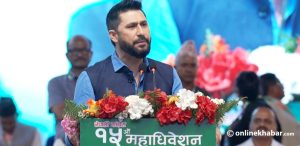
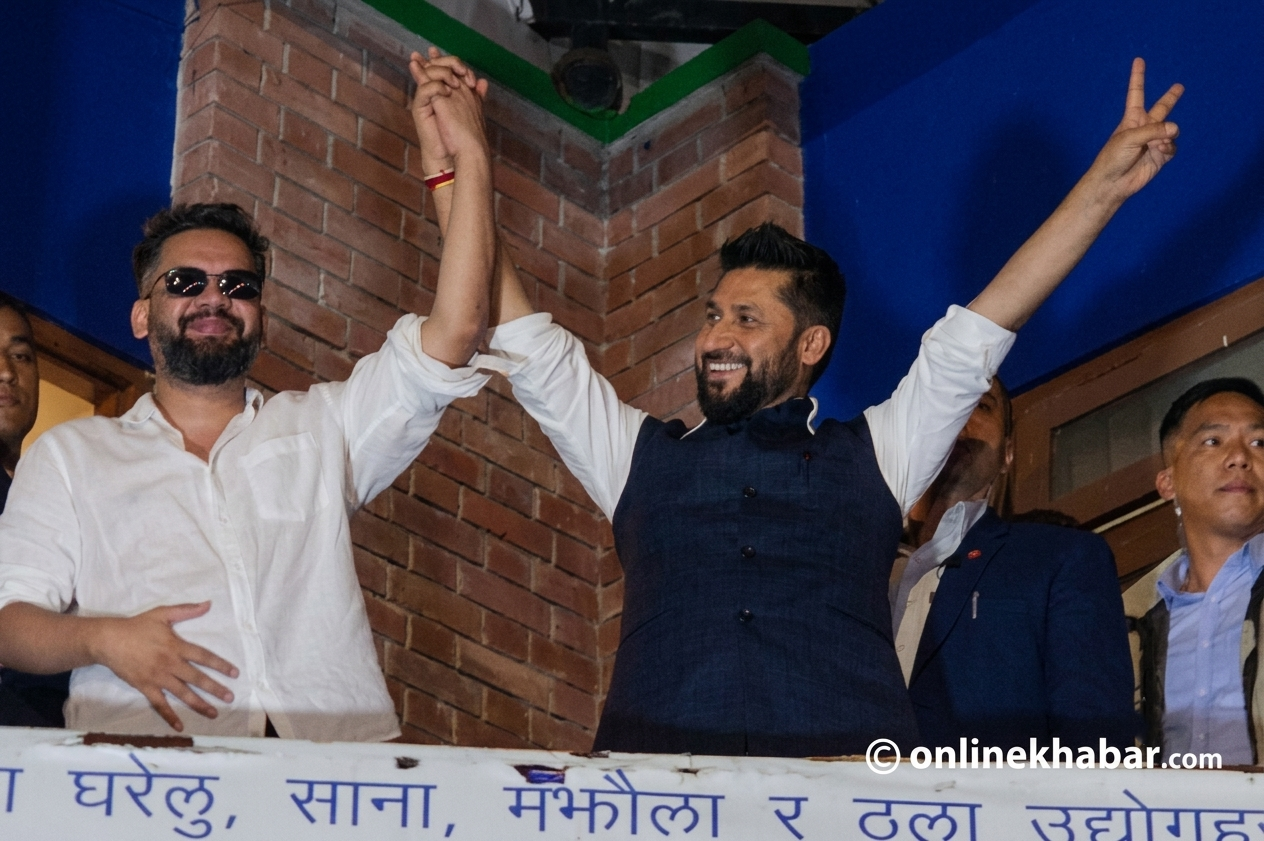
At the convention, which was jointly inaugurated by party chairperson Rabi Lamichhane and senior leader and Prime Minister Balendra Shah (Balen), leaders of various parties offered their congratulations and advised the RSP to learn from past mistakes and move forward.
In response, Chairperson Lamichhane had said, “We have heard of past conventions where people showed up wearing helmets because of fights, where things dragged on and on. We will not let that happen here.”
Lamichhane’s reference to attending a convention wearing a helmet was a jab at the fierce disputes, physical brawls, and chair-throwing incidents that have marred conventions of older political parties in Nepal, a picture of how violent and contentious internal elections can become in Nepali politics.
There have been no open brawls or major clashes within the RSP, but the party has clearly been caught up in internal disputes. Several leaders have expressed their discontent to OnlineKhabar, saying that the chairperson is about to read out names from his pocket in the name of consensus.
The closed session, which was supposed to begin on Monday afternoon, the second day after the inauguration, only got underway on Tuesday afternoon, June 23. Yet even settling the question of who the convention’s delegates are has proven a struggle for the RSP.
Right at the inauguration, it was more or less announced that Lamichhane would return as chairperson and Balen as senior leader. The debate within the party over who to include in the other posts is still ongoing.
The RSP, which swept in huge numbers at the general election by defeating other parties, has failed to advance that same transparent and healthy democratic practice in its own internal election on time, and that is the root of the growing complaints.
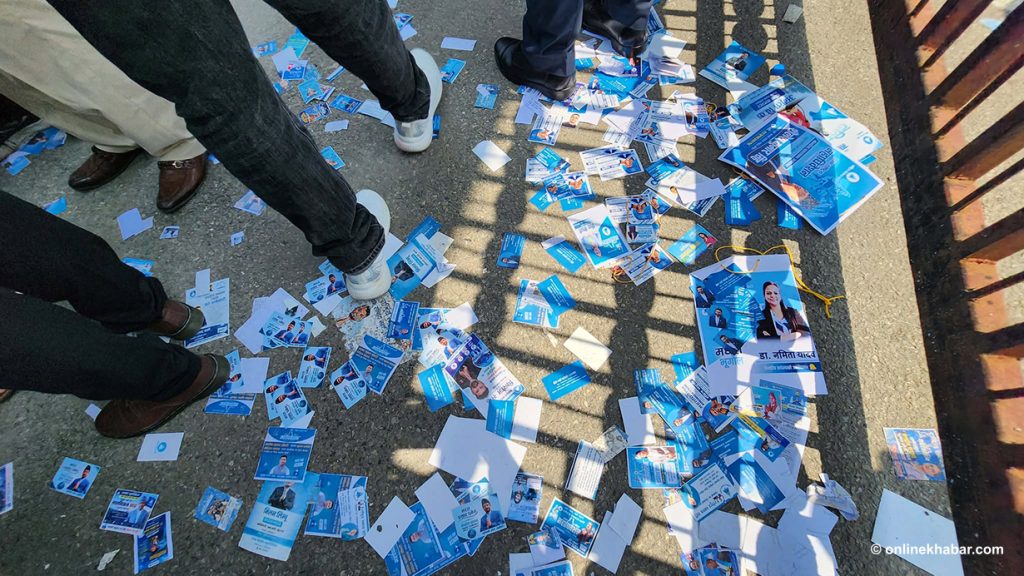
Candidates for the central member posts waited the whole day for the nomination window to open. Some delegates kept themselves occupied singing deuda; others slipped into nearby restaurants to follow World Cup football.
Acknowledging the internal situation that had shifted within just two days, Chairperson Lamichhane felt compelled to address the delegates on Tuesday, saying, “If the political character remains the same, if the political tug-of-war remains the same, if the race for power remains the same, if the character remains the same, and if the factional battles to become more powerful remain the same, the results we produce will also be the same, identical. Nothing will change.”
He went further, announcing, “We had to add two extra days. I want to make the 5,000-rupee fee set by the party for delegates optional. Those who do not wish to pay need not do so. It will make no difference.”
The party will make the necessary arrangements. Because you have incurred heavy expenses staying here all these days, and no one should be in a situation where they have to leave without voting because they cannot afford the costs. Those who have already paid the 5,000 rupees may take their money back if they wish, he added.
The closed session has been limping along amid all this friction.
In Chitwan’s oppressive heat, there is no shortage of people drifting about, waiting for the convention’s regular programme to get going.
And so, by Tuesday evening, the RSP’s much-vaunted smart management had come completely undone.
But the RSP is not the first party to hold such a disorderly convention. In the past, the Nepali Congress, CPN-UML, and the Maoists have all created considerable chaos at their own conventions.

The UML, then the largest party in the country, held its 10th general convention right here in Chitwan in 2021. When the closed session dragged on for two extra days beyond the scheduled time, the party later disclosed that costs had ballooned from 70 million to 90 million rupees.
The main reason for that delay had nothing to do with any particular technical issue. It was Chairperson KP Sharma Oli blocking the electoral process. Rather than accepting a smooth, transparent win-or-lose outcome through elections, Oli attempted to unilaterally dictate names under the guise of consensus, thereby pushing the convention off schedule.
Senior vice-chairperson Subas Chandra Nembang wanted to contest that post, but Oli took two additional days to engineer a consensus in favour of Ishwar Pokhrel, leaving delegates stranded. Oli also shut down the competition between Shankar Pokhrel and Bishnu Paudel for secretary general. When Bhim Rawal, Ghanashyam Bhusal, and others protested, demanding internal democracy, they were eventually pushed out of the party altogether.
The Nepali Congress, when it held a special general convention, saw proceedings delayed by a day and a half. Before that, a pattern of sister organisations like the Nepal Student Union holding their conventions, postponed dozens of times, beset by disputes and violence, had continued unchecked.
The failure to manage conventions in a transparent and accountable manner has historically led to splits in both the UML and the Congress. The then CPN (Unified Maoist) held its convention in Hetauda in 2013. When disputes over the size of the central committee and the allocation of seats between factions could not be resolved, a supplementary convention had to be held in Biratnagar, which then-Maoist leader Baburam Bhattarai and others boycotted, walking out midway. The national conference held in 2014 ended up institutionalising the ideological division and organisational split within the Maoists.
Upendra Yadav, C.K. Raut, Resham Chaudhary, and others have all, in their own ways, perpetuated this culture of suppressing internal democracy. Almost every party in Nepal has been plagued by some form of internal crisis, and it is at conventions that this reaches its peak.
The RSP, founded four years ago, is now experiencing precisely such a moment. The problems may look new, but the causes are the same old ones.
Civic leader Anup Subedi believes that party leaders find themselves under pressure to give everyone a share and to protect their own people.
“The kind of characters and tendencies seen in the UML, Congress, and Maoists over the past 30–40 years. The RSP has shown no sign of being an exception,” he says. “It has been an obstacle to building a democratic culture. Parties keep repeating this mistake because they prioritise individuals over systems.”
When Congress split to form Congress (Democratic), or when RPP split into RPP (Chand) and RPP Nepal, similar disputes over numbers and posts arose. Sher Bahadur Deuba, Bam Dev Gautam, CP Mainali, and others had themselves led the charge in splitting their parties. History even shows that poor convention management has directly caused party splits, a lesson that Congress, UML, and the current NCP leaders have passed on to the RSP as a warning.
Both Rabi Lamichhane and Balen have said this will not happen here, but the party leadership has not yet resolved the growing discontent, it has only tried to contain it.
Political scientist Sucheta Pyakurel believes that conventions are delayed, or held chaotically and arbitrarily, because of a deliberate desire to control outcomes from within.
“There is a practice of letting things proceed smoothly if your own side is going to get the posts and members, and of stalling if not. We saw this here too. The delay may be because the tendency to push individuals forward rather than build institutions is at play,” she says, comparing the RSP convention with those of older parties. “Earlier, when the RSP was the fourth-largest party, lawmaker Sumana Shrestha had actually built systems to manage certain events in an organised way, which impressed me. But perhaps because the party grew so fast, the problems have now surfaced.”
Pyakurel added that she had heard the expected leadership emerging from the convention would have fewer people aligned with the government side and more from the party’s founding faction, and she commented that going into a convention already carrying such a mindset is not a healthy approach.