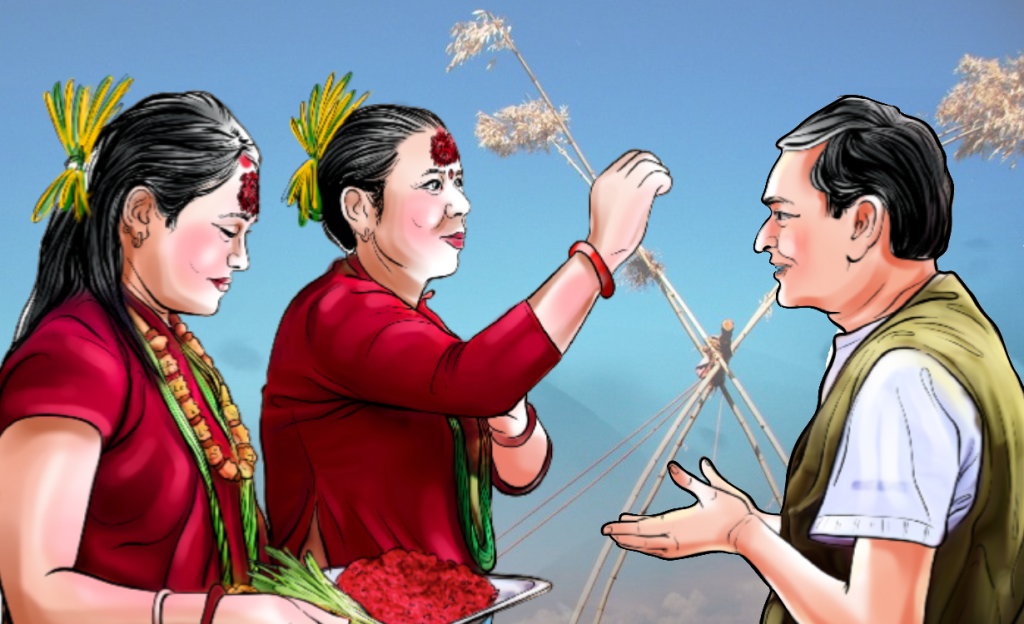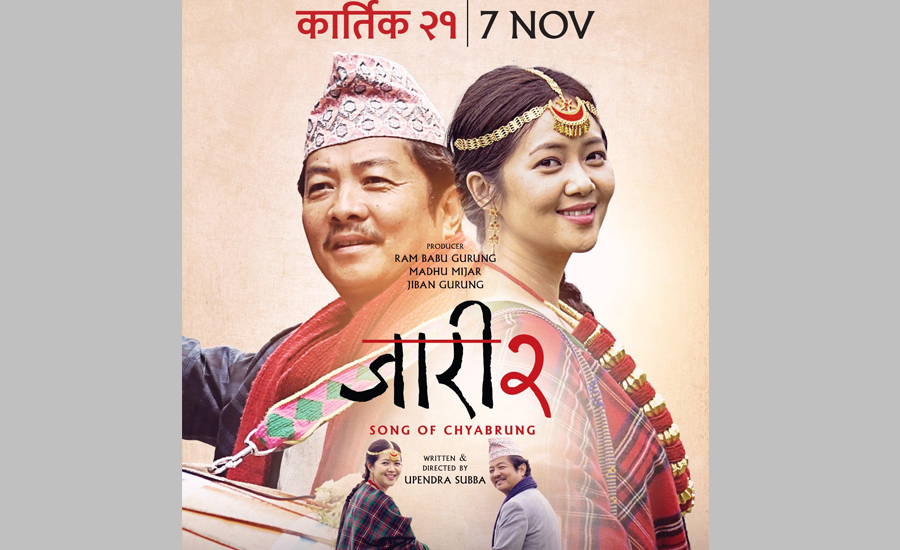
The film Jaari and Jaari 2 is widely acclaimed as one of the most awaited and watched movies amongst the Yakthung Limbu community as well as externally. Jaari is a Nepali movie, written and directed by Upendra Subba which was released on April 14, 2023. The film is based on Yakthung Limbu community and a tradition called Jaari which comes under the Mekkhim/ Marriage rituals.
The release of trailer itself brought a wave of excitement and elation amongst the audience. It is a film praised for exhibiting Yakthung Limbu culture, and traditions such as Pa:lam, Yalang (Dhan Nach), Chyabrung, music, Hena-Moma (exchange of honour), Yupparung etc. extensively shot at proper Yakthung Limbu villages and environment.
The movie was an emotional journey for most of the Yakthung Limbu people who connected ethnically, regionally, and critically. While, the story continued in the sequel Jaari 2 with the same flow and ethnic essence released on November 7.
Upendra Subba (Angdembe) is a prolific lyricist, poet, story writer who rose to fame as a script writer turned director. He hails from Angsarang, Panchthaar, Limbuwan (Eastern Nepal). His book, Lato Pahad encapsulates the organic stories from Yakthung Limbu villages and its essence. One can enjoy reading the book which is humorous, emotional, and connective in multiple aspects. It is visible that few references from the book are inducted in both sagas. There are scenes in the movie from chapter such as Sasurali, Thotey Saila, and Prabhu Maila taken from the book.
Jaari and my perspective
It has represented cultural aspects of Yakthung Limbu highlighting the Jaari ritual prevalent in the community. The film was lauded with appreciations, praising, and criticism simultaneously. There are two sides of a coin.
In one side, the movie represented and highlighted Yakthung Limbu cultural aspects and regional stories breaking the stereotyped mainland stories. It showcased the indigenous stories, identity, and their way of life, plucked from one of the indigenous communities of the eastern Nepal, Limbuwan.
In other side, the movie gave a pinch of patriarchal narrations and supremacy. The Limbu couple Namsang Angdembe (Dayahang Rai) and Hangma (Miruna Magar) married yet deprived of kids had a volatile marriage life. The emotional and psychological pain, grief and pressure experienced by Hangma was ignored by her husband.
Hangma’s infertility brought her humiliation, guilt, and blame that developed the story of the film towards Jaari episode. Namsang is depicted in a male chauvinistic character, who verbally and physically abuses Hangma and often threatens her to take a second wife to produce an heir. Following an aggressive quarrel, Hangma leaves for her parental home after throwing the Yupparung (a coin used in Marriage).
Yupparung is an important customary law of marriage in the Yakthung Limbu community. On staying with her family, Hangma attends a local cultural fair where she participated in the traditional Pa:lam song and dance. There she fell in love with another man, Serang with whom she enters a second marriage.
This triggers the social custom of Jaari. Hence, Namsang and his family demand monetary compensation for social humiliation from Hangma’s family. Unfortunately, failing to afford the demanded amount, Hangma returns to Namsang’s home as a servant to cover the debt herself.
The plot of the film where Hangma endured servitude antagonised the entire Yakthung Limbu community. Nowhere it is found any sources or social practices indicating servitude rituals to cover the debt. It felt a patriarchal domination resulted through proselytization in Yakthung Limbu society which is nowhere found in Yakthung Mundhum. Rather Mundhum indicates matriarchal system through characters such as Mujingna Kheyongna, Tetlara Lahadongna, Khappuna Mellongna, Angori Sashihangma, Erere Eduknama, Epnaso Sarongdongna etc.
While the music, background scores, scenes, and folksongs are highly praiseworthy. It raised a question in audience’s mind, is Jaari movie a cultural expressive film or a commercially successful movie? If commercial then why not a script which is not based on the wrong presentation of Yakthung Limbu culture.
Jaari 2 and my perspective
It is observed as a big challenge and fortunate to those who procured an advance ticket for the first show of the screening of Jaari 2 at Dharan (Waratappa/Bijaypur). The selling of tickets like a hot cake indicates confident that stories based on indigenous background and carrying their unexplored stories has a receptive audience.
It is indeed a changing of narratives in storytelling, branching out from mainland stories towards regional stories. Jaari 2 lacks the disappointment with the cultural aspects, while Pa:lam song along with descriptions was very informative. Most enjoyed the humorous punch lines carrying shades of consciousness and struggle for identity.
The film continues the story of Namsang and Hangma with Chyabrung (Limbu traditional instrument) taking the central role which encompasses tussle, tradition, passion, and reconciliations. The gift of Chyabrung by Hangma’s brother to Namsang carries the main plot in the movie. Chyabrung became the symbolic representation for the identity.
One incident where his Chaybrung was damaged along with an insult felt like a representation of his insult and struggle for identity. My expectation from the movie was about Chyabrung, evolution and connection to Yakthung Limbu while it seemed more about the religious and political dominance to preserve indigenous cultural identity.
Somewhere, the song of Chyabrung took a backseat in the political chaos. Comparatively, the Jaari 2 has avoided the inappropriate cultural representation unlike the first one. But the prequel was more engaging with the audiences in terms of strong emotions and personal connectiveness. The viewers might miss that flavor.
Comprehensive view
Both films carry a strong cultural aspects and traditional flavors of Yakthung Limbu community. It has been the most successful movie representing one of the indigenous communities of Eastern Nepal (Limbuwan).
The locations, and music of the film has garnered high public appreciations. The acting skills of all the actors are justifiable and at par. The show stealer of the film is undoubtedly Bijay Baral in an iconic role of Mangal Singh Kurumbang.
People thoroughly enjoyed the both movies and rich Yakthung Limbu cultural representations. It is a must watch movie for all the Yakthung Limbu people and a new adventure for those who believes in cultural secularism. It is a movie that depicts fragrance of soils.
The makers, minds, actor’s efforts, and accomplishments are highly appreciable. It is praiseworthy to express gratitude to director Upendra Subba for his vision, effort, representations, and space for indigenous stories and identity. He will definitely be instrumental in continuation of the journey of film-making and bringing out unsung stories to the outer world.