
Nepal’s debate over Hindu statehood is usually posed too narrowly: as a choice between the present constitutional arrangement and a return to formal Hindu privilege. The larger question is what kind of political community Nepal is becoming. Can religion remain culturally alive while citizenship remains equal and political authority non-confessional?
The Nepali term dharma-nirapekshata can carry an adversarial connotation of standing entirely apart from religion. Standard English usage does not necessarily convey this nuance. This semantic friction has sometimes been used to portray the post-monarchy state as actively anti-Hindu, including by projecting the more rigid, faith-exclusionary features of Western models such as French laïcité onto a constitutional order that does not share them.
Article 4 forecloses that reading on its own terms. Its definition is closer to a guarantee of liberty than to a negation of religion. This discussion therefore favors religious freedom, state neutrality, and non-establishment over secularism, using the latter when the constitutional category itself is at issue. For present purposes, “secular” means “the preservation of religion and culture handed down from time immemorial, including religious and cultural freedom.”
Religious freedom is not freedom from religion, and state neutrality is not hostility to belief. A devout citizen can support a neutral state, while a non-believer can defend religious freedom as a constitutional principle. Political neutrality limits the authority of the state, not the spiritual condition of the citizen. The central distinction is between protecting religion and giving it political privilege.
Religion, civilization, and the liberal problem of authority
Religion has been one of the deepest sources through which people understand moral obligation, community, and belonging. Religious institutions have also been major carriers of language, art, ritual, and historical memory. Any argument for neutrality that begins by dismissing these roles misdescribes the object it seeks to regulate. Religion has provided moral socialization, welfare and associational networks before the state supplied them, the transmission of ritual and craft across generations, and communal meaning in times of suffering. A liberal society still needs these functions because law cannot fully define the duties citizens owe one another.
These functions clarify what is at stake. The question is not whether religion belongs in public life, but whether it is better protected by establishment or neutrality. The case for restraint is not that religion is dangerous because it is powerful and therefore needs to be contained. It is almost the reverse. Religion can command forms of loyalty and mass mobilization that few institutions can match. For that reason, the state has particular reason to remain restrained toward it. A faith’s strength should come from conviction and community, not state patronage.
Will Durant’s Story of Civilization is not a treatise on religious freedom, but its historical narrative illuminates this problem. Religion appears throughout it as a formative civilizational force. The same history also shows what happens when religious authority becomes fused with coercive power. The Reformation is instructive. Breaking one religious monopoly did not by itself produce freedom. A Protestant state could be as intolerant as a Catholic one.
The more important achievement came later, when the state ceased to regard itself as guardian of a single religious truth. That is where liberal order begins: not with the absence of authority, but with authority sufficiently bounded that it cannot claim jurisdiction over conscience. Durant leaves another problem unresolved, and it deserves to be named. If religious authority no longer governs conscience, what provides the restraint a free society still needs? Religion has historically provided much of it. Yet religious authority, once coercive, can threaten the freedom it might otherwise sustain. The task is therefore not simply to free society from religious authority, but to preserve the moral resources freedom requires once such authority no longer commands by force.
B.P. Koirala, Durant, and the discovery of political neutrality
B.P. Koirala’s intellectual evolution is a case of a serious mind working through precisely this problem. In an interview, he expressed his profound happiness at completing Durant’s eleven volumes during his long imprisonment. This shows sustained and personally significant engagement rather than passing acquaintance. It would nevertheless overstate the evidence to say that Durant supplied B.P. with a doctrine. His democratic and socialist commitments, his reading of Gandhi, and his experience of authoritarian imprisonment drew on many other sources. The more defensible claim is that Durant gave him a framework in which religion, moral order, and political authority could be considered together rather than treated as separate subjects.
That framework helps clarify an otherwise puzzling turn in B.P.’s thought. An earlier rationalist, near-atheist B.P. became, in later life, a self-described spiritualist. Seen through the distinctions developed here, this was not a retreat from liberalism but a deepening of it. Religion is not the same as religious authority. Spirituality is not institutional power. Political neutrality is not philosophical rejection. His later spiritualism did not require the state to become spiritual, just as his respect for religion did not require it to become religious.
The earlier question was whether one can live without religion. The mature liberal question is why the state should decide whether anyone must. These are different questions. The liberal achievement is precisely that they do not need to have the same answer. His late advocacy of reconciliation with the monarchy is often read as political manoeuvre. It can instead be read as another expression of the same capacity for judgment: recognizing that means suited to one historical moment may become inadequate in another. That quality of mind, rather than any single political position, is what matters here. B.P. is more useful as a standard of intellectual seriousness than as political property to be recruited for a dispute he did not live to see.
What changes when religion becomes the religion of the state
State neutrality means refraining from officially privileging one tradition in law, public office, or public finance. It still protects belief and worship. Once religion becomes associated with the state, however, religious and political institutions acquire overlapping incentives. This does not necessarily result from insincerity. It happens because political power tends to instrumentalize whatever becomes politically useful, and an established religious identity inevitably becomes politically useful.
Three consequences follow. First, establishment invites capture. Access to the offices and patronage associated with an established religion becomes worth capturing. Because no religious tradition is internally uniform, the state must decide which interpretation deserves recognition. The question of what counts as authentically Hindu, or Buddhist, ceases to be purely internal and becomes political. This can narrow rather than enlarge the tradition’s own pluralism. Not every established religion is governed this way in practice; the degree of capture is an empirical question, not a necessary consequence. Second, establishment tends toward tiered citizenship.
Formally distinguishing one faith creates legal asymmetry in areas such as officeholding, family law, or representation, regardless of how liberally the arrangement is administered. The hierarchy is built into the category itself. Third, establishment can strain democratic accountability. It introduces the premise that political authority carries some form of religious sanction. Criticism of government can then be interpreted as criticism of the sanctioned faith. Laws justified chiefly by one tradition’s texts also narrow the reasons available to citizens outside that tradition for accepting, contesting, or revising them on shared terms.
None of this excludes religious conviction from democratic argument. Citizens may bring religious convictions into public debate on the same terms as other convictions. The distinction is between religious participation, which is an exercise of freedom, and religious establishment, which creates a hierarchy among freedoms.
The majority tradition and Nepal’s unfinished argument with itself
The case for neutrality applies with nearly equal force to the majority tradition itself. This is an argument that majoritarian confidence rarely wants to hear. Establishing whichever tradition holds the majority today is a wager against that tradition’s own future position. Demographic and religious composition are not fixed.
Establishment can also attract instrumental affiliation, with people seeking advantage rather than expressing belief. That can dilute precisely what sincere believers would value. Establishment also forces the state to decide which internal faction is authoritative, turning a tradition’s own disagreements into matters of state enforcement. A culturally confident majority should not need the coercive authority of the state to validate an inheritance whose vitality does not depend on it.
Nepal’s own history sharpens this point. Hindu civilization here cannot be reduced to caste hierarchy. Yet caste hierarchy was historically codified in Hindu-sanctioned law, most notably through the Muluki Ain of 1854. Its social consequences persist despite the constitutional abolition of untouchability. A comparable complexity concerns women. Hindu religious imagination contains some of the world’s most powerful images of female divinity. Alongside them are social practices, including menstrual exclusion, that have restricted women’s actual autonomy. Neither fact cancels the other.
The productive response is not to condemn the tradition, but to ask whether its own resources, including its exalted conceptions of the feminine, can be used to challenge the limitations that persist beside them. “The majority tradition,” in short, is not the settled and uniform thing that a constitution could safely elevate without inheriting its own unfinished argument with itself.
Nepal’s plural inheritance and the republican settlement
Establishment and exclusionary nationalism share a structural logic even though their content differs. Both draw a boundary around an ascriptive identity and attach different levels of standing to it. Both can recast dissent as betrayal. Both can also mobilize solidarity against one another at relatively low cost to political elites. This is not a claim of moral equivalence, but of a shared mechanism. The liberal alternative to both is not the abolition of identity. It is ensuring that no identity determines constitutional standing.
The republican transition changed not only institutions but also the symbolic relationship between state and society. For many conservatives, the monarchy and the Hindu Kingdom represented continuity and the protection of inherited values. Their disappearance is a genuine cultural loss. Those who feel that loss deserve to be taken seriously rather than dismissed as backward. But taking the loss seriously does not require restoring the guardian. The republic can instead demonstrate that tradition can survive without political restoration. This may be the harder half of the republican project.
Against this background, four constituencies help clarify what establishment would specifically cost. Dalit communities would not necessarily see caste hierarchy legally restored. They would, however, see the state once again identify with a religious order historically intertwined with that hierarchy. Women’s legal gains in inheritance and marriage would not automatically be repealed. Yet the symbolic basis of hierarchies whose social weight persists could be revived. Indigenous, Kirant, Bon, and animist traditions cannot be absorbed into a single Hindu category without losing what is distinctive about them. This is why Article 4’s protection of religion and culture should be read as protecting Nepal’s plural inheritance, not only that of the majority. Nepal’s relationship with Buddhism also exceeds its demographic share because it is the birthplace of the Buddha. That heritage should not be made constitutionally subordinate in the land associated with its own founding.
Religion, monarchy, and the changing political calculus
Hindu statehood was historically bound to monarchy. Before 1990 and before 2006, the political order combined the ideas of a “Hindu Kingdom” and monarchical rule as one package. In 2008, both were dismantled together. This gives contemporary Hindu-statehood advocacy a strategic asymmetry. Restoring the monarchy is an exposed institutional demand. Restoring the Hindu state, by contrast, can be presented as cultural continuity and can therefore provide a more resonant entry point into the same broader reversal.
This is not to claim that every advocate is secretly a monarchist or that every argument is merely strategic. The organizational overlap nevertheless deserves careful documentation rather than assumption. A society debating Hindu statehood is not always debating only what it appears to be debating. Nor can the historical fusion of these two symbols simply be dismissed. At the same time, the validity of other arguments for restoring the monarchy is a separate question, one that could be examined in a different but equally serious article.
A regional shift adds another dimension. The BJP’s rise and the RSS’s growing influence in India have made Hindu civilizational identity a more consequential political language across the region. This has changed the incentives surrounding religious symbolism in Nepal without impugning anyone’s sincerity. A politician can be genuinely devout while also recognizing that visible devotion now carries political advantages it once lacked.
What is notable is how widely this vocabulary has travelled across ideological lines. This suggests less a collective conversion than a changed political calculus available to all. The real question is not whether Hinduism has public space in Nepal. Plainly, it does. The question is whether that space is strengthened by making Hindu identity a constitutional attribute, or whether political usefulness itself is becoming an argument for changing the constitutional order.
The political economy of establishment
The persistence of establishment needs an explanation beyond religious sentiment. It offers a low-cost technology of political mobilization. Religious appeals are easier to organize than the sustained work of governing. Identification with a sanctioned order also supplies authority independent of competence. A government that cannot convincingly say “we govern well” may find it easier to say “we represent who you truly are.” This is powerful because identity often runs deeper than policy and can redirect attention from institutional performance toward cultural authenticity. Where Hindu statehood may serve as a vehicle for restoring a displaced institutional order, establishment can become a bridge between cultural nostalgia and a broader restoration than the religious question alone suggests.
A further and more contested claim is that neutrality carries an economic dividend because communal conflict can raise uncertainty and risk premiums. This is plausible given Nepal’s development needs, but it is weaker evidence than the constitutional argument. The case for neutrality does not need to rest on it. The less controversial point is broader. Societies that accommodate difference without turning it into existential conflict can devote more attention and resources to development. Social harmony is therefore not merely sentimental. It is part of the institutional environment in which economic confidence is built.
Equal belonging: The republican principle
Nepal’s democratic expansion has multiplied the identities seeking recognition. Federalism, migration, and education have widened horizons and expectations. This is not evidence of democratic failure. It is evidence that democracy has enlarged the number of people who expect to be heard. For that reason, what the republic owes its constituent identities cannot be settled once and for all. Equal belonging provides the organizing answer. The majority need not become a minority for minorities to become equal citizens. Minority equality does not require erasure of the majority.
Concretely, a Hindu-majority society can take pride in its inheritance without making the state Hindu. Buddhist heritage can be honoured without becoming a constitutional condition. Indigenous traditions can be protected without being absorbed into a single national narrative. Dalit citizens need not interpret symbolic restoration as a reopening of their own subordination. Minorities can belong fully without demonstrating cultural conformity. Women can reform inherited practices from within their own traditions without being told that doing so is an attack on civilization. Conservatives can mourn an earlier order without being excluded from its successor.
Citizens can also be as deeply religious as B.P.’s later life suggests is possible without surrendering the freedom that allows others to believe differently. This is not a reluctant compromise. It is part of what liberal democracy has been moving toward. It turns difference from a source of political insecurity into a condition of common life. A democratic order does not need to make every citizen agree about ultimate questions. It needs only to convince them that they need not agree in order to share one political community.
The case for a liberal republic
A serious version of this argument must concede real costs. Communities that have long organized themselves around a dominant tradition may genuinely experience neutrality as a loss of recognition. That is a real cost, not a grievance to be explained away. Neutrality also creates its own difficult boundary between public law and private practice. That boundary is not self-evident and must be renegotiated continually. Neutrality therefore substitutes a recurring dispute over boundaries for the different, and in this argument’s view worse, problem of formal hierarchy among traditions. A serious defense of liberal order should not pretend that neutrality solves everything or that every supporting claim is equally settled.
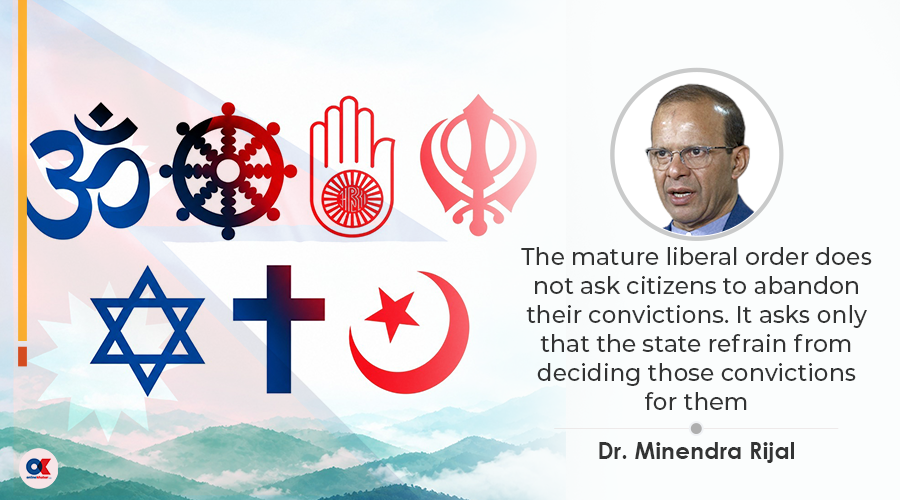
None of this is hostility toward Hinduism. It is closer to the opposite. Hinduism, like any tradition, deserves to flourish without becoming an instrument of the state. The strongest guarantee of Hindu religious life may be precisely the protection that applies to everyone else. The deeper point, reached through Durant and B.P. alike, is that a society need not choose between spirituality and freedom, or between respect for religion and liberal democracy. The mature liberal order does not ask citizens to abandon their convictions. It asks only that the state refrain from deciding those convictions for them. That is why Nepal’s constitutional principle is better understood not as dharma-nirapekshata in the sense of negation, but as a combination of religious freedom, equal citizenship, and state neutrality. These are three principles that Article 4 already holds together, if the political argument around it can be persuaded to do the same.
To continue B.P.’s legacy rather than merely commemorate him means several things. It means taking religion seriously without making the state religious. It means taking tradition seriously without making its inequalities sacrosanct. It means taking conservative anxiety seriously without granting it constitutional privilege. It means taking pluralism seriously enough that the republic does not dissolve into competing communities seeking the state’s endorsement. And it means taking development seriously enough to see social trust as one of its preconditions rather than an obstacle to it.
That, rather than the repetition of B.P.’s conclusions, is what taking him seriously today would mean. The danger in restoring Hindu statehood is not that Hinduism would become democracy’s enemy. The danger is that the state would again make religious identity part of the constitutional definition of belonging. In a society as layered and plural as Nepal, that could narrow rather than enlarge citizens’ freedom. If restoration also becomes a vehicle for reopening the question of monarchy, a dispute that presents itself as religious would become a dispute about the constitutional order itself.
The republic will be judged not by whether it eliminates Nepal’s civilizational inheritances. It should not want to do so. It will be judged by whether it builds institutions that allow those inheritances to coexist and evolve without any one of them having to govern the others in order to feel secure. The republic does not ask Nepal to choose between its Hindu inheritance and modern democracy. It asks the two to become compatible. It does not ask Nepal to forget its past. It asks Nepal to inherit that past without being governed by its inequalities. It does not ask Nepal to make religious citizens secular. It asks the state to remain neutral so that all citizens can live according to conscience. It does not ask Nepal to strip conservatives of memory. It asks the republic to show that continuity does not have to depend on restoration.
The deeper challenge is therefore neither secularization nor religious restoration. It is democratic maturation. The most fruitful reading of B.P. Koirala begins not by asking which contemporary position he can be recruited to endorse, but by asking what his intellectual development still allows Nepal to think about more deeply. The objective is a republic confident enough to let religion flourish, disciplined enough to keep political authority from appropriating it, and principled enough to insist that the republic belongs equally to all. This is not a rejection of Nepal’s civilizational past. It is one of the most consequential ways of carrying that past forward.