

Kathmandu, November 23
The number of seats and tuition fees for the 2026/27 academic session of undergraduate medical education have already been determined. The Medical Education Commission is now preparing to proceed with the student admission process. However, private medical college operators are once again raising demands for more seats and higher fees, seeking to disrupt the admission process.
The Association of Private Medical and Dental Colleges of Nepal has written to the commission, saying that its members cannot admit students to MBBS and other programmes under the current arrangements. They are demanding an increase in the number of seats at medical colleges and a revision of tuition fees.
This is not the first time private medical college operators have raised the issue of seats and fees just as the admission process is about to begin. For years, they have issued the same warning: increase the number of seats and raise fees, or they will not run the programmes.
The commission, however, has been determining seat allocations on the basis of standards and infrastructure. At its 28th meeting, chaired by Prime Minister Balen Shah this year, the commission allocated a total of 9,691 seats to 84 educational institutions. This is an increase of 418 seats compared with the previous year. The number of MBBS seats alone has increased by 110.
Private college operators are dissatisfied, arguing that the additional seats have been allocated exclusively to government health science academies. They insist that private colleges should also receive additional seats.
Pressure from private medical college operators to increase seats had also stirred debate in the medical education sector last year.
During the tenure of then Prime Minister KP Sharma Oli, the maximum number of MBBS seats was increased from 100 to 130 in response to demands from private medical college operators. Last year, 495 additional MBBS seats were allocated to private medical colleges.
The previous year, too, medical colleges had negotiated an increase in MBBS seats. At the time, the issue of providing stipends to resident doctors pursuing postgraduate (PG) programmes, including MD and MS, had reached a peak. An agreement was reached with the government to provide stipends to PG doctors only if the number of MBBS and BDS seats at private medical colleges was increased.
Decisions to increase or reduce seats in medical education should be based on the country’s demand for health professionals. However, college operators view seat allocation primarily in terms of their institutions’ financial conditions.
Government data itself shows that Nepal is producing more doctors than it needs. A projection prepared by the commission indicates that the country is likely to face an oversupply of doctors rather than a shortage in the coming years. Despite this, the number of seats at medical colleges continues to rise.
The report titled Health Workforce Projection in Nepal (2022–2030), published by the commission in 2023, estimated that Nepal would need a total of 32,219 doctors by 2030, including MBBS, BDS and postgraduate-level doctors.
That projection was based on the goal of achieving the doctor-to-population ratio set by the World Health Organization. Yet the number of doctors registered in Nepal has already reached around 43,000. Even after excluding those who have moved abroad or retired from service, the number of active doctors exceeds the projected demand.
Despite this, the number of MBBS seats at medical colleges continues to increase. In the 2024/25 academic session, there were 2,140 MBBS seats across the country. Last year, 495 seats were added at once, taking the total to 2,635. With another 110 seats added this year, the number has reached 2,745.
Even so, private medical college operators continue to insist on one thing: the number of seats must be increased.
The pressure to produce more graduates is not limited to MBBS; the situation is similar in BDS programmes. More than 600 students complete BDS courses in Nepal every year. Including those who return after studying medicine abroad, the country is on course to produce around 4,000 doctors annually.
If doctors continue to be produced at the current rate, the number of registered doctors could exceed 55,000 by 2030. Even after excluding those who have gone abroad or retired, more than 40,000 doctors could be available to provide services.
This is considerably higher than the 32,219 doctors the country is projected to need by then, according to the Medical Education Commission.
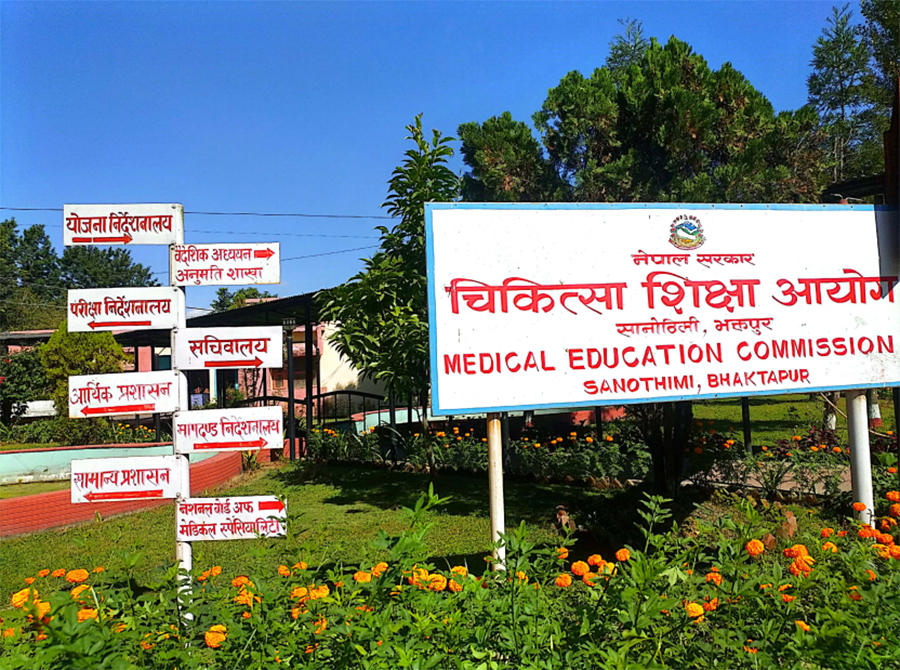
Experts say that increasing medical college seats on the grounds of a doctor shortage could leave Nepal producing more doctors than it needs within a few years.
The state has not paid sufficient attention to questions such as what kinds of doctors the country needs, in which specialisations there are shortages, and where the existing workforce is already adequate.
The overriding objective of medical education should be to ensure quality. Without quality medical education, it is not possible to produce competent health professionals, which in turn affects the quality and delivery of healthcare services.
There is considerable social pressure to become a doctor and to make one’s children doctors. Most students who study science aspire to become doctors. But not everyone can be trained as a doctor simply because they want to be one. Aspiration alone is not enough; aptitude and ability are also necessary.
In today’s context, ability alone is not sufficient either. The country needs health professionals who are socially responsible. Experts say it is inappropriate to produce doctors solely on the basis of students’ financial means and personal ambitions; workforce planning must be guided by national needs.
According to Dr Shrikrishna Giri, former vice-chairperson of the commission, medical education policy is currently being driven more by market demand and the commercial interests of medical college operators than by the country’s needs.
“Should we produce as many health professionals as we want, or should we produce them according to actual needs?” Giri asks. “The principle of demand and supply has also been applied to medical education. Students and parents want MBBS seats. They believe that an MBBS degree guarantees employment. So those running businesses also want to increase seats in that programme.”
According to Giri, a major policy weakness is that discussions on workforce production in medical education remain limited to MBBS and staff nursing seats. Additional seats are being demanded in fields that are already producing more professionals than required. Meanwhile, neither the government nor the private sector is prioritising disciplines that the healthcare system actually needs.
Giri says medical education is being treated as a business rather than as a means of meeting the country’s healthcare needs. Private investment is concentrated in subjects that students are willing to pay more to study. The state, too, is making decisions under the same pressure.
Pointing to the imbalance in medical education, Giri asks, “Where there is a gap in the workforce, production should be increased to fill it. But attention is focused only on areas where students are willing to pay to study. No one is paying attention to producing the health professionals that people actually need.”
Threat to halt student admissions
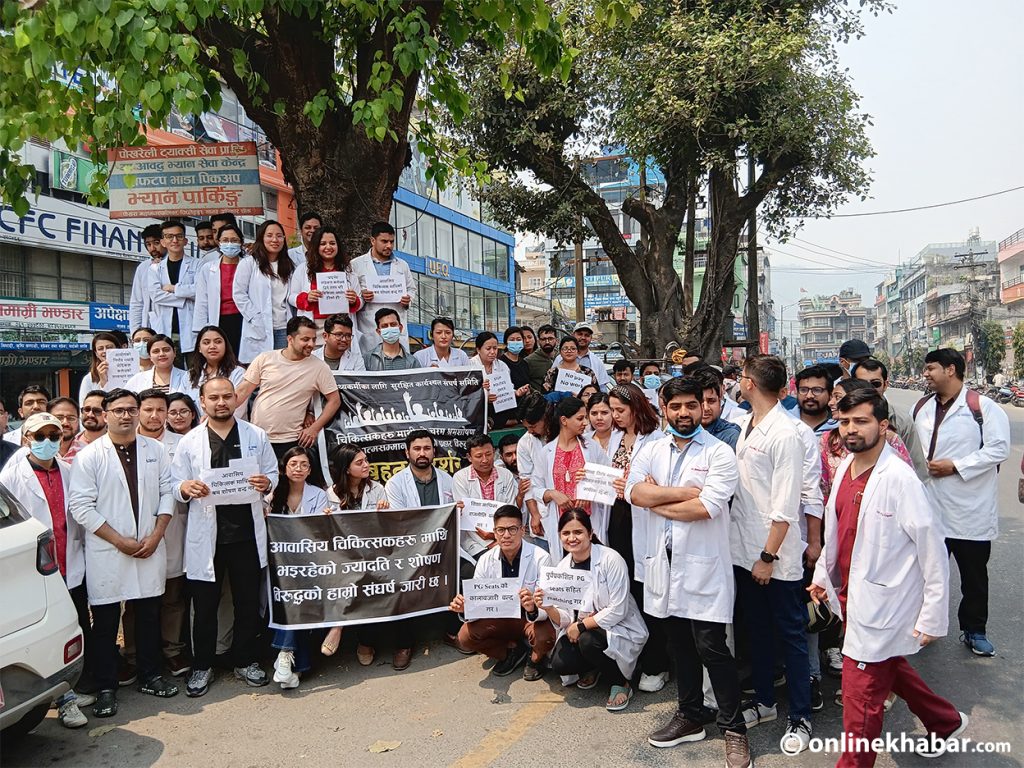
Meanwhile, Association President Dr Gyanendra Man Singh Karki has warned that private medical colleges may stop admitting students. He says they will be unable to run MBBS and other programmes unless the government adjusts tuition fees and revises seat allocations.
“The MBBS fee has increased by only Rs 200,000 over the past 10 years. Meanwhile, inflation and operating costs have increased many times over during the same period,” Karki says. “How can we teach an expensive subject like medicine by charging just Rs 55,000 a month? Institutions cannot be run simply by taking on more bank loans.”
Arguing that tuition fees should not remain fixed, Karki said they should be determined on the basis of market prices, inflation, operating costs and the performance of colleges.
The association claims that inflation has reached around 26.64 per cent over the past five fiscal years. It says colleges are under financial pressure because operating costs have risen alongside inflation, while tuition fees have not been adjusted.
Karki says a task force on fee and seat revision formed by the commission’s 18th full meeting had recommended reviewing fees for various undergraduate and postgraduate programmes, but the recommendations have not been implemented.
The commission has fixed the MBBS fee at Rs 4,168,090 for colleges inside the Kathmandu Valley and Rs 4,595,720 for those outside the valley. The fee for BDS has been set at Rs 2,092,290 and that for BSc Nursing at Rs 1,036,000.
Asked what the commission would do following the private medical colleges’ warning, Commission Member Secretary Hari Niraula avoided giving a clear answer.
Asked what steps would be taken if colleges refused to admit students despite the commission having already allocated seats, Niraula said he had no official information on the matter.
“Please don’t ask me anything. I don’t have any official information about this,” he said.
Instead, he suggested that the commission could not act alone, shifting responsibility to other agencies.
“It would be better to move forward in coordination with everyone. There is nothing the commission can do on its own,” Niraula said.