

As the date for the House of Representativesve Election is approaching, digital campaigning by candidates in Nepal has surged significantly.
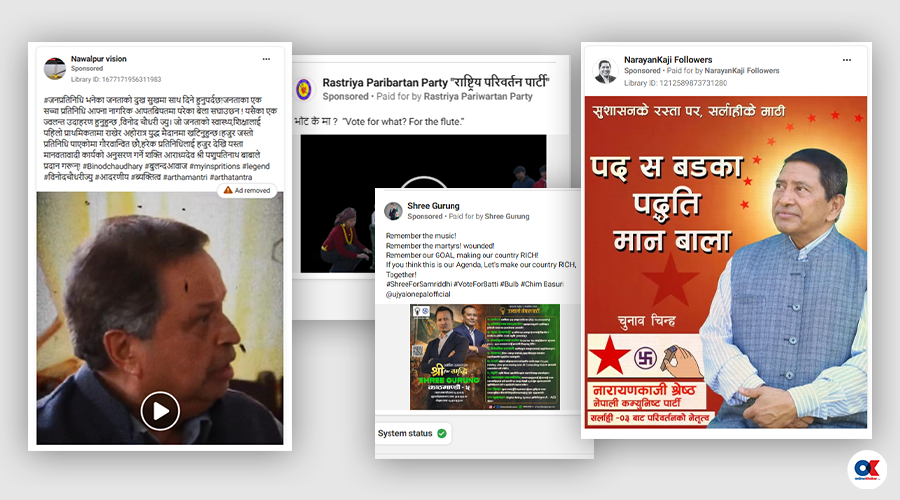
According to Meta’s Ad Library, more than 500 advertisements under the categories of issues, elections, and politics were run from Nepal in the last 30 days (from December 24, 2025, to January 22, 2026).
During this period, around 104 election-focused advertisements were placed on Meta platforms through more than 100 different accounts.
An estimated total of around USD 1,900 was spent on these ads. Of the advertisers, 97 spent USD 100 or less.
The money paid for such advertisements goes directly to Meta. These ads are displayed across Facebook, Instagram, Messenger, and Meta’s Audience Network, which includes third-party apps and websites partnered with Meta.
When placing ads on Meta, advertisers typically target users based on age, interests, behaviour, geography, and other factors.
According to the Meta Ad Library, the Rastriya Paribartan Party ranks first in election-related advertising on Meta platforms. In the last 30 days, the party ran 11 advertisements, spending USD 597.
These advertisements have collectively been viewed at least one million times. The content includes information about the party and its activities, interviews with families of Gen Z martyrs, speeches by party leaders, and calls for votes.
The second-highest spender is Shree Gurung, who spent USD 182 over the same period. His advertisements focus on election promises. He is a candidate from the Ujyalo Nepal Party contesting from Kathmandu-5.
Other notable spenders include Rastriya Paribartan Party Okhaldhunga, RSP Coverage, Narayankaji Followers, the Dynamic Democratic Party, and Sunil Kumar Sharma.
A comparative review of Meta Ad Library data shows that most of these advertisements are still active, meaning they are continuing to appear in users’ feeds.
However, some advertising accounts have since been deleted. For instance, an account that promoted a post by Balen Shah seeking votes for Jhapa-5 has been removed now.
Some election-focused ads have been run by agents rather than candidates or parties. For example, a page named MPG Solution ran advertisements promoting its own services with messages such as “Make your election campaign more effective.”
Similarly, some ads have been used to attack or criticise specific political parties or leaders.
Geographically, the highest spending has come from the Bagmati Zone, where more than USD 1,024 has been spent. This is followed by Koshi, Narayani, Mechi, Janakpur, Lumbini, Gandaki, and other regions.
However, when comparing spending over 90 days, 30 days, seven days, and one day, the overall expenditure appears to be decreasing progressively.
As the election approaches, aggressive campaigning on social media has become more visible, an area that falls under the jurisdiction of the Election Commission’s code of conduct.
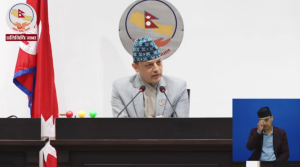
According to Election Commission Information Officer Suman Ghimire, the Commission closely monitors advertisements on digital platforms.
“Since the spending limit for each parliamentary candidate is set at NPR 2.5 million, the Commission reviews what falls within this limit, including social media advertising,” Ghimire says.
However, he noted that running boosted campaigns on social media at this time would be a violation of the election code of conduct.
The Election Commission has allocated time for parties to begin campaigning only from February 16, and any ads run before that would be against the code, Ghimire says.
“Political parties are not allowed to carry out election campaigns until the 16th. If it is happening now, the Election Commission will take action,” Ghimire told Onlinekhabar.
Campaigning carried out after the permitted date will be reviewed by the Commission based on expenditure. Explaining the process, Ghimire said, “Just as you can view reports from Meta, we will do the same. Since this also falls under election expenses, candidates must ensure that all spending remains within the NPR 2.5 million limit.”
Beyond this, the Election Commission will also use software to monitor electronic media.
According to Ghimire, the software, provided with support from UNDP and The Asia Foundation, will screen social media content.
If any issues are identified, the Commission will coordinate with the respective social media companies to remove the content. Those spreading misinformation will also be kept under special surveillance.
However, the Commission appears less clear about monitoring social media spending carried out by individuals or entities other than the candidate or their official campaign team.
The code of conduct does not clearly specify what action should be taken if someone else runs a social media campaign in support of a candidate. Nevertheless, Ghimire said the Commission would account for such advertisements as well and include all forms of advertising in its assessment, even though campaign promotions are increasingly being run in the names of foundations and private individuals. The Meta Ad Library shows many political campaigns being conducted through such handles.
The election code of conduct prohibits campaigning through multiple handles.
It states: “Political parties or candidates shall not conduct or cause to be conducted any publicity through online web pages, TV scrolling, displays in shopping malls, call centres, bank ATM messages, street dramas, or similar media.”
However, it adds that having campaign materials on a maximum of one personal or official website of a political party or candidate will not be restricted.
That said, the Election Commission has been working with companies such as Meta and TikTok to regulate such issues since the 2022 local-level elections.
After Facebook included Nepal in its Meta Ad Library, regulation became easier, as Meta began publicly providing details of political, social, and election-related advertisements and expenditures.
Ghimire told Onlinekhabar that the Commission is once again attempting to collaborate with Meta for regulation during this election.
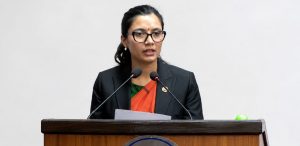
According to AI expert Dovan Rai, maintaining a presence on digital platforms is no longer unusual. Since voters themselves are on digital platforms, campaigning there is natural.
However, Rai stressed the need to assess how well election codes of conduct are being followed online. She noted that practices such as creating fake IDs and purchasing fake views are on the rise and require close monitoring.
“Showing artificial reach is illegal. Spreading misinformation and disinformation must not happen,” Rai says. “At the same time, campaigning on social media within legal boundaries is a necessity of the times. When voters are in the digital space, campaigning there is not inherently wrong.”