Hetauda, 17 August
The process of forming a new government in Bagmati Province has begun following a change in the power equation.
The process will move forward after Nepali Congress leader Indra Bahadur Baniya resigned as chief minister on Monday, submitting his resignation to Province Province Chief Deepak Prasad Devkota.
Province Province Chief Devkota will now invite parties represented in the provincial assembly to stake a claim to form a new government in accordance with the constitutional provisions.
Leaders say the new government is likely to be formed based on an earlier agreement between the Nepali Communist Party and CPN-UML to run coalition governments in the provinces.
Under the two-party power-sharing arrangement, the CPN-UML has been agreed to lead the Bagmati Province government.
The 104-member provincial assembly requires a majority of 53 lawmakers to form a government. The Nepali Communist Party and CPN-UML have 51 lawmakers combined, meaning they need the support of another party to secure a majority.
The Nepali Congress has 36 seats, the Nepali Communist Party 26, CPN-UML 25, Rastriya Prajatantra Party 12, Nepal Workers’ and Peasants’ Party three and Hamro Nepali Party two.
Rastriya Prajatantra Party’s support appears crucial for the Nepali Communist Party and CPN-UML to secure a majority.
There could be legal complications if the two parties rely only on the support of Hamro Nepali Party to claim a majority and subsequently secure a vote of confidence.
Article 186 of the Constitution provides that decisions in the provincial assembly are made by a majority of members present and voting. The provision does not give the presiding officer the right to vote, except in the event of a tie.
According to Provincial Assembly spokesperson and Deputy Secretary of Law Prakash Chapagain, the presiding officer can cast a deciding vote only when votes are equally divided.
CPN-UML lawmaker Apsara Chapagain is the deputy speaker. The post of speaker has remained vacant since August last year, and she has been presiding over the assembly.
A Supreme Court ruling in the case of government formation in Koshi Province suggests that involving the presiding officer in government formation could create legal complications.
In its ruling on July 27, 2023, on a writ petition challenging the formation of the Koshi provincial government, the Supreme Court held that the speaker could not support a particular party or candidate to facilitate government formation.
The court had declared the speaker’s support unconstitutional and overturned the appointment of then-Chief Minister Uddhav Thapa.
Based on that precedent, questions could arise over whether an alliance between the Nepali Communist Party, CPN-UML and Hamro Nepali Party alone would be sufficient to form the government.
One option would be for Deputy Speaker Chapagain to resign from the post and participate in the government formation process only as a provincial assembly member.
If she resigns, the assembly would have to select its senior-most member to preside over the meetings. The senior-most member is Nepali Communist Party lawmaker Ram Prasad Dhungana.
However, even if Dhungana presides over the assembly, he would not be able to vote on a confidence motion unless the votes were equally divided.
Therefore, support from Rastriya Prajatantra Party would make both the government formation and confidence vote processes more secure for the Nepali Communist Party and CPN-UML.
CPN-UML lawmaker and former minister Kiran Thapa Magar said discussions were underway with other parties to secure the required majority to form the new government.
RPP Bagmati parliamentary party leader Uddhav Thapa told Onlinekhabar that the party would make a decision at an appropriate time, recalling the decision of its executive committee.
He indicated that the RPP was likely to participate in the government, saying failure to support the new government could create a constitutional crisis in Bagmati Province .
Who will be the seventh chief minister?
Bagmati Province is expected to get its seventh chief minister within a few days.
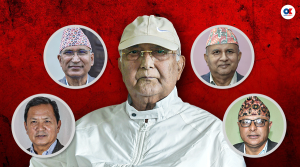
Under the power-sharing agreement, the CPN-UML will lead the provincial government. However, the party has yet to finalise its candidate amid an internal dispute.
The future chief minister will be decided after the CPN-UML resolves a no-confidence motion filed against its current parliamentary party leader, Jagannath Thapaliya.
A no-confidence motion was registered on August 12 with the signatures of 16 lawmakers, seeking to replace Thapaliya with Kiran Thapa Magar of Bhaktapur as the parliamentary party leader.
According to Thapa Magar, a meeting of the CPN-UML parliamentary party has been scheduled for 11 am on Tuesday in Hetauda.
The meeting will decide on the no-confidence motion. If the motion against Thapaliya is passed by a majority, Thapa Magar will become the parliamentary party leader.
Thapa Magar has claimed that he has the support of a majority of lawmakers.