

Kathmandu, October 13
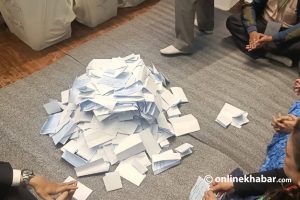
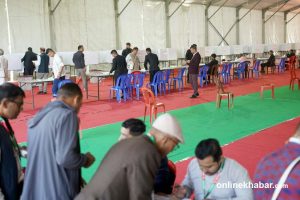
Gagan Thapa won the Nepali Congress presidency with an overwhelming majority, leaving his rival Shyam Krishna Khadgi with just 5.38 per cent of the valid votes in the party’s 15th General Convention.
Thapa secured 6,584 votes, or 94.61 per cent, out of 6,959 valid votes. Khadgi received 375 votes. Of the 7,013 votes cast, 54 were declared invalid.
Given the power dynamics within the party during the convention, the outcome was hardly surprising. Despite four decades of association with the Nepali Congress, Khadgi had not built the organisational base needed to challenge Thapa.
Khadgi, who once taught mathematics to Thapa at Siddhartha Vanasthali, had served as secretary of the Nepali Congress Kathmandu district committee and president of the party’s Constituency No. 6 committee. After serving two terms as constituency president, he took the plunge and challenged Thapa for the party’s top post, securing a modest share of the vote.
Speaking at a press conference on Monday to thank convention representatives, Khadgi argued that his candidacy had helped preserve the party’s democratic culture.
“There was a proposal to elect the president unopposed, and I also sat down for discussions with Gaganji,” Khadgi said. “But institutionalising internal democracy has benefited both him and me. We went to representatives across the country to seek their votes and received suggestions on how to improve the party.”
Former joint general secretary Kishor Singh Rathour had also contested the presidency. He had a stronger organisational standing than Khadgi, but withdrew his candidacy after Thapa’s proposal, making the contest even more one-sided.
Had Rathour remained in the race, he might have attracted support from leaders who had distanced themselves from former party president Sher Bahadur Deuba. More than 80 per cent of the members of the central working committee elected at the 14th General Convention, along with all the office-bearers, had belonged to the Deuba camp. A united bloc could have mounted a substantial challenge to Thapa.
But the 15th General Convention unfolded without the old factions retaining their previous influence, allowing Thapa to consolidate power on his own terms.
The political circumstances that emerged after the Gen Z movement helped create the conditions for such a lopsided outcome in a party with a long democratic tradition.
Following the movement, demands grew within the Nepali Congress for a special general convention. When then-president Deuba failed to address those demands in time, general secretaries Gagan Thapa and Bishwa Prakash Sharma moved ahead with an alternative course.
The two led a special general convention in January and elected a new leadership. Thapa became president and assembled a team largely aligned with his leadership. Both the Election Commission and the Supreme Court recognised the special convention.
The 15th General Convention continued that process, leaving Thapa arguably the most powerful party president since BP Koirala.
The same pattern in newer parties

The situation is not unique to the Nepali Congress. Despite provisions in the national constitution and party statutes, members of political parties have limited opportunities to exercise their sovereign right to choose their central leadership through open competition.
Even the Rastriya Swatantra Party (RSP), which emerged promising a departure from the practices of established parties, has seen its central leadership dominate internal processes. The outcome of its first general convention, held in Chitwan in late June, does not necessarily demonstrate that the party has achieved full internal democracy.
After securing nearly a two-thirds majority in the House of Representatives in the March 5 election, the RSP adopted a model in which its top leaders were effectively protected from electoral competition while other positions were contested.
Rabi Lamichhane was retained as party president without a contest, while Prime Minister Balendra Shah, popularly known as Balen, was made senior leader unopposed. Elections were held for only seven of the 19 office-bearer positions, with the party statute providing for the remaining positions to be filled through nomination.
Such an arrangement limited the opportunities for convention representatives to elect party leaders directly.
RSP leader Pramod Neupane, however, disputes the argument that the nomination process makes the party president overly powerful.
“The statute gives the president only the right to propose names. The central committee must approve them,” he said. “Therefore, it is not correct to argue that the president becomes powerful in the context of nominations.”
The RSP’s founding message had been different. When Lamichhane left his television presenting job and established the party on June 21, 2022, he declared that any capable Nepali could become party president.
Under the heading “How are we different?”, the party promised that every member would have a direct route to the top leadership.
“Capable Nepalis who have achieved professional and personal success in their lives but want to enter politics do not have the opportunity to directly assume leadership in other parties,” the party’s declaration stated. “In this situation, our party ensures that they can become members and rise directly to the position of party president. The party president will be selected through voting by all party members.”
Yet the RSP’s first general convention followed the representative-based model used by established parties. Members first had to become convention representatives to participate in the leadership selection process.
“To participate in the general convention, one must first become a representative. Once a representative, one can contest any position, including party president,” Neupane said. “But this does not mean we can be compared with other parties, because our statute does not require someone to spend a certain number of years in the party before becoming eligible to contest a leadership position.”
However, the party’s four-year history and the outcome of its first general convention raise questions about the gap between its stated principles and practice. By becoming president without a challenger at the first convention, Lamichhane has also positioned himself to lead the party for another term.
The party’s declaration states that its central, provincial, district and municipal presidents cannot serve more than two terms, with the term limit counting only from the first general convention. This provision allows Lamichhane to seek another term, and the current balance of power offers little indication of a serious challenge.
UML has forgotten its democratic past
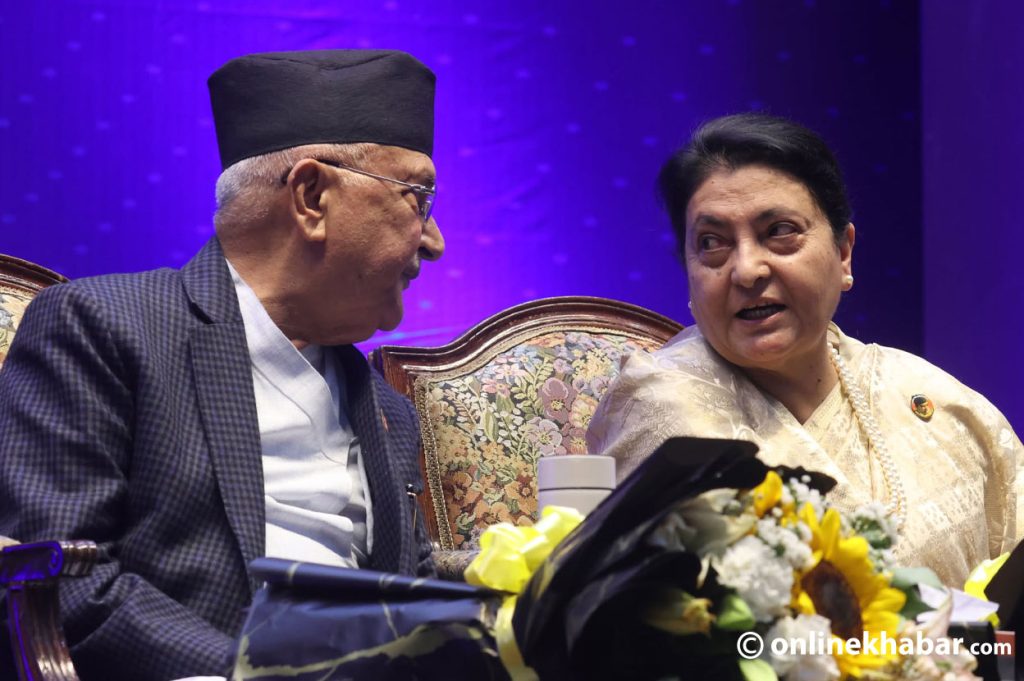
The CPN-UML, the third-largest party in the House of Representatives, has faced growing criticism over its internal democracy. Party chair KP Sharma Oli has amended the party statute to suit his leadership and taken disciplinary action against leaders who challenge him.
In recent months, General Secretary Shankar Pokhrel has appeared to be among those at odds with Oli. Following the party’s poor performance in the March 5 election, Pokhrel had been active in efforts to reorganise the UML.
But Oli did not allow Pokhrel’s organisational reform report to be presented at the central committee meeting. Instead, he used another leader, Pradeep Gyawali, to prepare the political report. The central committee meeting held in late September proceeded largely as Oli wanted, leaving Pokhrel, who had spent much of his political career working alongside Oli, with little influence.
Oli’s willingness to sideline even trusted allies has helped make him virtually unchallenged within the UML. At the party’s 11th General Convention in December 2025, he secured nearly 75 per cent of the votes.
Even after being forced out of office by the Gen Z movement while serving his fourth term as prime minister, Oli retained substantial support within the party. Of the 2,227 valid votes cast in the leadership election, he received 1,663, while his rival Ishwar Pokhrel secured 564.
UML leader Thakur Gaire says the party’s present condition can only be understood by examining developments over recent years.
“He has been in leadership for a long time and has served as prime minister repeatedly. During this period, a mindset was cultivated that the entire party must stand behind the leadership to defend it,” Gaire said. “At the same time, leaders who could compete with him left the UML. As a result, internal democracy weakened.”
When the UML split in 2021, former prime ministers Madhav Kumar Nepal and Jhala Nath Khanal, among others, left the party. Oli was elected chair for a second time at the 10th General Convention, where he faced Bhim Rawal.
By the 11th General Convention, however, Rawal and several leaders who had supported him had left the party. Rawal and Ghanshyam Bhusal were among those who departed.
Other leaders who remained in the party, including Amrit Bohora, Yubaraj Gyawali, Surendra Pandey, Ashtalaxmi Shakya, Gokarna Bista and Yogesh Bhattarai, were politically weakened within the organisation. After former president Bidya Devi Bhandari was widely expected to pose a challenge, Oli announced a unilateral decision not to renew her party membership.
Amid substantial internal disagreement, the party also removed the 70-year age limit and the two-term limit for party leadership from its statute. Committee sizes were expanded considerably. These moves further reduced the prospect of a strong challenge to Oli at the convention.
This marks a departure from the UML’s earlier reputation as one of Nepal’s leading parties in democratic practice. Oli himself rose to leadership through internal competition.
Prachanda has led for nearly four decades
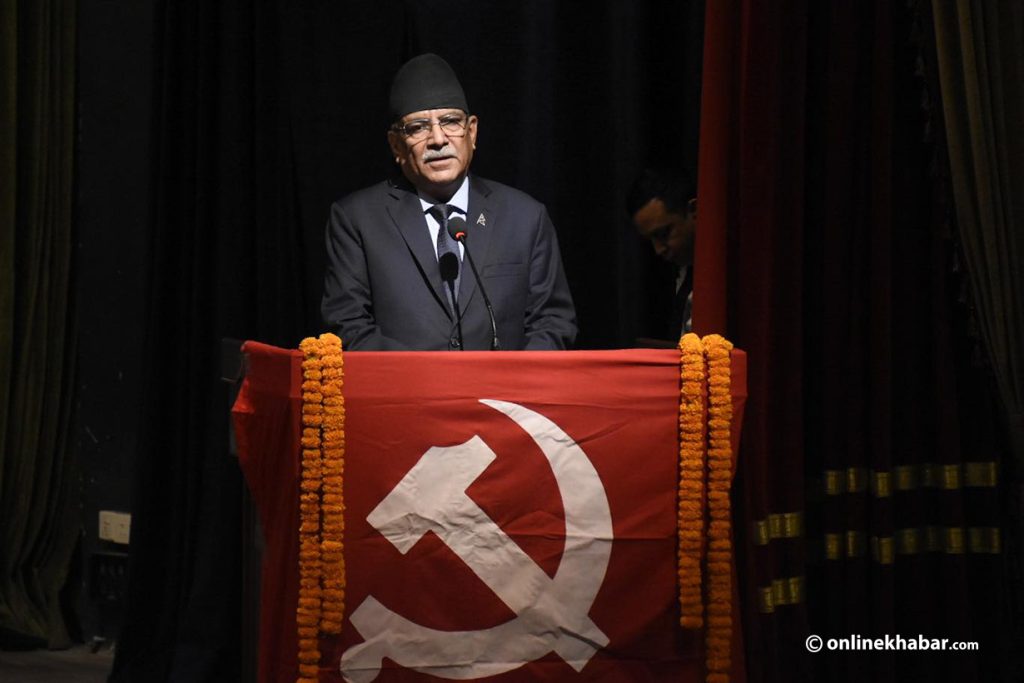
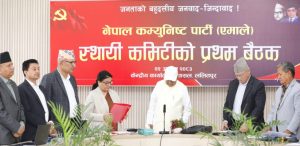
The Nepali Communist Party, formed through the merger of the CPN (Maoist Centre), the CPN (Unified Socialist) and more than two dozen other parties, has yet to hold a general convention. The party remains organisationally unsettled.
The party, which has been making political decisions in consultation with Pushpa Kamal Dahal and Madhav Kumar Nepal, has not even finalised the list of central committee members a year after its formation.
It had decided to form a central committee of no more than 2,500 members and hold a national general convention in November to organise its party structure. However, a meeting of the central coordination committee on October 9 decided to postpone the convention.
“We concluded that we could not hold the convention in November because of floods, landslides and festivals,” party spokesperson Prakash Jwala said. “We have drawn up a new plan to hold it after the local elections.”
According to Jwala, the party plans to hold ward conventions on January 11 and municipal conventions on February 15 as part of a mobilisation campaign. It also plans to launch a two-month awareness campaign using the Dashain, Tihar and Chhath festivals. The central committee, which had not met for a year, is scheduled to convene in late November.
Even if the convention is eventually held, there is little indication that the party has developed a process for choosing its leadership through competitive elections among representatives. Dahal’s nearly four-decade dominance of the Maoist movement also makes a democratic transition within the party difficult to envisage.
Dahal has repeatedly failed to create an environment in which leaders who challenge him can remain in the party. Janardan Sharma’s departure is the latest example of this pattern. The list of leaders who have left after challenging Dahal is long.
Smaller parties face similar problems

Internal democracy also appears weak in other small and emerging parties.
Madhesh-based parties have moved towards unification under the Janata Samajbadi Party Nepal following the Gen Z movement. Mahanta Thakur and Upendra Yadav have reached an arrangement over leadership positions, leaving little prospect of an alternative leadership emerging as long as the two remain aligned. These parties, which grew out of political movements, have also struggled to institutionalise internal democratic practices.
The Shram Sanskriti Party, which became a nationally recognised party following the March 5 election, has built its political identity around its chair, Harka Sampang. The party has embraced what it calls “Harkabad”, and members are required to wear T-shirts bearing Sampang’s image to attend meetings. In such a party, the likely outcome of a general convention would be relatively easy to anticipate.
The Rastriya Prajatantra Party (RPP), the party associated with former Panchayat-era political figures, offers a different example. Rajendra Lingden was elected chair through a competitive vote five years ago. But after losing the election, Kamal Thapa left the party, allowing Lingden to consolidate his position. The episode also highlighted the reluctance of some leaders to remain in a party and continue competing internally after losing a leadership contest.
The reasons vary across parties, but the result is similar. Members’ votes rarely determine leadership in a meaningful and open contest. General conventions continue to take place, but the decision-making process remains largely controlled by established leaders and their political arrangements.