Before leaving his mountain village in Parbat District, Dhan Bahadur Gurung had dreamt of a simple life where his family could sit down to a proper meal every morning and evening without worrying about whether there would be enough to eat. To make that dream possible, he left for Saudi Arabia, worked there as a waiter for fifteen hours a day, yet earned barely thirty‑five thousand Nepali rupees a month.
Gurung had studied up to grade nine and had expected hard work abroad, but to his surprise, he found that the long shifts in Saudi Arabia were still easier than the gruelling labour he had known back home. What’s more, there was almost no rest, and over 16 years, he rarely got a single day off.
One day, a severe headache gripped him. He went to a nearby pharmacy, bought some paracetamol tablets and took them, hoping it was just a passing pain. But the headache did not go away, and after a week, his legs began to swell. Worried, he went to a hospital for a checkup. A blood test followed, then a sudden rush to the emergency room. His kidneys had stopped working.
He had never heard of ‘kidney failure’ before and did not understand what it really meant.
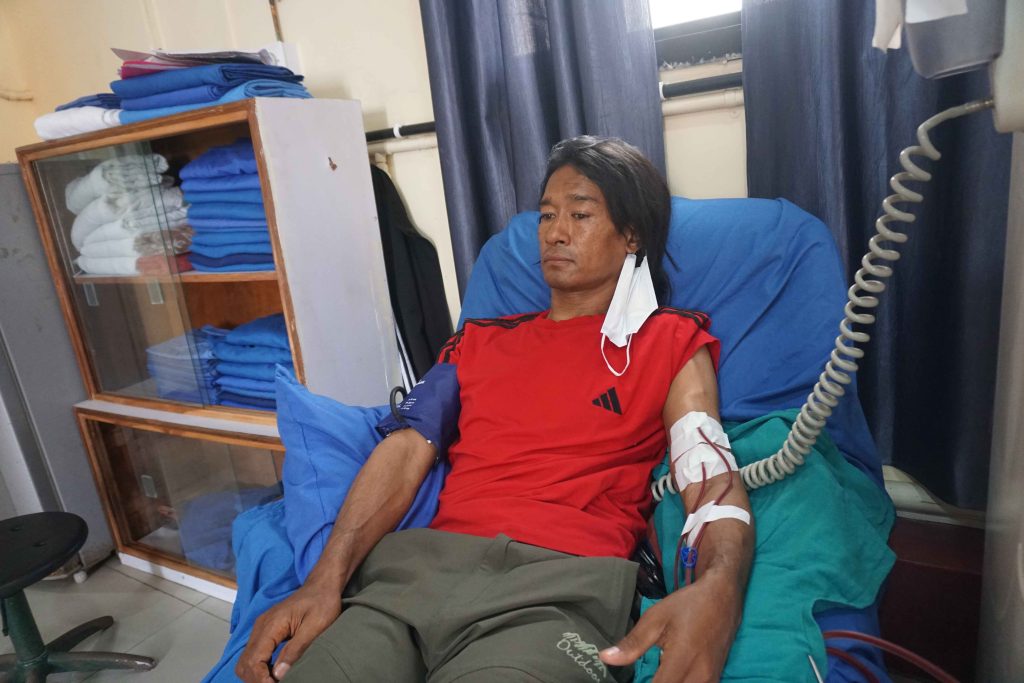
Gurung (47) says, “At that point, I did not realise I had come home with an incurable disease.”
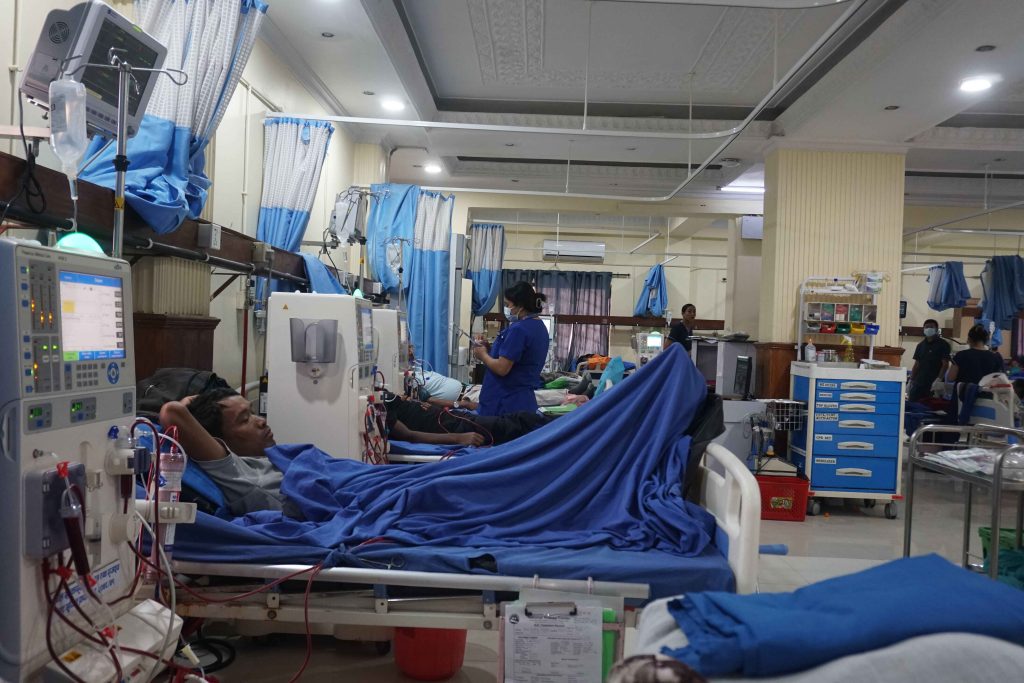
He is now undergoing dialysis at Nepal Kidney Centre three times a week for four hours.
About 1.7 million Nepalis work abroad, the vast majority in Gulf countries, and their remittances account for more than a quarter of the country’s GDP. However, this apparent prosperity comes at a steep price that the youths are paying. There is a rising trend of young workers returning home with failing kidneys and serious health complications.
Dipesh Ghimire, associate professor at Tribhuvan University, said that remittances have helped reduce poverty, but it is the young people working abroad who are paying the real price
Gurung said that while in Saudi Arabia, he was drinking four or five energy drinks a day. He believes they made him feel more energetic and helped him last longer in the scorching heat, and that he preferred them to water.
While heat is a major cause of kidney problems, migrant workers’ kidneys are failing from drinking energy drinks instead of water, eating too much meat, and not resting during long shifts,” says Senior Nephrologist Dr Rishi Kumar Kafle.
Many Nepali migrants come from cold, mountainous regions and struggle to adjust to the extreme heat and exhausting work schedules they face abroad. Dehydration and heat stress significantly raise the risk of kidney disease, particularly when workers constantly move between long hours in scorching outdoor conditions and living in tightly air‑conditioned rooms. These sudden shifts between extreme heat and cold can disrupt the body’s fluid and electrolyte balance, placing extra strain on the kidneys, said Senior Nephrologist Dr Rishi Kumar Kafle.
A study led by doctors and public‑health researchers in Nepal and the UK has found that a survey of 1438 people in Dhanusha, including 718 recent returnee migrant workers and 720 non‑migrant residents, shows that severely reduced kidney function is relatively uncommon overall. However, certain sub‑groups of returnee migrants appear to face higher kidney‑health risks.
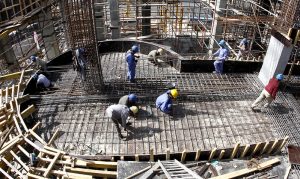
According to Kafle, the migrant workers often toil outdoors in temperatures above 40 degrees Celsius, sweating heavily for 10 to 12 hours a day with little access to clean drinking water, rest, or toilet breaks. This persistent dehydration cuts blood flow to the kidneys and can trigger acute kidney injury, which, when repeated over time, may progress to chronic kidney disease or full kidney failure.
Since the kidneys are responsible for regulating the body’s fluid balance, they are especially vulnerable to extreme temperatures, said Kafle.
He says, “As the body is repeatedly pushed into a dehydrated state, the kidneys gradually lose their ability to filter waste effectively, until they eventually stop working altogether.”
The Arab region is warming at close to twice the global average, 2024 being the hottest year recorded. The Gulf Cooperation Council countries like Bahrain, Kuwait, Oman, Qatar, Saudi Arabia, and the United Arab Emirates saw some of the hottest days since records began during the third week of July 2024, with daytime temperatures in Riyadh occasionally touching around 46°C (116°F), close to the capital’s all‑time highs.
Nevertheless, the Gulf continues to be the main destination for Nepali migrant workers.
In the mid‑1990s, Nepal liberalised its migration policies and opened up to global labour markets, particularly after the 1990 political change and subsequent economic reforms, laying the groundwork for large‑scale migration to the Gulf. At the same time, construction and infrastructure booms in Qatar, Saudi Arabia, and the UAE created a sharp demand for low‑skilled labour, while Nepal struggled with poverty and unemployment. By the late 1990s, recruitment agencies multiplied in Kathmandu, and their share of officially recorded migrants going to the Gulf jumped. By 2001, about 87 percent of workers sent through licensed agencies were headed for the Gulf, mainly to Saudi Arabia, the UAE, Kuwait, and Qatar.
Lal Singh Gharti, from Rolpa in western Nepal, went to the Gulf to build a better future for his children, following the same path that so many men in his village had taken. For three years, he worked in Saudi Arabia and Dubai, carrying sand, shovelling, and toiling as a labourer on skyscraper sites, sending money home so his two children could get a good education.
Then one day, at the age of 32, he suddenly collapsed at work. After being rushed to the hospital, doctors told him his kidneys had stopped working. With no savings and nothing left from his years abroad, he returned to Nepal empty‑handed and has been living on kidney dialysis for the past eight years.
His wife now works as a school cleaner, earning about fifteen thousand rupees a month, which barely covers his treatment, keeps the house running, and sends their children to school. Now at the age of 40, Gharti said, “I can’t do anything. Dialysis has weakened my body.”
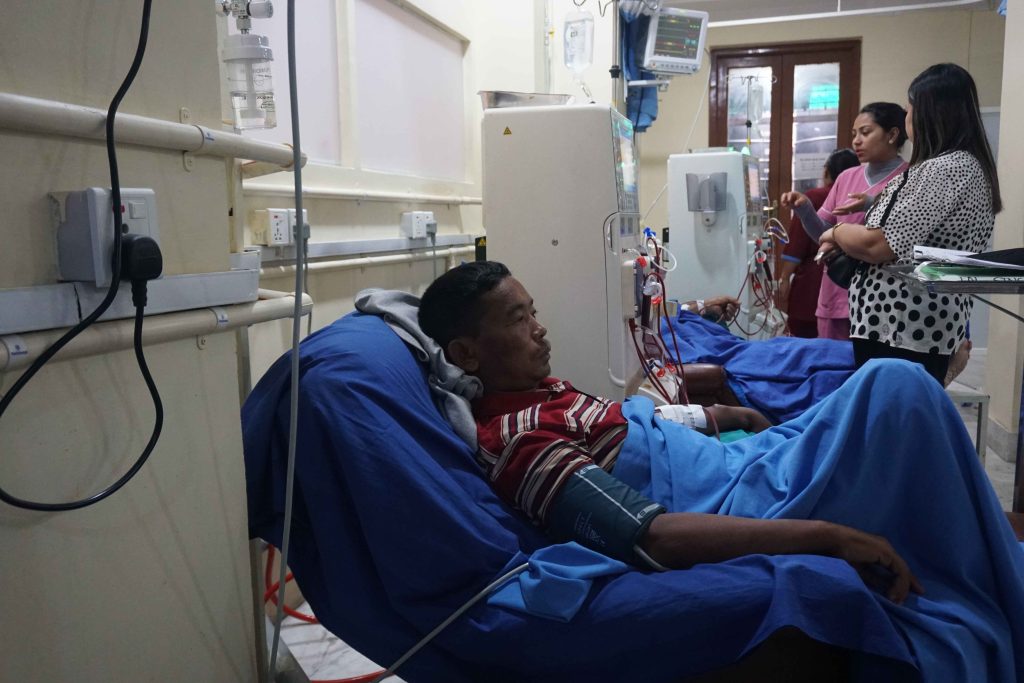
Since 2016, Nepal has been providing free kidney dialysis and transplant services, along with a monthly allowance of Rs. 5,000 for patients suffering from kidney failure.
Nonetheless, for Gurung, even though the dialysis is free, the financial burden has not eased. He rents a room in Kathmandu just to stay close to the hospital for his dialysis sessions. He still spends more than Rs. 50,000 a month on medicines, injections, vitamins, and other essential drugs used during treatment. “The support barely covers a fraction of my actual out‑of‑pocket costs,” he said.
At the National Kidney Centre, 28 workers who went abroad for employment between July 2025 and July 2026 have already been added to the list of patients with kidney failure.
Associate Professor Ghimire said that kidney‑failure patients are trapped in a vicious cycle of poverty. He added, “They go abroad hoping to improve their family’s financial condition, but once the breadwinner falls into a long‑term illness, the household quickly slips below the poverty line. The money they earn is rarely enough to cover treatment, and it is not only one person who gets sick, but the entire family is also pulled into financial and emotional devastation.”
Nephrologist Kafle said the special thing about kidneys is that we cannot tell if they are deteriorating without a blood test. People assume that if the kidneys are failing, the person will feel unwell. But in reality, we only become aware once the kidneys are already 70 to 80 percent damaged. By then, it is often too late.
Because symptoms appear so late, Kafle pointed out the importance of prevention. Kafle said that to protect the kidneys, one should drink water instead of soft drinks, pass at least two litres of urine per day, get regular health checkups, avoid taking medications without a prescription, and rest in the shade during work breaks.
Labour Migration expert Rameshwar Nepal said the government is behaving irresponsibly toward its citizens. Healthy Nepalis are sent abroad to work, who send back remittances that fuel the economy, yet many return home sick with no compensation or proper treatment waiting for them.
He said, “The government should clearly state its position and responsibilities towards its citizens in those host countries, rather than allowing them to drown in debt and illness.”
“The government is trapping its own citizens in a quagmire,” he says, “driven by the greed for remittances.”
Ministry of Labour, Employment and Social Security spokesperson Pitambar Ghimire said the government is lobbying Gulf countries to improve the safety of Nepali workers. While these countries publicly commit to worker protection, their promises often fall short in practice.
He says, “We can’t afford to just stop sending workers to the Gulf—they’re mostly unskilled, and if Nepal halts recruitment, other South Asian countries will quickly fill the gap.”
Despite several attempts to get a kidney transplant, Gharti could not find a donor. He said he will have to live on dialysis for the rest of his life.
In a despairing voice, he says, “I am waiting for death. I know I cannot recover… but I cannot die either.”