

Nepal is scheduled to graduate from the Least Developed Country (LDC) category on 24 November 2026, along with Bangladesh and Lao PDR. While public discourse has largely centred on whether Nepal should seek deferment, the more substantive national conversation must shift toward ensuring that graduation is smooth, strategic, and sustainable.
Graduation is not merely a ceremonial milestone; it is a structural economic transition that will redefine Nepal’s engagement with the global economy. The question is no longer simply whether Nepal should graduate, but whether it is institutionally and economically prepared to manage the post-LDC landscape.
Nepal’s graduation process
The LDC category is reviewed every three years by the Committee for Development Policy (CDP), which reports to the United Nations Economic and Social Council (ECOSOC). Graduation eligibility is determined based on three criteria: Gross National Income (GNI) per capita of US$1,306 or above, the Human Assets Index (HAI) should be 66 or above, and the Economic and Environmental Vulnerability Index (EVI) should be 32 or below.
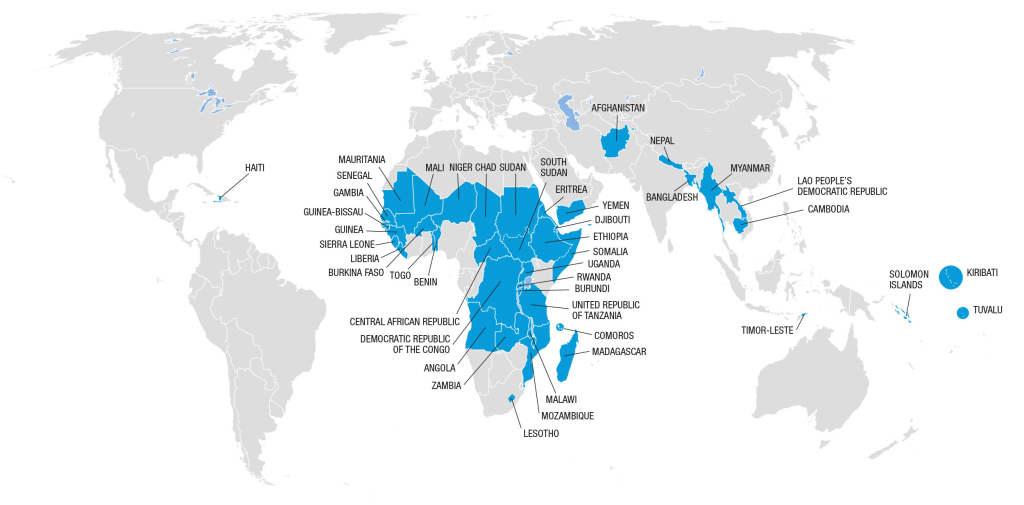
However, countries that meet two of the three criteria in two consecutive triennial reviews become eligible for graduation from the category. Nepal was among the first 25 countries designated as LDCs in 1971. As of January 2025, 44 countries remain in the category, with 32 in Africa, 8 in Asia, 3 in Oceania, and one in Latin America and the Caribbean.
Among them, 14 are in the graduation process, and 8 countries have graduated so far. LDCs comprise around 15% of the global population, but accounting for only 1.4% of global GDP and 1.1% of global merchandise trade, the disparity illustrates structural marginalisation of LDC economies in the global system. Nepal first met graduation eligibility in 2015. Despite being eligible again in 2018, the country deferred the process due to the devastating 2015 earthquake.
It was rather extraordinary that with a per capita income (of $745 in 2018) as low as just 40% of the graduation threshold level of per capita income (of 1,230), Nepal became eligible for graduation. The next triennial review in 2021, by CDP, showed further improvements in both HAI and EVI, and Nepal appeared to be set to graduate. However, in light of the COVID-19 pandemic circumstances, Nepal was granted an extended preparatory period of five years.
Hence, Nepal is set to graduate from an LDC status on 24 November 2026, after a transitional period of five years. Nepal is the only country amongst all the graduated countries as well as countries with graduation eligibility (which are likely to graduate by 2021), to secure graduation requirements without fulfilling the per capita GNI threshold criterion. Nepal’s graduation score at the 2024 Triennial Review were EVI at 29.7, HAI reaching 76.3 and GNI at $1300, slightly below the graduation threshold of $1306.
However, according to the 2025 UN monitoring report, Nepal’s per capita GNI has reached US$1,404, exceeding the threshold. Now, statistically, deferment is difficult to justify; however, structurally, vulnerabilities remain. Potential Implications of Graduation Erosion of Trade Preference: Perception vs. Reality As an LDC, Nepal enjoys duty-free, quota-free access to the EU under the Everything But Arms (EBA) initiative, along with special concessions from the UK, Türkiye, Canada, Australia, and Russia, exporting major commodities such as garments, carpets, and handicrafts.
The International Trade Centre estimates a 4.3% decline in exports due to preference erosion—modest compared to other graduating countries. Studies show such losses to the Lao PDR at 7.3%, and Bangladesh around 14% of its exports, indicating higher use of facilities from those countries than Nepal.
However, the EU provides a three-year transition period after graduation, and Nepal can apply for GSP+ status, which maintains duty-free access in exchange for implementing 27 international conventions on governance, labour, environment, and human rights.
Furthermore, historically over two-thirds and recently over 80 % of Nepal’s exports go to India under the Indo-Nepal Treaty of Trade, which provides duty-free access irrespective of LDC status. Thus, graduation will have minimal impact on Nepal’s largest export market. Nepal’s total goods exports constitute just 7 % of GDP, and manufacturing value-added remains around 5 %, according to studies.
Production costs are estimated to be 30% higher than in India due to logistics inefficiencies, high input costs, weak quality systems, limited finance access, and technological lag. Overcoming those impediments is key to export enhancement rather than revolving around losing trade preferences.
Shrinking policy space and WTO obligations
The second impact will be on a significant loss of policy space in supporting various domestic sectors, as LDCs are often exempt from making commitments and implementing stringent provisions of the WTO. The pharmaceutical sector, which enjoys benefits under the TRIPS waiver in the form of the ability to produce and export patented drugs without the need to comply with patent/license requirements, may be impacted.
On the other hand, Nepal has amended required policies, applied tariffs at much lower bound rates, made a commitment to phase out all ODCs (other duties and charges within 10 years from the entry into the WTO in 2004, has already stopped use of export subsidies, indicating that policy space was lost much before the LDC graduation.
More than that, at the 13th WTO Ministerial Conference (MC13) in February 2024, members approved a “smooth transition” package for graduating Least Developed Countries (LDCs), allowing them to retain specific LDC technical assistance, training, and certain special and differential treatment (S&DT) provisions for three years after graduation to mitigate potential trade disruptions.
Development finance: Income classification matters more
As we know Nepal has been receiving foreign assistance from both bilateral donors such as OECD countries, India, China, Japan and multilateral agencies such as World Bank, Asian Development Bank (ADB), International Monetary Foundation (IMF), the European Union institutions, United Nations, etc. and Official development assistance (ODA) has remained vital to Nepal’s budgetary framework. However, the share of external financing in the national budget has gradually declined from over 28% in 2016/17 to 14.6% in 2025/26, indicating a gradual fiscal transition already underway.
Aid from OECD countries, LDC climate change fund (LDCF) and Enhanced Integrated Framework (EIF) funds will be impacted. India and China, major bilateral ODA contributors, don’t directly link aid with LDC status. The patterns and trends in aid allocation suggest that recipient countries’ historical and bilateral relationships with donors, and country-specific situations such as civil wars and unrest, natural disasters, refugee crises, etc., are important determinants of aid inflows.
Crucially, most concessional lending is determined by the income classification definition of the World Bank, such as low-income countries (LICs), lower-middle-income countries (LMICs), etc., not LDC criteria. Nepal has recently graduated from LICs (the per capita income threshold of US $1,335) to LMICs, and the World Bank has already increased its annual loan interest from 0.75% to 1.5%.
This shows that LDC graduation will have a partial impact on most of the ODAs for Nepal. Strategic Preparations and the Smooth Transition Strategy Nepal has developed a Smooth Transition Strategy (STS), 2024, built around six pillars: macroeconomic stability, trade and investment, economic transformation, productive capacity, climate resilience, and social inclusion. The strategy outlines 167 actions aligned with the 16th Five-Year Plan.
However, policy formulation has historically outpaced implementation. Effective execution, coordination among ministries, and budget alignment remain critical challenges. Structural Vulnerabilities and Emerging Risks Nepal’s graduation will be taking place amid rising global protectionism, financial instability, and intensifying climate risks.
Externally, shifts in US and EU trade policies, the Free Trade Agreement between India and the EU, request for LDC graduation deferral by Bangladesh may further undermine the export competitiveness of Nepali products and erode market share. Nepal is among the most climate-vulnerable countries globally, particularly due to its mountainous terrain and socio-economic circumstances.
Recent climate-induced disasters like the 2024 monsoon events and projected threats such as glacial lake outburst floods (GLOFs) are expected to triple by the end of the century. Recent political instability and economic disruptions have dampened investor confidence. Growth forecasts have been revised downward by the World Bank to 2.1% from 5.2%, 3 to 3.5 % from 5.2 by the IMF, Nepal Statistics Office’s first quarter estimate of around 3% against the targeted growth rate of 6%, reflecting weakened private sector morale and uncertainty.
Additionally, Nepal’s placement on global AML/CFT grey lists has negative implications for foreign direct investment inflows and financial credibility. Domestically, Nepal faces structural economic fragility, with a heavy dependence on remittances, stagnant industrial output, and insufficient job creation to absorb youth entrants.
Conclusion and recommendation
Nepal’s graduation reflects decades of progress in education, health, and institutional development. It enhances international credibility and may improve investor perception. Yet graduation alone does not guarantee transformation. Nepal should request at least 3 years of extension of the final preparatory period, and there is the case of Solomon Islands, being extended by three years, until 13 December 2027, for the second time.
However, any extension must be treated as a final preparation window—not a comfort zone. The path forward requires:
● Prompt implementation of Smooth Transition Strategy (STS), 2024,
● Optimum use of LDC-specific foregone opportunities if granted extension,
● Aggressive pursuit of EU GSP+ status,
● Strengthened trade diplomacy and ally with landlocked countries and explored facilities,
● Rapid exit from AML/CFT grey lists,
● Improved governance and creditworthiness,
● Investment in logistics, digital trade, and industrial upgrading,
● Climate adaptation financing and green transformation,
● Structural reforms to boost productivity and job creation.
Ultimately, graduation must be felt by citizens through higher incomes, stable employment, and resilient growth. It must translate from statistical compliance into tangible economic transformation. Nepal stands at a pivotal crossroads.
If managed strategically, LDC graduation can serve as a launchpad toward sustainable middle-income status. If mishandled, it risks exposing unresolved structural vulnerabilities. The outcome will depend not on the label of graduation itself, but on the nation’s capacity to implement reforms, strengthen institutions, and harness this historic transition as an opportunity for durable progress.