

Kathmandu, November 20
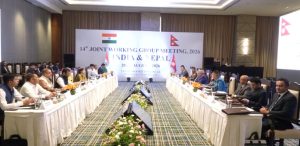
Negotiations between Nepali and Indian officials are underway to finalise agreements and understandings expected during Prime Minister Balendra Shah’s visit to India, but no formal agreement has yet been reached on major agenda items, according to senior government sources.
The two sides are engaged in intensive discussions, particularly on air routes and India’s financial assistance to Nepal.
However, some issues Nepal had prioritised have been dropped from the visit’s agenda, while others that had appeared close to agreement remain unresolved after India introduced additional conditions.
At least three government sources confirmed that, apart from routine agendas such as inaugurations and groundbreaking ceremonies, the two sides have yet to reach agreement on major issues.
“We are still not in a position to say that an agreement has been reached on any particular issue or that something has been finalised. But we remain hopeful. We hope the visit will be fruitful,” a senior government source told Onlinekhabar.
Pancheshwar project dropped from agenda

Nepal had hoped to advance the long-delayed Pancheshwar Multipurpose Project during the prime minister’s visit. However, the project has been dropped from the agenda.
India has indicated that the project could move forward only if there is broad political consensus in Nepal, according to a source familiar with the discussions.
The source said India’s position was not limited to consensus among opposition parties but also required agreement within the ruling party.
“India raised the issue of broad political consensus after it became apparent that there was no unified position on the Pancheshwar project within the Rastriya Swatantra Party itself and that sufficient discussions had not taken place between the government and the party,” the source said.
A senior government official said disagreements between the two countries over the project’s detailed project report (DPR) had also prevented it from being included in the agenda.
The two sides have yet to agree on the assessment of benefits from the project, investment-sharing arrangements and the distribution of downstream benefits. These disagreements have prevented technical experts from reaching consensus on the DPR.
India has maintained that the project should not reduce the water available to the Lower Sharda Barrage, located 165 kilometres downstream of the Sharda Barrage at Banbasa. Nepal has not accepted India’s position on the matter, according to a source.
“The two sides have also not agreed on the proportion of investment each country would make. However, if the issue of water rights is resolved, the investment-sharing arrangement would not be difficult to settle,” the source said.
A Foreign Ministry source said India had been reluctant to engage on the Pancheshwar project from the outset of the preparations for the visit.
“Nepal’s proposal on Pancheshwar would need to be accepted by India. But as they were not ready to do so, the project could not move forward,” a senior government source said.
Under the Mahakali Treaty, India is required to release 10 cubic metres of water per second for Nepal’s Mahakali III Irrigation Project. Nepal is currently developing the project and has been insisting that India release the water as stipulated in the treaty.
Nepal had hoped to reach an agreement on the water release during the visit, but officials at the Ministry of Energy say the possibility has now receded.
Sources also said there was little prospect of agreement on other major proposals related to energy and water resources.
The Upper Arun and Dudhkoshi hydropower projects, which Nepal plans to develop with financing from the World Bank and the Asian Development Bank, have also faced obstacles due to India’s reluctance, according to government sources.
The World Bank had sought India’s no-objection before approving investment in the Upper Arun project, as India is a downstream country. India has yet to provide the clearance, preventing the bank from approving the financing.
The reservoir-based Dudhkoshi project does not face the same formal obstacle, but Indian officials have also expressed interest in it, according to Ministry of Energy officials.
Nepal has been attempting to reassure India that the projects would not adversely affect its interests. However, sources said an agreement on either project was unlikely during the prime minister’s visit.
Air route talks remain unresolved after India seeks access to airspace for Bagdogra

India has agreed in principle to Nepal’s long-standing requests for additional air routes and airspace access for Bhairahawa, but has sought permission to use Nepal’s airspace in the Jhapa region for flights to and from Bagdogra airport.
Nepali officials have requested additional time to study India’s proposal, particularly because Bagdogra is also a military airport.
India, however, has insisted that the two proposals be agreed upon as a package, according to a source involved in the negotiations.
“Bagdogra is also a military airport. Civilian flights operate when military activities are not taking place. India has sought Nepal’s airspace for both civilian and military purposes,” the source said.
The two sides held discussions on the matter on Wednesday. Nepal has already conveyed that it cannot grant airspace access for military purposes and has said it needs to study the proposal for civilian flights as well.
“India is insisting that we agree immediately. We have said that we cannot reach a conclusion without studying a proposal that was submitted only 20 days ago,” the source said.
A source at the Ministry of Tourism said India had been asked to allow additional air routes for Nepal for the past 10 to 15 years, and that Nepal needed time to examine the new proposal.
Currently, aircraft entering Nepal from abroad can enter through Simara alone. Nepal has been requesting India to allow international flights to enter and exit through routes via Mahendranagar, Nepalgunj, Bhairahawa and Janakpur, arguing that the restrictions have made it difficult to operate international airports in Bhairahawa and Pokhara effectively.
Nepal awaits India’s response to proposal for Rs 200 billion in assistance

Nepal has requested India to announce financial assistance worth 200 billion Indian rupees during the prime minister’s visit.
The proposal includes 100 billion rupees in concessional loans through a line of credit and another 100 billion rupees in grants, with Nepal submitting projects for the proposed assistance.
Of the proposed grant component, Nepal has requested 50 billion rupees for reconstruction following the floods in Rasuwa and another 50 billion rupees for the Butwal-Pokhara Expressway.
“India has conveyed that it is positive about the proposal. However, it has not yet indicated whether it will announce assistance of the same amount or, if not, how much it would provide,” a source said.
India has announced four lines of credit for Nepal so far, all of which have expired.
According to a source at the Ministry of Finance, nearly 85 billion rupees from previously announced Indian credit lines remain unused because of conditions requiring 75 percent of the goods used in projects financed through the loans to be sourced from India.
“We have requested that India announce a 100-billion-rupee line of credit, adding 15 billion rupees to the 85 billion that remains unutilised from its previous commitments. We expect India to agree to that, but we are not very optimistic about the grant component,” the source said.
A Foreign Ministry source said India had not formally stated that it would treat the loan and grant proposals separately.
Border dispute to be discussed, but no framework for resolution
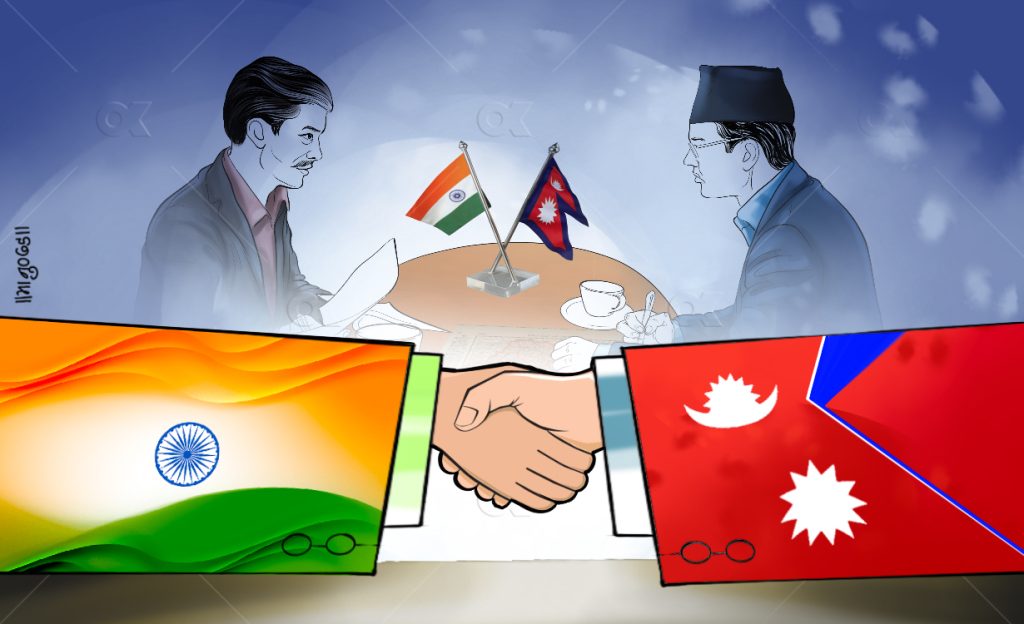
The border dispute is another issue Nepal is expected to raise during the prime minister’s visit.
Nepal and India have acknowledged disputes over the Kalapani-Lipulekh-Limpiyadhura area in Darchula and Susta in Nawalparasi.
Despite more than six decades since Nepal reached a border agreement with its northern neighbour, disputes with India remain unresolved. The disagreements extend beyond encroachment in the no-man’s-land and the disappearance or damage of border pillars.
The issues have been raised during successive visits by Nepali prime ministers to India as well as visits by Indian prime ministers to Nepal.
Foreign Ministry sources said the border disputes would likely be discussed during the visit, but no framework for resolving them had been prepared.
“The border dispute will naturally come up in bilateral discussions. However, there is no framework for reaching an agreement, nor has any preparation been made for one,” a source said.
Agnipath not on the agenda

Nepal had also hoped to discuss the recruitment of Nepali citizens into the Indian Gorkha regiments during the prime minister’s visit, but the issue is not on the agenda.
Nepal suspended recruitment after India introduced the Agnipath scheme in 2022, aimed at making its military leaner, more modern and younger, while reducing costs.
Under the scheme, India recruits young people aged 17 to 21 as Agniveers for four years, with only 25 percent eligible to continue in regular military service. Nepali citizens have not been recruited under the programme.
Nepali citizens have traditionally been recruited into the Gorkha regiments under a tripartite agreement between Nepal, India and the United Kingdom.
Nepal has maintained that India’s introduction of the four-year temporary service scheme without consulting Nepal was contrary to the tripartite agreement and has refused to allow its citizens to participate.
“Nepal’s position on Agnipath remains unchanged. India has not made any new proposal on the issue. Therefore, there is no possibility of discussion or a new agreement on it,” a source said.