Kathmandu, September 24
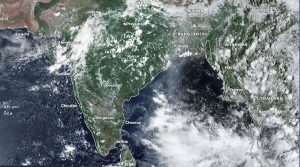
The deep depression that has developed over the Bay of Bengal is likely to weaken gradually after the next 24 hours, but its influence is expected to continue bringing heavy to very heavy rainfall to parts of Nepal, the Meteorological Forecasting Division said.
Meteorologists have warned that the ongoing rainfall could affect normal life and urged people in areas vulnerable to floods and landslides to maintain high alert.
The weather system has already brought rain to many parts of the country since early Thursday morning. Meteorologist David Dhakal said the intensity and coverage of rainfall were expected to increase further on Thursday.
The Meteorological Forecasting Division has advised people to exercise caution in flood- and landslide-prone areas and avoid travelling at night as far as possible.
The department has also warned of the possibility of heavy snowfall in high Himalayan areas.
Which districts face higher risks?
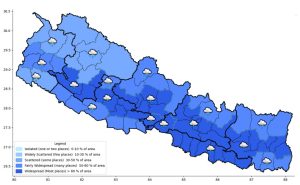
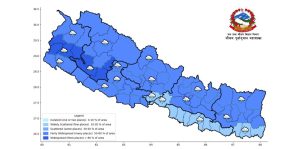
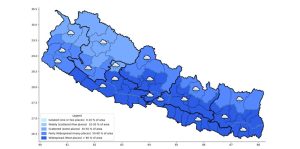
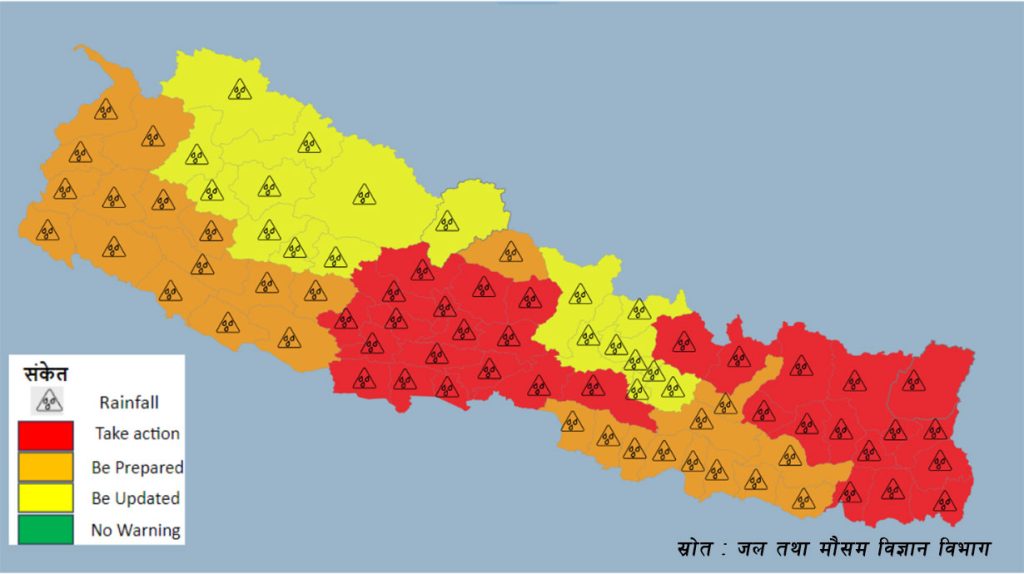
The division released a four-day risk map on Wednesday evening based on its five-day weather forecast.
For Thursday, orange alert has been issued for eastern hill districts of Koshi, Bagmati and Gandaki provinces and eastern hill districts of Lumbini Province. Orange indicates a potentially hazardous situation requiring caution.
Yellow alert has been issued for the Terai districts of Koshi, Madhesh, Bagmati, Gandaki and Lumbini provinces, as well as some districts in Karnali Province. People in these areas have been advised to remain updated on weather conditions.
The risk is expected to increase on Friday.
On Friday, red alert has been issued for high Himalayan areas of Koshi, Bagmati and Gandaki provinces, indicating the need for response and preparedness.
The districts under the red alert are Taplejung, Sankhuwasabha, Solukhumbu, Ramechhap, Dolakha, Sindhupalchok, Rasuwa, Dhading, Gorkha, Manang and Mustang.
Yellow alert has been issued for Jhapa, Morang and Sunsari in Koshi Province and Saptari, Siraha, Dhanusha, Mahottari, Sarlahi, Rautahat, Bara and Parsa in Madhesh Province.
The department revised its earlier risk assessment for five districts in Sudurpaschim. Kailali, Kanchanpur, Doti, Dadeldhura and Baitadi, which were marked orange on Wednesday evening, have been placed under yellow alert in the latest update.
Karnali, Sudurpaschim face higher risk on Saturday
The risk is expected to shift towards Karnali and Sudurpaschim provinces on Saturday.
The department has placed Dolpa, Jajarkot, Jumla, Mugu, Kalikot, Bajura, Bajhang, Humla and Darchula under red alert.
Orange alert has been issued for Lamjung, Kaski, Syangja, Parbat, Baglung, Myagdi, Palpa, Nawalparasi West, Rupandehi, Kapilvastu, Arghakhanchi, Gulmi, Pyuthan, Dang, Rolpa, Rukum East, Rukum West, Banke, Bardiya, Salyan, Surkhet, Dailekh, Kailali, Kanchanpur, Achham, Doti, Dadeldhura and Baitadi.
Rainfall is expected to decrease somewhat on Sunday compared with Thursday, Friday and Saturday.
On Sunday, yellow alert has been issued for all districts west of Bagmati Province, while all districts in Koshi, Madhesh and Bagmati provinces have been marked green.
Yellow indicates that there is no significant risk but people should remain updated on weather conditions.
Weather system weakening
The weather system developed as a deep depression over the west-central Bay of Bengal and adjoining northwestern areas.
The system crossed the coast near the area southwest of Kalingapatnam, between Visakhapatnam and Gopalpur in India, and moved across northern Andhra Pradesh and adjoining southern Odisha.
The India Meteorological Department has said the system is likely to move north-northwestwards and gradually weaken over the next 24 hours.
Nepal’s Meteorological Forecasting Division has also said in its latest bulletin that the system is expected to gradually weaken after the next 24 hours.
However, meteorologist Dhakal said the system could continue to cause heavy rainfall in parts of Nepal, increasing the risk of floods and landslides in vulnerable areas.
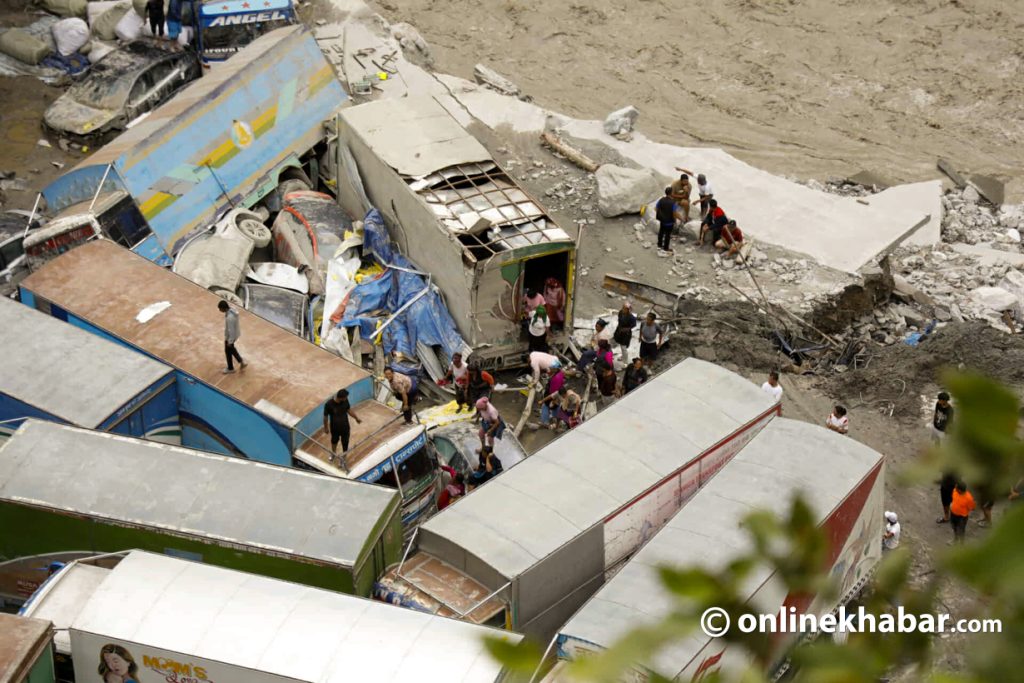
The division has warned that rainfall could trigger soil erosion, floods, landslides and debris flows, while urban and Tarai areas could face inundation. Rising water levels in major and minor rivers and streams could also disrupt daily life, agriculture, health, tourism, construction activities near rivers, roads and air transport.
The department has also warned of the possibility of heavy snowfall in mountainous areas and urged mountaineers and others staying in the high Himalayas to exercise heightened caution.
The Meteorological Forecasting Division said it was continuously monitoring the weather system and would update forecasts and warnings as conditions change. It has urged the public and concerned agencies to regularly follow official weather forecasts and alerts.