Kathmandu, October 2
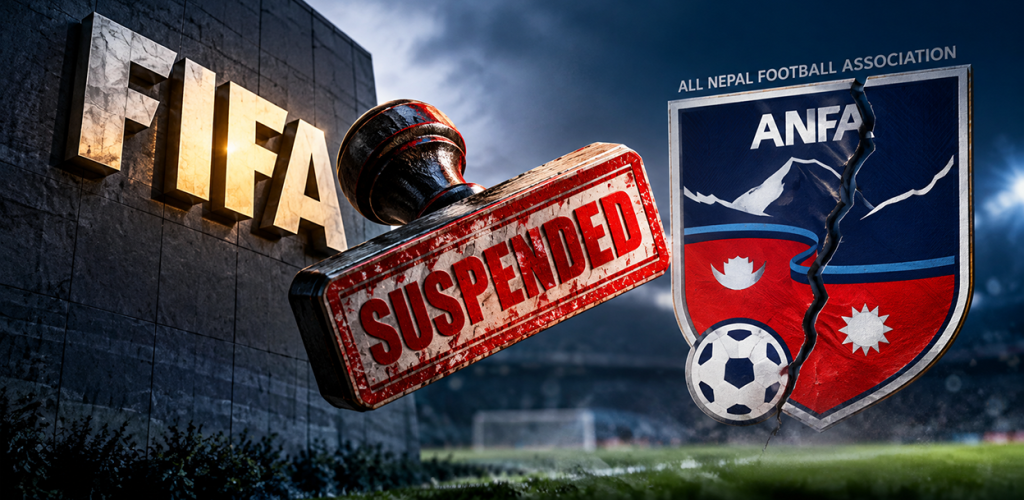
It has been 100 days since FIFA suspended the All Nepal Football Association (ANFA), but there is still no clear indication of when the ban on Nepali football will be lifted.
FIFA suspended ANFA indefinitely on June 25, citing third-party interference in the affairs of the football governing body. The suspension has prevented Nepal’s national teams and clubs from participating in FIFA and Asian Football Confederation (AFC) competitions and cut ANFA off from FIFA and AFC funding, development programmes and training opportunities.
The prolonged suspension has become more notable when compared with recent cases involving Nepal’s neighbours.
India was suspended by FIFA in August 2022 over third-party interference after the country’s Supreme Court appointed a Committee of Administrators to take over the functions of the All India Football Federation (AIFF) executive committee.
FIFA suspended India on August 16 and lifted the ban after the committee was dissolved and the AIFF administration regained full control of its daily affairs. FIFA announced the lifting of the suspension on August 27, meaning the ban lasted 11 days by calendar dates.
Pakistan, meanwhile, was suspended by FIFA in February 2025 for a different reason. FIFA said the Pakistan Football Federation (PFF) had failed to adopt constitutional amendments required to ensure democratic elections.
The suspension was lifted on March 2 after the PFF Congress unanimously approved the constitution validated by FIFA and the AFC.
Nepal, however, remains suspended 100 days after FIFA’s decision.
What FIFA wants from Nepal
FIFA has set conditions for lifting the suspension.
One requires the complete revocation of the National Sports Council’s March 25 decision concerning ANFA and the reinstatement of the current ANFA Executive Committee.
The second requires ANFA to complete the electoral process it had already initiated, as soon as possible and in accordance with its statutes and regulations.
The dispute dates back to the conflict between the National Sports Council and ANFA over the football association’s election process.
On March 25, the NSC suspended ANFA for three months, citing violations of the Sports Development Act. ANFA had planned to hold its election in Jhapa on March 27, but the election was postponed after the NSC’s decision.
The government later revoked the three-month suspension on May 15. However, the dispute over the election process and the extent of state involvement was not fully resolved.
FIFA subsequently concluded that the continued involvement of state authorities amounted to third-party interference and suspended ANFA indefinitely.
A dispute with no clear exit
The central disagreement now remains between the government and ANFA.
The government has maintained that ANFA must comply with the decisions and directives of Nepal’s sports authorities, while ANFA has argued that it must operate independently in line with FIFA and AFC regulations.
FIFA’s position is that member associations must be able to manage their affairs independently and without undue third-party influence.
The football body had already warned Nepal about the issue before imposing the suspension. According to FIFA’s account, it had repeatedly sought assurances that ANFA would be allowed to conduct its affairs and complete its electoral process without interference.
The consequences of the suspension are not limited to the national team’s international fixtures.
ANFA and its member bodies have lost access to FIFA and AFC funding and development programmes, while Nepal’s national teams and clubs cannot participate in competitions organised by the two bodies for as long as the suspension remains in place.
The suspension has also already affected Nepal’s participation in continental competitions. The AFC had informed ANFA that Nepal’s youth teams could take part in upcoming qualifiers only if FIFA lifted the suspension before specified deadlines.
What happens next?
There is currently no indication that the two sides have reached an agreement that would satisfy FIFA’s conditions.
The longer the dispute continues, the greater the uncertainty for Nepali football.
The immediate issue is no longer simply when FIFA will lift the suspension. It is whether the government and ANFA can resolve their disagreement over the football body’s autonomy and electoral process in a way that meets FIFA’s requirements.
Until then, Nepal remains outside international football — 100 days after the suspension that brought an unprecedented disruption to the country’s football administration.