Lumbini, December 11
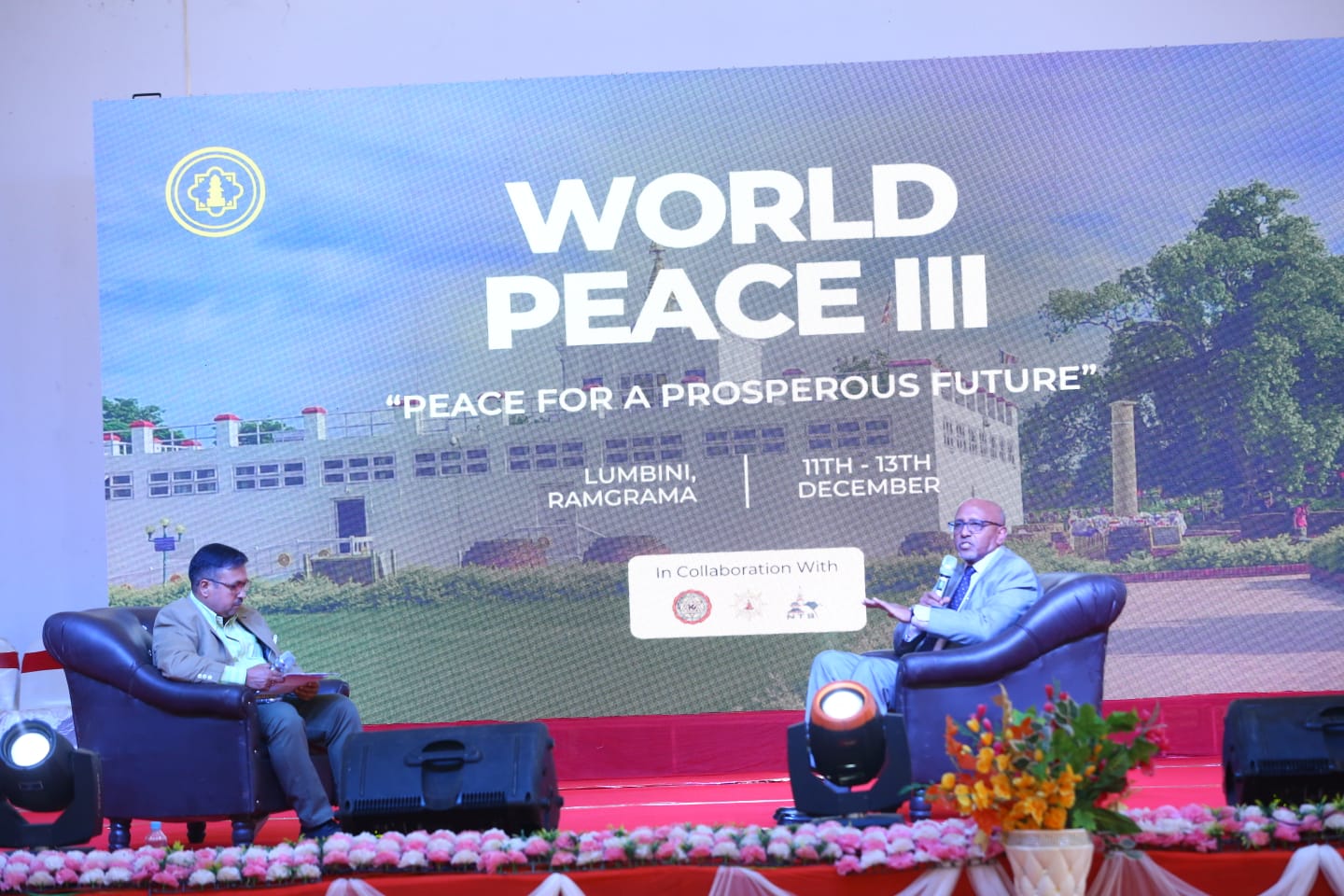
Former Prime Minister of Ethiopia Tamrat Layne has called on Nepal’s political leadership and youth to cultivate humility, reject selfish interests, and harness technology responsibly to build a peaceful and prosperous nation. He made the remarks during an interactive session at the third edition of the World Peace Program held at the Lumbini International Conference Hall. The session was moderated by Sudhamshu Dahal, Associate Professor at Kathmandu University.
Reflecting on his own turbulent political journey, Layne said his life had been shaped by both violence and peace. “In my earlier life, I was involved in a revolutionary movement, mostly violent, and later for 16 years I went through a war during the Derg Regime that took the lives of 70,000 people. It was a fight against the military government,” he said.
He said Ethiopia’s transformation began in 1991, when his party took power after 16 years of armed struggle. “We did two most important things. First, we created peace and ended the era of war. Second, we brought all political forces together. We gathered everyone for the end of poverty, and because of that the nation became peaceful,” he said. For nearly a decade, Ethiopia became one of Africa’s fastest-growing economies, he noted.
Layne emphasized that sustainable peace depends on leaders who can rise above ego and personal gain. “The most important thing for leaders to foster peace is to start from themselves. I call it the leadership of humility, it cuts selfishness and motivates politicians to live for others and work for the betterment of society,” he said.
Turning to Nepal, he stressed that the country urgently needs leaders who can resist self-interest and remain committed to integrity. “A leader who avoids being egoistic can be loyal to the nation. I believe Nepal has a young generation that can give birth to this kind of leader,” he added.
Addressing the growing influence of technology, Layne said the digital age offers both opportunities and dangers. “We can’t skip technology as it is ruling our life. We should use technology for development, not for conflict and hatred,” he said, adding that dialogue, not violence, is the path to resolving differences.
He also called for greater creativity, freedom, and intellectual vibrancy, describing them as drivers of empowerment and economic progress. “The intellectual elite is responsible for change. If they become vibrant, change is possible. They should organize new ideas,” he said.