
Kathmandu, January 18
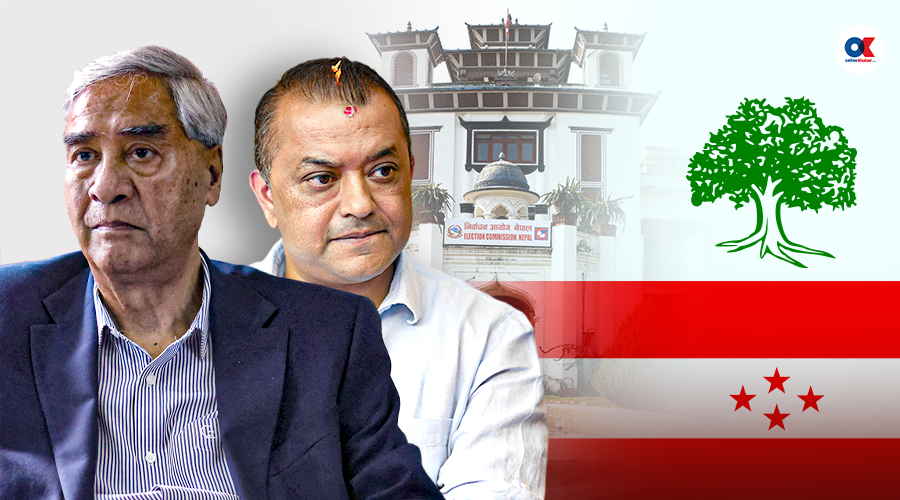
The Election Commission has commented that the actions and conduct of the Deuba faction of the Nepali Congress were not in line with democratic values and norms.
In a decision regarding the update of office bearers selected and the amended statute adopted by the special general convention held at Bhrikutimandap last week, the Commission concluded that the actions and activities of the Deuba faction could not be considered compliant with the party statute.
In a decision issued by Acting Chief Election Commissioner Ram Prasad Bhandari and Commissioner Sagun Shumsher Jabara, the Commission stated that attempts by the central committee elected by the general convention to ignore and control the demands of the convention were not consistent with democratic principles.
While the decision comments on the actions of the outgoing central working committee of the Nepali Congress, it does not explicitly name the Deuba group, though the remarks are directed at the committee led by that faction.
The Commission decided to update party records, stating that a majority of general convention representatives had called a special general convention and, through due process, elected a new central committee leadership.
The decision notes that details of the 135-member central working committee elected by the special central general convention will be updated in accordance with Section 51 of the Political Parties Act, 2073, and Rule 25 of the Political Parties Regulation, 2074, and that the concerned party will be informed accordingly.
Tenure of all office bearers expired
The Election Commission has determined that the term of the central working committee of the Nepali Congress led by the Deuba faction had expired.
Article 43 of the party statute states that the tenure of office bearers and members at all levels of the party shall be four years, with a provision allowing the central working committee to extend the term by up to one year in extraordinary circumstances.
Similarly, Article 17(1) provides that the party’s central general convention must be held every four years. Based on a comparative analysis of these provisions, the Commission concluded that the term of the central working committee had already expired on Mangsir 23.
According to records of the 14th General Convention of the Nepali Congress held from Mangsir 14 to 28, 2078 BS, the Commission stated that the tenure claimed by the Deuba faction had expired on Mangsir 23. While the party had first extended the term until Magh 2082 BS, citing extraordinary circumstances, it later extended it again until the end of Jestha 2083 BS.
The Commission noted that the terms of office of bearers and members at all levels had been extended without the party statute clearly defining what constitutes an “extraordinary circumstance.”
Compliance with the statute is lawful
Article 17(2) of the Nepali Congress statute provides that a special central general convention may be convened if requested by 40 per cent of general convention representatives, and that such a convention must be held within three months.
Stating that the central working committee had ignored a statute-compliant request for a special convention, the Commission said there was no basis to invalidate the convention convened by the general secretaries.
Citing Article 15 of the statute, which defines the central general convention as the party’s supreme authority, the Commission concluded that the election of office bearers and members by the convention was lawful.
The decision states that it is not reasonable to deny the occurrence of a special general convention or ignore the election of new office bearers and members conducted through it.
While noting that a political party’s statute must be democratic, the Commission observed that democratic values must not remain limited to words but must be reflected in practice and implemented democratically.
Not an intra-party dispute
The Deuba faction had questioned the legitimacy of the special general convention convened by the Gagan–Bishwo group, arguing that the general secretaries lacked the authority to call such a convention.
However, the Election Commission interpreted the mandatory provision requiring a convention to be convened upon a written request submitted to the “centre,” clarifying that the statute defines the centre as including both the central committee and the central office.
Citing Article 27(1) of the statute, which places the central office under the authority of the general secretary, the Commission said the convention called by the general secretaries was consistent with both the statute and the law.
The Commission further stated that a party’s general convention is its supreme body, and that the selection of new leadership by a majority of representatives through due process was natural and valid.
The Deuba faction had filed a petition with the Election Commission challenging the special convention, its decisions, and the selection of new leadership. However, the Commission refused to treat the matter as an intra-party dispute under Sections 43 and 44, stating that the case did not fall under the dispute resolution procedures outlined in those provisions.
Three questions, one dissenting sentence
After analysing the facts, the Election Commission issued its decision by examining three key questions: whether a special general convention was held at Bhrikutimandap in Poush, whether the convention was in line with the party statute, and whether the changes in the central working committee should be updated under Section 51 of the Political Parties Act, 2073.
Concluding that a statute-compliant special general convention was held despite the central committee’s disregard, and that new office bearers were elected through due process, the Commission decided to update the party records accordingly.
Commissioner Dr Janaki Kumari Tuladhar expressed a dissenting opinion. However, she did not elaborate on the grounds or reasons for considering the convention inconsistent with the statute or for opposing the update of the petition submitted by the Gagan–Bishwo group.
In her one-sentence dissent, she wrote: “I disagree with this decision as it is not consistent with the Constitution, prevailing laws, the Commission’s practices, and the principles of justice.”