Kathmandu, October 27
Nepali Congress President Gagan Kumar Thapa has proposed a month-long nationwide dialogue campaign in Mangsir to reconnect with voters who have distanced themselves from the party in recent years.
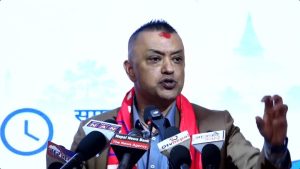
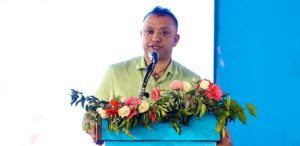
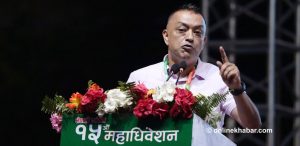
Speaking at a programme in Pokhara on Tuesday, Thapa said the party needed to engage with people who had supported the Nepali Congress for years but had stopped voting for it.
He urged party leaders and cadres to visit voters at their homes, listen to their grievances and answer their questions instead of blaming them for withdrawing their support.
Thapa said the party must understand why voters had turned away and demonstrate its commitment to addressing their concerns.
Following the party’s 15th general convention, the Nepali Congress has moved forward with new ideas and commitments, he said, expressing confidence that it could address the grievances of voters who had become disillusioned with the party.
“I propose that we conduct a nationwide dialogue campaign throughout Mangsir. Rather than remaining confined to the centre, party leaders must reach villages, wards and neighbourhoods,” Thapa said.
He added that the party should reach out to voters not merely by highlighting its past achievements but by demonstrating its commitment to resolving present-day problems.
Thapa calls for cooperation between generations
Thapa also stressed the need to bring together younger and older generations within the party, saying both had their own knowledge, perspectives and experience.
“If the younger generation feels that the older generation lacks experience with them, the older generation may also feel that the younger generation lacks experience. But both have their own knowledge and experience,” he said.
He called for appropriate representation of four generations across the party’s organisational structures and urged leaders to work together rather than allowing generational differences to create divisions.
Thapa said the party should also ensure that women and people from different castes, ethnic groups, linguistic backgrounds and communities receive fair opportunities, particularly in the upcoming local elections.
He noted that local party members would select candidates for local elections, making it necessary for both aspiring candidates and party leaders to engage directly with the public.
According to Thapa, voters should be able to meet political leaders easily, express their concerns and hear their responses.
“Only when there is a change in how we work, think and reach out to the public will people feel that the party has changed,” he said.