Kathmandu, October 5
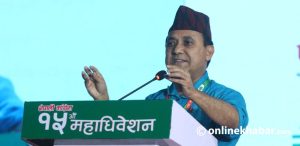
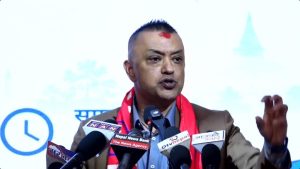
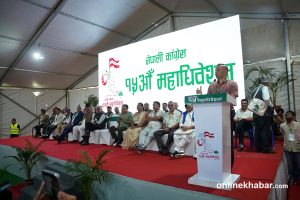
Nepali Congress President Gagan Kumar Thapa has presented his political report for the party’s 15th General Convention at the Central Working Committee meeting.
The report outlines the party’s political, ideological, organisational and economic direction for the next four years. It includes a review of the party’s past performance, a stronger opposition role, a policy against pre-election alliances, organisational restructuring, greater cooperation with the private sector, increased youth participation and the concept of a “Prosperous Nepal, Respected Nepali.”
The report acknowledges that the Nepali Congress has prioritised positions and power over its core political objectives over the past two decades.
It says coalition management, power-sharing, factionalism and transactional politics have weakened the party’s moral standing. It also says the tendency to protect people associated with the party in cases of corruption and irregularities has weakened the autonomy of public institutions.
The report further acknowledges that the party has grown increasingly distant from younger generations and has failed to understand changing expectations among citizens. It says the party has sought to apologise to the people through the second special general convention and pledged to reform itself.
Congress to remain in opposition
The report describes the Congress’ defeat in the February 21 election as a result of the growing distance between the party and citizens, as well as political weaknesses that have accumulated over the past two decades.
With 38 seats, the party has proposed playing a responsible role as the main opposition and effectively monitoring the government.
The report calls for the party to question government actions based on evidence and facts, speak out against corruption, rights violations and poor governance, and present alternative policies rather than limiting itself to criticism.
It also proposes a “shadow government” mechanism to monitor ministries at the federal and provincial levels, while giving greater priority to long-term national issues over day-to-day political disputes.
No pre-election alliances
Thapa has proposed that the Nepali Congress should not form electoral alliances with other parties before the next election.
The party would contest elections under its own tree symbol, with its own candidates and agenda. Candidate selection would prioritise qualifications, contribution and performance over factional affiliation, access and political patronage.
The report proposes considering primary elections, public opinion surveys and direct voting by party members in candidate selection. It also proposes that membership rules should not be changed at the last minute to influence conventions or candidacies.
Ideological renewal
The report proposes retaining nationalism, democracy and democratic socialism as the party’s core ideological foundations while updating its political thinking to reflect the needs of the 21st century and changing socioeconomic conditions.
It proposes linking nationalism not only to geography and slogans but also to national capacity in energy, food, technology and finance.
Democracy, it says, should not be limited to elections but should include meaningful citizen participation in decision-making and the exercise of public power.
The report also proposes connecting BP Koirala’s socialist vision with a modern social-market economy and incorporating Pradeep Giri’s emphasis on study, debate, self-criticism and the concerns of marginalised communities into the party’s ideological tradition.
‘Prosperous Nepal, Respected Nepali’
The report says economic growth alone should not be the measure of prosperity.
Education, health, nutrition, skills, capabilities and people’s real freedom should form the foundation of development, it says.
It proposes pursuing development through cooperation among citizens, communities, the private sector, cooperatives, universities and experts rather than relying solely on the government.
The report also calls for clear outcomes and accountability in major decisions taken by the state.
Five-question accountability system
The report proposes a five-question accountability system for major government and public decisions. It asks what decision was made, why it was made, who is responsible, what the outcome was and what was done if the expected outcome was not achieved.
These five questions would form the basis of public accountability under the proposed system.
Open-source citizen dashboard
The report proposes developing a digital system through which citizens can monitor development projects, budget expenditure and the officials responsible for them.
Information on the progress of projects, spending and responsible officials would be made publicly available to facilitate real-time monitoring and institutionalise citizen oversight of government work.
Private sector and economy
The report proposes treating the private sector not merely as a source of tax revenue but as a key engine of wealth creation, production, innovation and employment.
It calls for protection of private investment and policy stability, along with a business-friendly environment. The relationship between the government and private sector should shift from regulation and tax collection towards cooperation and partnership, it says.
Production, entrepreneurship and job creation would be placed at the centre of economic policy. The report also proposes directing remittances towards productive investment in agriculture, industry, tourism and technology.
Hydropower and clean energy would be promoted as a foundation for industrialisation and green-energy exports.
Jobs and foreign employment
The report proposes making the expansion of productive and dignified employment within Nepal a national priority.
Foreign employment, meanwhile, should be made safer, better managed and rights-based rather than treated solely as an economic compulsion.
It also calls for policies to protect the rights and social security of Nepalis working abroad and for creating an environment in which remittances can be invested productively.
Migration and population
The report calls for different approaches to declining populations in the hills, increasing migration towards the Madhes and highway corridors, and growing pressure on major cities.
It proposes designing development plans based on actual settlement patterns, mobility and demand for services rather than administrative boundaries alone.
Education, healthcare, housing, transport and social security policies should also reflect changing lifestyles and family structures, it says.
Agriculture, industry and production
The report proposes shifting Nepal from an economy dependent on imports and remittances towards one driven by production.
Agriculture, hydropower, energy, tourism, industry and digital technology have been identified as major pillars of economic growth.
The report calls for agriculture to be connected with modern technology, markets and entrepreneurship, while remittances should be channelled into agricultural and industrial investment.
Climate change and green development
Climate change should be treated not only as an environmental issue but also as an economic and national security concern, according to the report.
It calls for disaster risks to be incorporated into development plans, infrastructure and settlement planning, while promoting sustainable use of natural resources.
The report also proposes linking green energy, hydropower and environmental protection with economic opportunities and emphasises intergenerational justice.
Technology and artificial intelligence
The report notes that artificial intelligence and digital technology are changing employment, education, knowledge and competition.
It proposes preparing Nepal not only to use new technologies but also to take advantage of opportunities created by them.
Education and skills systems should be adapted to new technologies, while media literacy and fact-based public dialogue should be promoted to counter misinformation and hate in the digital age.
Social sector
The report proposes linking the Congress with continuing social campaigns against caste discrimination, child marriage, gender-based violence and malnutrition.
Public education and healthcare should serve as foundations for equal opportunity, while social security for senior citizens, children, women and vulnerable communities should be strengthened.
Mental health, loneliness and changing family structures should also be incorporated into long-term state policy, the report says.
Federalism and the Constitution
The report acknowledges that although the federal structure has been established, its effectiveness remains weak.
It calls for better coordination among the federal, provincial and local governments, along with improvements in administrative capacity and fiscal federalism.
The debate on constitutional amendments, it says, should be based on national consensus rather than immediate political power equations.
Transitional justice
The report calls for completing the remaining tasks of the peace process and ensuring truth, justice and reparation for conflict victims.
Transitional justice should not be used as a tool for political bargaining or power-sharing, it says, arguing that the trust of victims and the credibility of institutions should remain central.
National sovereignty and foreign policy
The report proposes understanding national sovereignty not only in terms of formal independence but also in terms of national capacity in energy, food, finance, technology and knowledge.
It calls for maintaining Nepal’s independent decision-making capacity amid changing geopolitical competition and expanding diplomatic options based on national interests.
It also stresses the need to view domestic economic capacity and external relations as interconnected.
New concept of national reconciliation
The report proposes developing BP Koirala’s concept of national reconciliation beyond a political settlement and as a basis for social and cultural unity.
It calls for strengthening a shared Nepali identity among people from the mountains, hills, Madhes and the diaspora, while promoting coexistence, dialogue and democratic culture among different communities, religions and cultures.
Organisational reform
The report proposes transforming the Congress into an organisation that remains connected with citizens throughout the political cycle rather than becoming active only during elections.
It calls for greater transparency in membership, participation and internal democracy, while creating an institutional mechanism for leadership transition between generations.
The report proposes establishing a Leadership Training Institute for cadres and young leaders, a Policy Institute for research, an Election Bureau for election preparations and a Governance Institute to assist elected representatives on policy, budgeting and good governance.
Internal anti-corruption measures
The report proposes high ethical standards for party officials and elected representatives, along with financial transparency and mandatory public audits.
It calls for no protection for party members accused of corruption, a clear suspension process for those facing corruption allegations and an independent internal ombudsman to investigate conduct and corruption-related complaints.
What Congress says it will not do
The report proposes a public commitment that the Congress will not engage in partisan appointments or power-sharing in the judiciary, constitutional bodies, universities and administration.
It also proposes not using public property and authority for the benefit of a party, faction or individual, and not giving opportunities based on money, access or proximity to party leaders.
The party would also commit to treating corruption allegations against its own members consistently and not changing rules at the last minute to delay conventions or influence candidacies.
Two-term limit for prime minister
The report proposes initiating efforts for a constitutional provision preventing anyone from serving as prime minister for more than two terms.
It says a term limit would help prevent long-term concentration of power and leadership in an individual.
Electoral reforms
The report proposes introducing primary elections for candidate selection and exploring a “none of the above” option.
It also calls for legal and constitutional initiatives to enable Nepalis living abroad to vote.
The report proposes discussions on alternatives such as rotating reserved constituencies to make the electoral system more participatory, transparent and representative.
Rs 100 million endowment fund
The report proposes establishing a Rs 100 million endowment fund to support the education and healthcare of families of martyrs, injured party workers and displaced activists.
It also calls for long-term protection for families who contributed to the party’s political movements.
Special measures for young people
The report proposes forming a special task force comprising independent young experts to study the concerns and demands of the Gen Z generation.
Its recommendations would be incorporated into party policymaking, while youth participation and leadership development would be placed at the centre of party renewal.
The report also proposes increasing youth participation in policymaking and party decisions through digital platforms.
Timeline for implementing ‘prosperity’
The report sets out a timeline for implementing its concept of prosperity.
During the first 100 days, it proposes reviewing the party’s political and organisational performance from 2006/07 to 2025/26, beginning the review process in all seven provinces, publishing the first “Prosperity Policy Paper” and preparing a record of community contributions.
During the first year, provincial task forces would be formed on education, nutrition, employment, good governance and green development. Citizen dialogue and public-service monitoring would also begin.
Before elections, the party would publish clear criteria for candidate selection and advance a primary election process, with community work, ethical conduct and performance considered in selecting candidates.
The report also proposes internal reviews every three months, an annual public “Prosperity Report” and an assessment of the four-year leadership based on the implementation of policies and commitments.
A broader restructuring agenda
The political report links the Congress’ proposed renewal not only to leadership or organisational changes but also to political culture, economic policy, private-sector cooperation, employment, social security, federalism, good governance, youth participation, technology, climate change and national sovereignty.
Its central concept is “national renewal and prosperity.” The report seeks to acknowledge past weaknesses, reduce the party’s distance from citizens, strengthen democratic institutions, expand production and employment through cooperation with the private sector, and establish measurable outcomes for party policies and commitments.
Thapa has proposed regular reviews of policies, organisation and programmes throughout the four-year leadership period, with performance assessed on the basis of results. The broader objective is to transform the Congress from an election-focused organisation into a political institution that remains continuously connected with citizens.