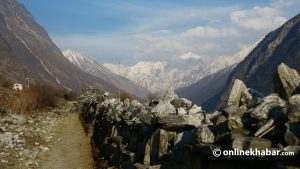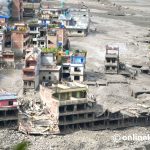


On the morning of August 26, a slab of ice and rock broke away from roughly 5,200 metres on the flank of the Langtang massif, on the border Nepal shares with Tibet, and fell some 1,200 vertical metres into the valley of the Lhende Khola.
Seismometers registered the impact as the equivalent of a magnitude 5.2 earthquake. The debris dammed the river, then gave way. Downstream at Galchhi, the Trishuli rose about nine metres in thirty minutes, a wall of what one researcher called liquid concrete, travelling roughly a hundred kilometres through Rasuwa and Nuwakot.
By September 6, Nepali authorities had recovered 1,342 bodies. Some 4,996 people were still missing; 13,391 had been rescued. It is Nepal’s deadliest disaster since the 2015 earthquake.
The event was not a glacial lake outburst flood, the hazard Nepal has spent two decades preparing for. It was the failure of frozen ground itself. Alton Byers, a mountain geographer at the University of Colorado Boulder, describes high-altitude permafrost as the glue holding these slopes together. That glue is thawing: temperatures on Langtang Lirung have climbed since the 1980s, and four of the last five summers rank among the warmest recorded there.
The mountain gave notice
The most uncomfortable finding of the past week is that the collapse was visible in advance. A rapid hazard assessment by the HiRISK team, using Planet and Landsat 9 imagery, found indicators from August 24, two days out: the glacier’s surface changed, meltwater ran brown, water within the ice accelerated, and a crack propagated into the bedrock slope behind it.
No one was watching. “No early warning system for glacier-related hazards had been set up in the affected area,” the assessment concluded. Jakob Steiner, a geologist and co-author, put it bluntly: “We can’t say, oh my God, nobody knew.”
The alerting failed as well. Text warnings did go out on August 26. “People received SMS alerts about the event on the 26th,” said Saswata Sanyal, who manages disaster risk reduction at the International Centre for Integrated Mountain Development. “But people didn’t know what exactly to do with the warning or where to safely evacuate to.” Recipients read a routine monsoon notice and behaved accordingly.
The physics leaves almost no margin: settlements here get five to thirty minutes between detection and impact; a window only automated alerting can use. More than 200 Himalayan glacial lakes are rated high risk, and coverage is sparse. But the ice that failed was not a monitored lake at all, which is the deeper problem: Nepal’s hazard map was drawn around the wrong mechanism. The glacier also sits partly in Chinese territory, where no permanent mechanism for real-time hazard data exists.
Inside the tunnels

More than 500 of the missing were registered hydropower workers across nine projects with hundreds more informal laborers and truckers unaccounted for along the corridor. At Trishuli 3A, 42 are unaccounted for in a headrace tunnel more than four kilometres long. At Chilime, rescuers pushing into a 250-metre tunnel reached 130 metres before chest-high sludge stopped them. One survivor estimated that of roughly 1,000 workers at nearby sites, about 100 got out. Brigadier General Ujwal Rana warned that clearing the tunnels “may not even be completed in three to four months.”
These were mostly men working weeks from home and remitting wages to hill villages. After the 2021 Chamoli disaster in India and now this one, deep tunneling beneath thawing permafrost in a valley with a documented flood history is a foreseeable risk, yet Nepal has no regime for holding developers liable for such siting decisions and no compensation standard for the families.
The arithmetic of blame
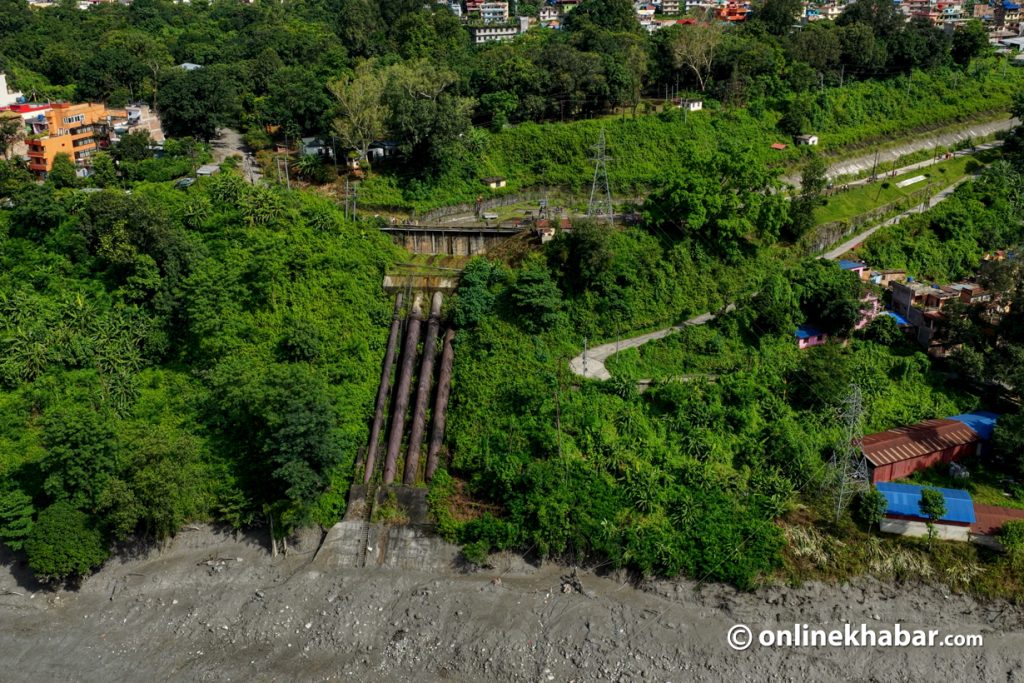
Here is what makes this a story about somebody else’s power plants.
Nepal emitted 18.8 million tons of carbon dioxide in 2024, or 0.05 percent of the global total. Its cumulative contribution since 1850 is about 232 million tons, 0.013 percent of the 1,845 billion tons humanity has emitted in that span. Ten countries account for roughly 68 percent of the total. Nepal’s entire industrial history amounts to less than two days of current global emissions.
Who put the carbon there: cumulative fossil CO2, 1850 to 2024
| # | Country | Billion tons | Share of world |
| 1 | United States | 434.7 | 23.6% |
| 2 | China | 285.1 | 15.5% |
| 3 | Russia | 122.8 | 6.7% |
| 4 | Germany | 94.9 | 5.1% |
| 5 | United Kingdom | 76.5 | 4.2% |
| 6 | Japan | 69.6 | 3.8% |
| 7 | India | 66.1 | 3.6% |
| 8 | France | 39.7 | 2.2% |
| 9 | Canada | 35.6 | 1.9% |
| 10 | Ukraine | 31.2 | 1.7% |
| Top ten combined | 1,256.2 | 68.1% | |
| Nepal | 0.232 | 0.013% | |
| Madagascar | 0.113 | 0.006% |
World total 1850 to 2024: 1,844.6 billion tonnes. Calculated from the Global Carbon Project and Our World in Data series.
What the water cost
Nepal’s finance minister, Swarnim Wagle, initially put losses above $4 billion; later estimates have run toward $7 billion. Reuters reported that rebuilding could consume up to a tenth of an economy of roughly $50 billion.
One flood, one balance sheet
| Measure | Figure |
| Bodies recovered, as of Sept. 6 | 1,342 |
| Still missing | 4,996 |
| Rescued | 13,391 |
| Damage estimate | $4bn to $7bn |
| Nepal GDP | about $50bn |
| Rebuild cost as share of economy | up to 10% (estimated) |
| Operating generation lost | about 280 to 550 MW |
| Capacity under construction damaged | about 390 MW |
| Share of national electricity supply | about 10% |
| Annual export earnings now at risk | NPR 18.75bn (about $142m) |
| Trade through the severed China corridor | about $600m a year, 30% of China trade |
| Public debt | NPR 2.975tn, 45.1% of GDP |
| Nepal share of emissions since 1850 | 0.013% |
Toll figures from Nepali authorities as of Sept. 6, 2026, and still moving. Generation losses are disputed.
Generation losses are still being counted, with published tallies ranging from about 280 to 550 megawatts of operating capacity destroyed or offline, plus roughly 390 megawatts under construction. In a system of some 4,300 megawatts that is more than 90 percent hydro, that is close to a tenth of the country’s electricity.
The timing is cruel. Nepal became a net electricity exporter in fiscal 2025-26, earning about 18.75 billion rupees, roughly $142 million, and its 2025 Energy Development Roadmap targets 15,000 megawatts of exports by 2035. The flood reversed the direction of the wire: flows to India have fallen from a monsoon peak of 950 to 1,000 megawatts to about 400, and Kathmandu has asked Delhi for advance import approvals from September. India’s grid absorbs the loss easily, since the Dhalkebar to Muzaffarpur link alone carries 1,000 megawatts. What is a rounding error in one grid erases an export revenue stream and creates an import bill in the other, in the same quarter.
The flood also severed Nepal’s only functioning road to China. The Rasuwagadhi and Gyirong crossing handled roughly $600 million a year, close to 30 percent of all China-to-Nepal trade; its customs complex, rebuilt after a July 2025 flood, is again under five feet of mud, and that earlier closure took five to six months. Beijing has offered emergency cash, supplies and two teams of tunnel-rescue specialists, without publishing a figure. Nepal is thus receiving help from the world’s first- and third-largest cumulative emitters as aid and electricity sales, while the mechanisms meant to deliver compensation as an obligation remain unfunded.
Madagascar: the same equation, a different ocean
Four thousand miles southwest, Madagascar runs identical arithmetic. Its 32 million people emitted 4.5 million tonnes of carbon dioxide in 2024, 0.006 percent of cumulative global emissions and, by the World Bank’s accounting, 0.09 percent of current greenhouse gases. In two decades, it has absorbed 35 cyclones, eight major floods and five severe droughts. This year brought two cyclones eleven days apart.
Madagascar cyclone season 2026, so far
| Fytia | Gezani | Combined | |
| Landfall | Jan. 31 | Feb. 10 | |
| Region | Boeny | Atsinanana | |
| People affected | 164,714 | 416,044 | 581,000 in need |
| Children affected | 79,063 | 203,513 | 274,080 |
| Displaced | 40,000 | 20,800 | 60,800 |
| Homes damaged or destroyed | 18,600 | 102,000 | 120,600 |
| Classrooms hit | 380 | 1,076 | 1,456 |
Source: UNICEF Madagascar cyclone response plan, February 2026.
The World Bank projects that without adaptation, climate change will cut Madagascar’s economy by 5.8 percent by 2050 and push 1.68 million more people into poverty; the country needs $3.37 billion by 2030 for urgent adaptation and mobilised $416 million in 2020. The damage is cumulative: a cyclone in January takes the roof, a delayed rainy season in March takes the harvest, and the household sells livestock, then land, then sends someone north for work.
Madagascar also cautions against easy storytelling. When famine gripped the Grand Sud in 2021 and was called the world’s first climate-change famine, World Weather Attribution scientists found a roughly one-in-135-year drought whose likelihood human warming had not significantly increased; poverty, subsistence farming, pandemic restrictions and pests did the killing. A 2024 Harvard-led study found an anthropogenic fingerprint in the delayed onset of the rainy season. Both point the same way: vulnerability converts weather into catastrophe, and vulnerability is a product of history and income.
The funds that cannot pay
Global temperatures in 2025 averaged 1.44 degrees Celsius above the 1850 to 1900 baseline, and the last eleven years are the warmest in the 176-year record. Over three decades, Germanwatch counts more than 830,000 deaths and $4.5 trillion in direct damage from extreme weather. Two institutions are supposed to answer for that. Neither is close.
The Green Climate Fund is the largest dedicated climate fund in existence, and after eleven years it has approved $20.4 billion across 359 projects in 134 countries, disbursing about a third of it. Its second replenishment, covering 2024 to 2027, drew $10.64 billion in pledges, of which $9.64 billion was confirmed after Washington rescinded its outstanding commitments.
The bigger fund, and what it delivers
| Green Climate Fund, eleven years on | Amount |
| Cumulative resources received, all periods | $24.9bn |
| Second replenishment pledged, 2024 to 2027 | $10.64bn |
| Of which confirmed | $9.64bn |
| Approved for projects | $20.4bn (359 projects, 134 countries) |
| Actually disbursed | about $6.5bn, roughly 32% |
| Average time to accredit a national institution | about 30 months |
| Share flowing through developing-country institutions | about 20% |
Portfolio figures read from the fund on Sept. 3, 2026.
The fund’s procedures are part of the problem. Accrediting a national institution has taken about 30 months on average, and some adaptation approvals have stretched beyond four years, according to Mukesh Ghimire, a researcher who previously coordinated Nepal’s climate fund proposals. The share of money flowing through developing-country institutions rather than international intermediaries has been stuck near 20 percent for a decade.
The distribution is the more awkward finding. The largest portfolios belong to India, at about $1 billion, Brazil at $756 million and Indonesia at $612 million, with Mongolia, Kenya, South Africa and Bangladesh each between $460 million and $500 million: substantial economies with the capacity to prepare bankable proposals. Nepal has been approved for $157 million across six projects in eleven years, Madagascar for $191 million. Set against a single morning in Rasuwa, Nepal’s lifetime receipts from the world’s flagship climate fund amount to between 2 and 4 percent of the flood damage.
The younger instrument is smaller still. The Fund for Responding to Loss and Damage, created at COP27, has attracted $788.8 million in pledges since 2022, holds about $407 million and caps its startup phase at $250 million, with individual projects limited to $20 million. Estimated annual needs in developing countries run to about $395 billion.
The smaller fund
| Fund for Responding to Loss and Damage | Amount |
| Estimated annual need, developing countries | $395bn |
| Pledged since 2022 | $788.8m |
| Converted into signed agreements | $583.1m |
| Actually, in the bank | $407.4m |
| Committed to the startup phase | $250m |
| Maximum size of a single project | $20m |
| Pledges as a share of annual need | 0.20% |
| A maximum grant against Nepal low-end damage | 0.5% |
On August 31, Finance Minister Wagle and Environment Minister Geeta Chaudhary asked the fund’s board co-chairs for emergency financing rather than waiting until December. “The scale of the damage caused by the floods is far beyond Nepal’s domestic resources,” said Maheshwar Dhakal, who heads the government’s climate change division. Even the fund’s largest possible grant would cover half of one percent of the low-end damage estimate, and of 176 proposals submitted, 129 are still stuck at eligibility screening.
So the reconstruction will be borrowed. Nepal’s public debt reached 2.975 trillion rupees by mid-July 2026, or 45.1 percent of GDP, with debt service at 5.85 percent. The mechanics deserve attention: of the 300 billion rupees added to the stock last year, more than half came not from new borrowing but from currency depreciation. Nepal’s obligations are in dollars and its earnings in rupees, so the debt grows on its own. Add several billion dollars of reconstruction loans and the arithmetic stops working.
There is now a legal alternative to waiting. On July 23, 2025, the International Court of Justice held that a state’s failure to take appropriate measures to prevent foreseeable climate harm can constitute an internationally wrongful act, that 1.5 degrees is the operative legal standard, that remedies include cessation, restitution and compensation, and that scientific evidence permits emissions to be attributed to individual states, subject to a sufficiently direct and certain causal nexus. Advisory opinions do not create a cashier’s window, and causation for a single ice avalanche is a formidable evidentiary problem. But the opinion converts loss-and-damage finance from a request into a claim, and it is the first instrument here that does not depend on a donor’s mood.
Build back better, or build somewhere else
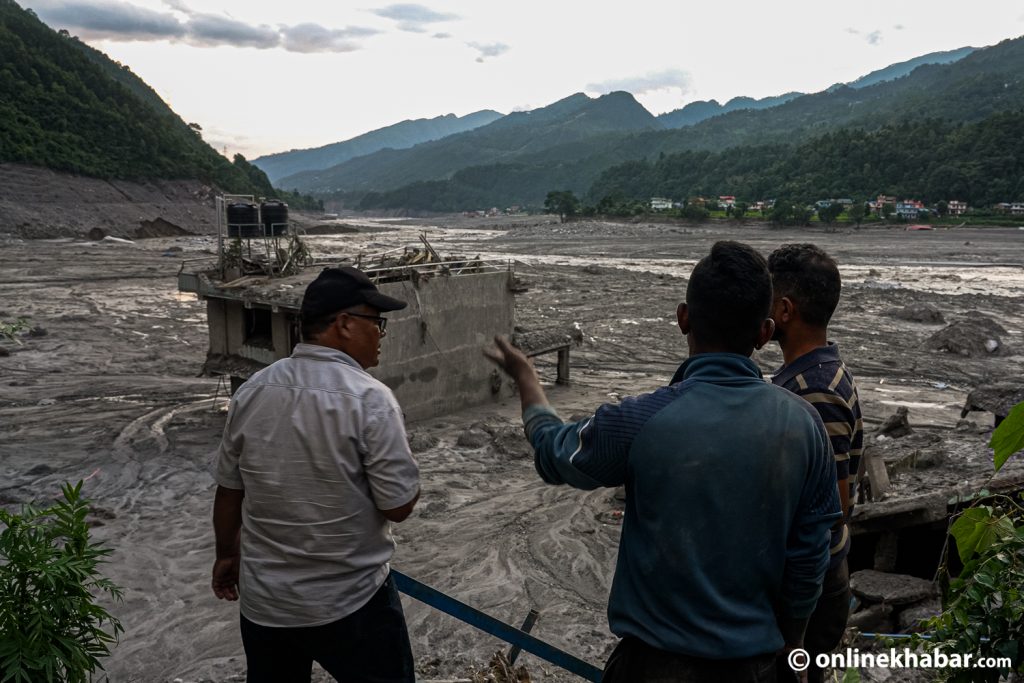
The hardest question facing Kathmandu is not how to rebuild but whether to rebuild in the same valleys. Nepal’s development model routes national income through high-head hydropower in steep, glaciated, seismically active terrain, precisely the terrain that thawing permafrost is destabilising. Building for that risk is affordable: engineers estimate resilient design, through underground powerhouses, redundancy and evacuation protocols, adds 10 to 12 percent to construction cost. That is cheap insurance against losing a plant outright, and it was not bought.
Some answers are visible. Multi-hazard assessment should precede licensing rather than follow it, after years of what one environmental economist called haphazard permissions issued without accounting for glacial hazards. Shree Raj Shakya of Tribhuvan University argues the export-first strategy needs rethinking in favour of domestic supply. And diversification is now a resilience argument as much as an economic one: solar supplies under 3 percent of Nepal’s electricity but could reach 20 percent as costs fall, dispersed across the country rather than concentrated in a few vulnerable gorges.
None of this is free, which returns the argument to where it started. Nepal will pay for warning systems it should not have to fund alone, resilient turbines it can barely afford, and reconstruction loans denominated in the currency of a country that emits a hundred times more carbon per head. The question the Belem timetable leaves open is not whether the polluters can pay. It is whether they intend to before the ice moves again.