
Kathmandu, September 7
Rocky and Jumbo have had a difficult few days.
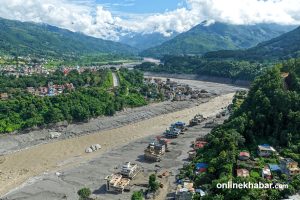
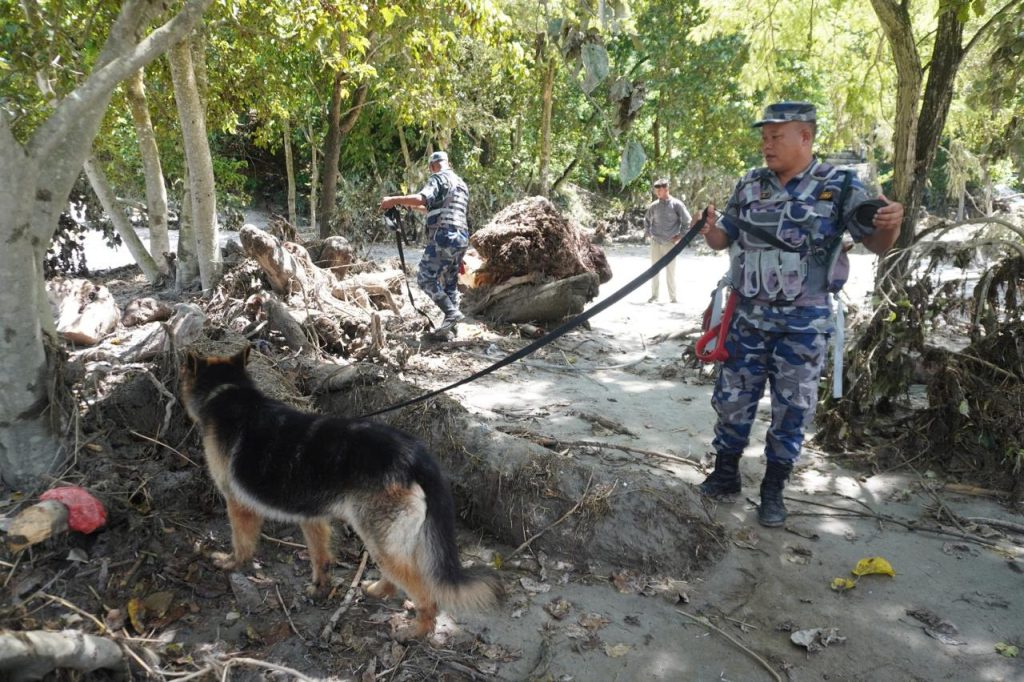
The two Nepal Police canines have been working alongside their handlers in Timure and Ghattikhola in Rasuwa, areas badly damaged by the Bhotekoshi flood that struck on August 26.
Rocky, a Belgian Shepherd, and Jumbo, a German Shepherd, were deployed with Assistant Sub-Inspector Krishna Sen and Senior Head Constable Narayan Prasad Devkota on the very day the flood hit.
Since then, they have been searching through the damaged areas, following scents that can lead rescuers to places they cannot easily see or reach.
Their work has helped locate two bodies and a body part.
“The canines were fully equipped and deployed on the very day the flood came. They have proved to be very effective,” said Deputy Inspector General Abinarayan Kafle, central spokesperson for Nepal Police.
Rocky and Jumbo are trained in search and rescue and were brought in from the Nepal Police Canine Office in Kathmandu. But they are not the only police dogs working through the aftermath of the flood.
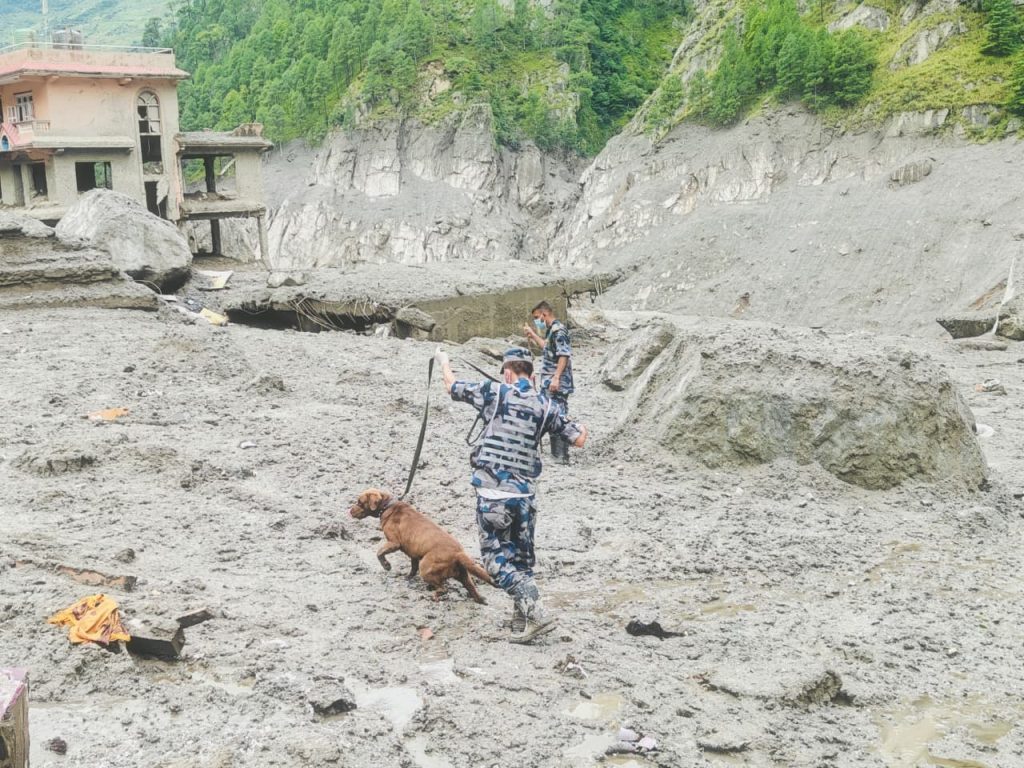
Three days after the disaster, on August 29, another team travelled from Kathmandu with two Labradors, Leo and Kalu.
Five handlers—Sub-Inspector Sudeep Thapa Magar, Head Constable Kishunlal Chaudhary, Head Constable Rishibahadur Thapa, Constable Sachin GC and Constable Sajindra Tamang—were deployed with them.
Leo and Kalu have been working across a wide stretch of the affected area, from Bidur, Archale and Shantibazar to Mailung Hydropower, Dhunge, Devighat, Betrawati, Bhainse and Battar.
At the employee quarters of Mailung Hydropower-3B, they helped locate a small body part. At Battar Solar House, they found part of a palm, according to police officials.
On the same day, another canine team was sent out by the Canine Branch of the Bagmati Province Police Office.
Deepsi, a German Shepherd, was deployed with four handlers—Assistant Sub-Inspector Ramesh Bahadur Singh, Senior Head Constable Anoj Adhikari, Head Constable Lok Bahadur Thapa and Assistant Head Constable Sagar Sinjali.
The team, operating from Chitwan, searched around the Narayani Bridge, Devghat and as far as Damouli Golaghat.
Deepsi helped locate two bodies at Damouli Golaghat, according to records at Nepal Police headquarters.
Together, five Nepal Police canines and 10 handlers have been deployed in the search and rescue operation following the Rasuwa flood.
The dogs work differently from the people searching beside them.
They are trained to locate bodies through smell. When a dog detects something, it signals its handler, who then decides how to proceed with the search.
That can make a difference in the kind of terrain left behind by a flood—places where debris is unstable, openings are too small for a person to enter, or something is buried beneath the surface.
The dogs can squeeze through small openings and use their powerful sense of smell to indicate whether someone is present.
Their signals have led rescuers to buried bodies.
The Armed Police Force has also deployed its own canine teams across the affected areas.
According to APF spokesperson Deputy Inspector General Netra Bahadur Karki, seven APF canines are working in the flood-affected areas: one each in Timure, Devighat, Betrawati, Trishuli Bazaar and Dhading, and two in Chitwan.
Fourteen handlers have been deployed with them.
The APF says its canines have helped locate and recover 19 buried bodies. Excavation teams found the bodies at locations indicated by the dogs.
Taken together, the canines of Nepal Police and the Armed Police Force have helped locate 26 bodies and body parts.
For the dogs, the work comes with its own limits. After working for a certain period, they have to be given time to rest before they can continue searching.
The handlers watch them closely, following their movements and acting on their signals.
It is work Nepal’s security forces have relied on before.
Police have used canines in search-and-rescue operations on numerous occasions, including after the 2015 earthquake.
The Nepal Army’s canines have not been deployed in the current operation. According to Army spokesperson Brigadier General Rajaram Basnet, they have not been deployed in coordination with Nepal Police and the APF, although they remain on standby.
The search has also brought dogs from outside Nepal. A South Korean rescue team arrived with five canines and is working in the affected areas. Foreign rescue teams also brought canines to Nepal during the earthquake.
Nepal’s security forces have been training and using canines for decades.
The Nepal Army has maintained canines under a dedicated establishment since 1999, using them in search and rescue as well as for detecting explosives. The Armed Police Force has maintained canines since 2006 and has an establishment for 30 dogs, including those used for patrols at border points.
Nepal Police began keeping canines in 1970 after bringing two trained dogs from Malaysia. Since then, police dogs have been used in investigations, search and rescue, and the detection of explosives and drugs.
Some Nepali canines have also travelled abroad, serving in United Nations missions in conflict-affected countries.
But for Rocky, Jumbo, Leo, Kalu and Deepsi, the assignment at the moment is much closer to home.
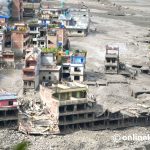
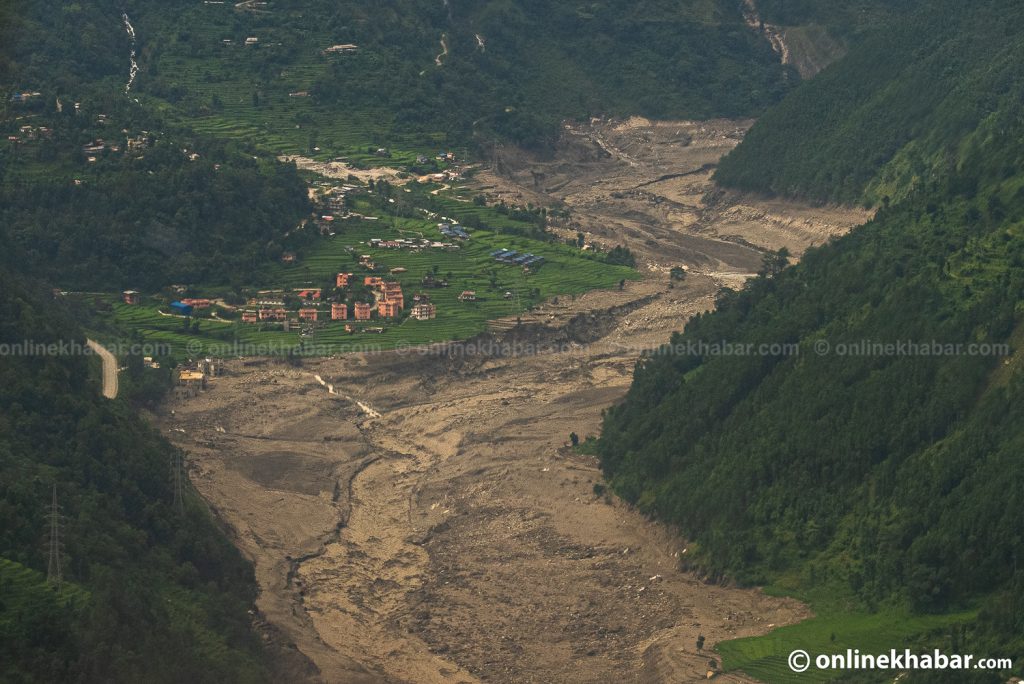
The flood has left large parts of Rasuwa and surrounding areas buried beneath debris, and rescuers are still searching.
The dogs move through the rubble with their handlers close behind.
They stop, sniff and move on.
And when one of them finally gives a signal, the search team knows where to look.