

Kathmandu, September 7
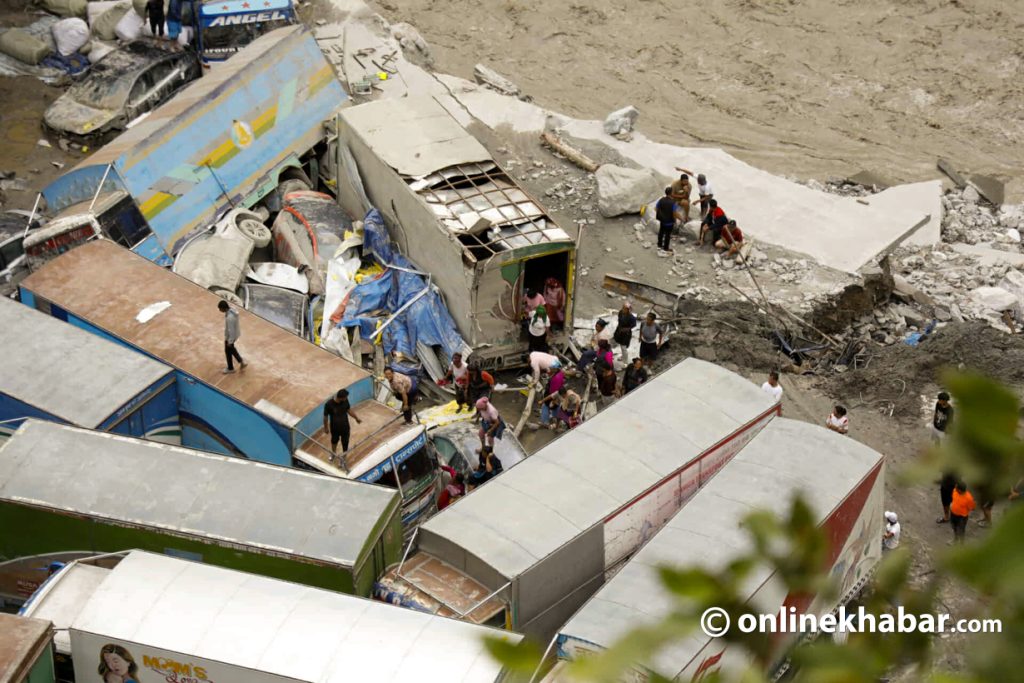
The devastating flood that swept through Rasuwa and Nuwakot on August 26 has struck one of Nepal’s most economically active river corridors, leaving damage that could reverberate across the country’s energy supply, tourism industry, foreign trade and government finances.
A preliminary Rapid Damage and Needs Assessment (RDNA) report has identified damage to 13 hydropower projects with a combined capacity of 783 megawatts.
A solar plant and two transmission lines have also been damaged, according to government data.
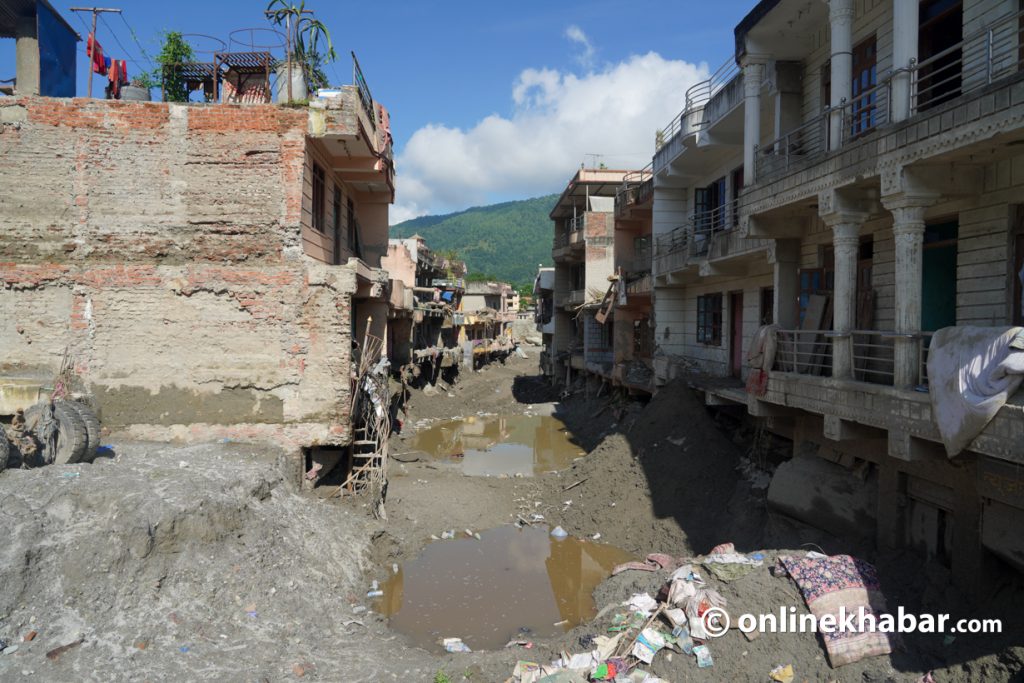
The physical destruction extends far beyond the energy sector. The flood has completely destroyed 7,570 private houses, directly affecting 32,933 people living in those households.
It has damaged 48 government structures, 35 of which have been completely destroyed. Eighteen schools have been damaged, including 11 that were completely swept away. Seven health facilities have also been affected, four of them completely destroyed.
The flood washed away around 55 kilometres of roads and 37 motorable bridges, while 68 suspension bridges were damaged. Fifty-five drinking water projects have suffered losses estimated at Rs 640 million.
Agriculture has also taken a major hit. Around 1,806 hectares of farmland have been completely destroyed, with an estimated reduction of 7,686 tonnes in food production.
Seventeen bank branches have also been damaged.
A blow to three pillars of the economy
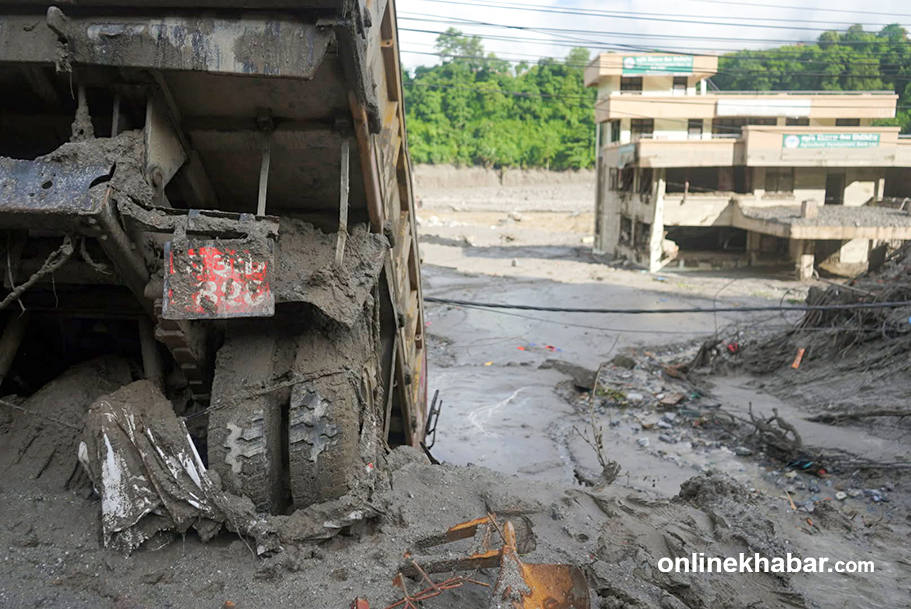
The scale of the destruction has led concerns to move beyond immediate rescue and relief.
Rasuwa lawmaker and businessman Mohan Acharya says the flood has devastated three important pillars of the national economy—hydropower, tourism and the Rasuwagadhi trade route.
“Not just Rasuwa, but the country’s major economic foundations—hydropower, tourism and the border trade route—have been devastated,” Acharya said while presenting details of the flood damage at a Nepali Congress meeting on Sunday.
He said many economically active young people remain missing and entire villages have been emptied.
The human loss, he said, could prove to be the most consequential part of the disaster.
Acharya compared the impact with the 2015 earthquake, saying the two disasters caused fundamentally different forms of destruction.
“The earthquake damaged houses but did not destroy people’s land. This flood has left large numbers of people homeless all at once,” he said.
Many young people who had taken bank loans to start businesses have been affected, while in some villages mainly children have been left behind, he said. This could create a heavy economic burden for children at an early age and produce long-term psychosocial consequences.
Tourism faces a long road to recovery

Tourism has suffered another major blow. The Ministry of Culture, Tourism and Civil Aviation estimates that the flood has caused around Rs 50 billion in damage to the tourism sector alone.
Around 142 hotels along the river corridor are estimated to have been swept away, while 57 restaurants and 141 tourism vehicles have been damaged.
Twenty-seven cultural heritage sites have also suffered damage.
The trekking routes to destinations such as Langtang and Gosainkunda have been severely damaged. Some sections have been completely washed away and will have to be rebuilt from the beginning.
According to former Nepal Tourism Board CEO Deepak Raj Joshi, the damage could have consequences beyond the businesses and infrastructure directly hit by the flood.
The Langtang region attracts more than 50,000 tourists annually, according to Langtang National Park data. Gosainkunda also draws large numbers of religious visitors every year.
The corridor has another important tourism connection: the Kailash Mansarovar pilgrimage route.
Joshi said the monsoon season, generally considered an off-season for Nepal, attracts relatively high-spending Indian and non-resident Indian visitors travelling to Kailash Mansarovar through Nepal.
“These are all high-spending tourists,” he said, adding that their contribution to employment and economic activity through Nepal’s tourism industry is significant.
Tourism has also lost business owners, guides and workers in the disaster.
“The loss of human lives has no price,” Joshi said. “On top of that, business owners and workers have been caught in this flood. They made an invaluable contribution to tourism.”
Tourism companies have reported deaths among tour guides, trekking guides and other workers.
Rebuilding the infrastructure may therefore be only one part of the challenge. Rebuilding the workforce and businesses that supported the tourism economy could take considerably longer.
Rasuwagadhi trade route disrupted
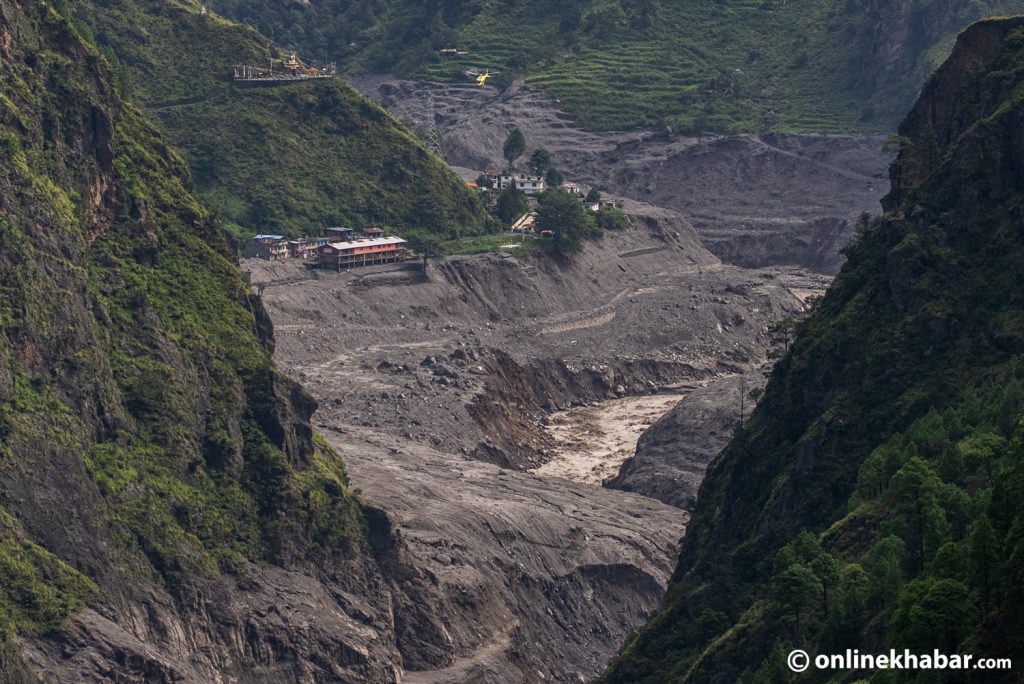
The flood has also disrupted Nepal’s trade with China after the structures and roads around the Rasuwagadhi border point were swept away.
The disruption has forced some trade to be diverted towards the geographically more difficult Korala border point, increasing transportation costs and creating concerns over prices inside Nepal.
In the last fiscal year, 2082/83, imports through Rasuwagadhi accounted for 2.18 percent of Nepal’s total foreign trade, according to government data.
Although the border point operated for only six months during the year, goods worth Rs 45.73 billion were imported through Rasuwagadhi, while exports amounted to Rs 894.6 million.
Its importance was even greater in fiscal year 2081/82, when imports through Rasuwagadhi amounted to Rs 85.23 billion and exports to Rs 2.04 billion. That represented 4.72 percent of Nepal’s total merchandise imports and 0.74 percent of exports.
From earthquake disruption to flood destruction
Rasuwagadhi has become Nepal’s most important operational land route for trade with China after prolonged disruptions at the Tatopani border.
According to Customs Department Director and Information Officer Kishor Bartaula, Rasuwagadhi has been the most reliable trade point between Nepal and China.
The border point lies around 132 kilometres from Kathmandu via Galchhi, with approximately 40 kilometres of the road on the Rasuwa side estimated to have been completely washed away.
The Department of Roads has begun assessing the condition of different sections.
More than two dozen bridges between the Friendship Bridge and Galchhi have also been swept away, raising uncertainty over the future operation of the customs and immigration points at Rasuwagadhi.
“The government will study all aspects and make a decision. The department will work accordingly,” Bartaula said.
Rasuwagadhi has served as an important trade and cultural route between Nepal and Tibet since ancient times. The Rasuwa Customs Office was established there in 2013 BS to facilitate trade and revenue collection.
China formally recognised Rasuwagadhi as an international border point in 2018, further increasing its importance.
Nepal imports electronic goods, ready-made garments, footwear, construction materials, agricultural products, telecommunications equipment, vehicles and industrial machinery through the route. Nepal exports carpets, handicrafts, woollen products, herbs, noodles, copper utensils and agricultural goods to China.
The border trade also supports thousands of jobs through hotels, transport operators, container loading and unloading services, customs agents and small businesses.
Billions invested in infrastructure swept away
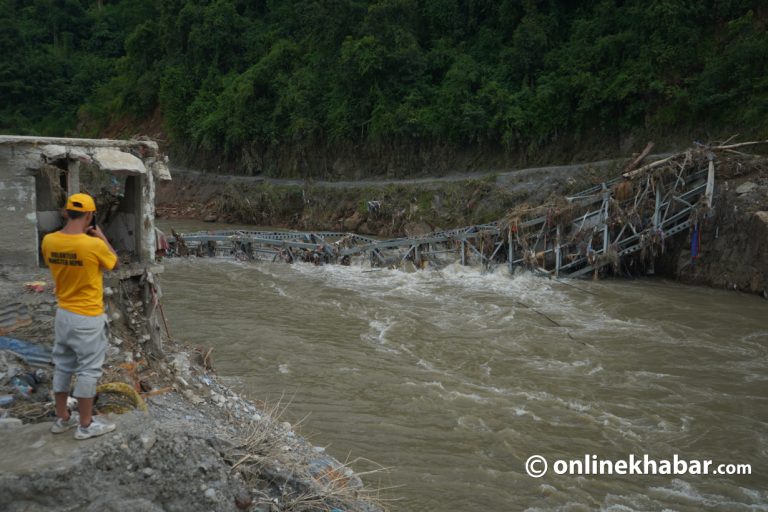
The destruction at Rasuwagadhi comes after years of investment.
The Timure Dry Port was a project worth around Rs 3 billion, according to Ashish Gajurel, chair of the parliamentary Development Committee and former executive director of the Intermodal Transport Development Board.
Around Rs 2 billion had already been spent and most of the structures had been completed. The project was reportedly nearing its finishing stage.
The previous year’s flood had already caused substantial damage to the project, limiting further investment.
This time, however, many of the remaining structures have been completely destroyed.
The state has lost infrastructure and employees, while the extent of damage suffered by private businesses remains to be fully assessed.
The historic border and customs point now faces the daunting task of rebuilding almost from scratch.
Pressure on government budget and economic growth
The economic consequences could extend well beyond the affected districts.
Former National Planning Commission vice-chairman Dr Prakash Kumar Shrestha says the disaster could affect the government’s policies and programmes, the fiscal year 2083/84 budget, the Medium-Term Expenditure Framework and the targets of the 16th periodic plan.
The government will face greater pressure on its resources and may have to divert capital expenditure towards rescue, relief and reconstruction.
That, in turn, could make it difficult to achieve the government’s economic growth target.
The disruption to road infrastructure has already affected supply chains, potentially increasing pressure on prices.
“Disruption in an economically active corridor will also make it difficult for the government to meet its revenue targets,” Shrestha said.
As reconstruction becomes a priority, other government plans and development priorities could also be pushed back.
When taxpayers become aid recipients
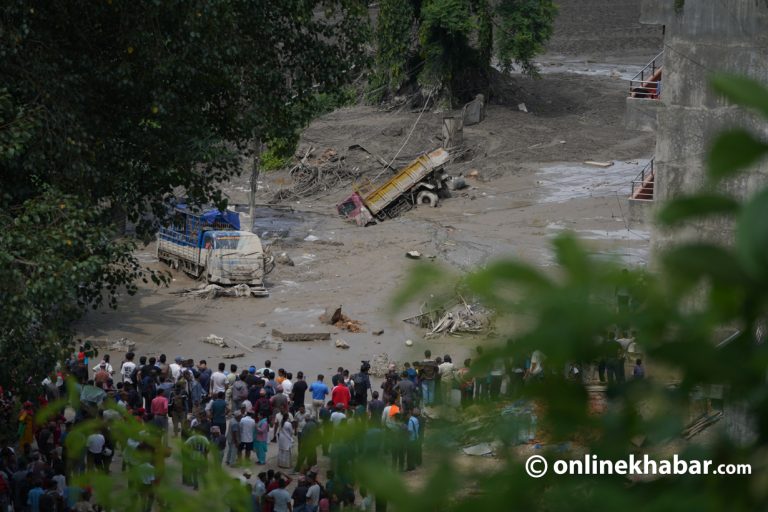
Another less visible consequence is the sudden economic decline of people who were previously financially secure.
The flood has destroyed urban settlements and businesses along the Bhotekoshi-Trishuli corridor, pushing many people who once earned incomes, ran businesses and paid substantial taxes into dependence on others.
“People who were paying millions of rupees in taxes to the state yesterday have today been forced to depend on others,” Shrestha said. “This naturally deals a blow to our poverty reduction efforts.”
He said Nepal should now link its social protection system more closely with disaster management and urgently work to return families who have lost their homes to safe housing.
Loss of skilled workforce
The long-term impact could also be felt in Nepal’s labour market.
The disaster has taken a heavy toll on skilled workers in hydropower projects, while business owners and workers involved in border trade and tourism have also been affected.
Shrestha said the loss of skilled workers could affect the country’s labour supply for years.
Replacing experienced hydropower technicians, tourism workers, guides, traders and other specialised workers will take time.
Rebuild stronger, not simply faster
Former National Planning Commission vice-chairman Prof Dr Gobinda Raj Pokharel says the devastated corridor is one of Nepal’s most economically active areas, with hydropower, trade, tourism and agriculture all concentrated along it.
He argues that the government must move quickly towards a strong and safer reconstruction programme rather than simply restoring infrastructure to its previous condition.
The government should install early warning systems along river corridors and require disaster audits before major infrastructure projects are built, Pokharel said.
Such requirements should apply to hydropower projects, roads, bridges and other major infrastructure.
The flood has therefore exposed a challenge much larger than the repair of damaged roads and bridges.
For Nepal, the question is now whether this corridor will simply be rebuilt—or rebuilt in a way that makes its economy, communities and infrastructure more resilient to the next disaster.