

On August 26, catastrophic debris flows swept down the Bhotekoshi and Trishuli river corridors, exposing severe vulnerabilities in Himalayan hydropower infrastructure.
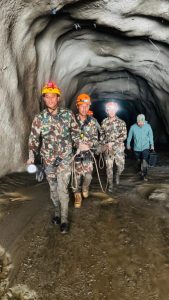
Several projects remain inundated, with workers still missing or trapped deep inside underground headrace tunnels and powerhouses.
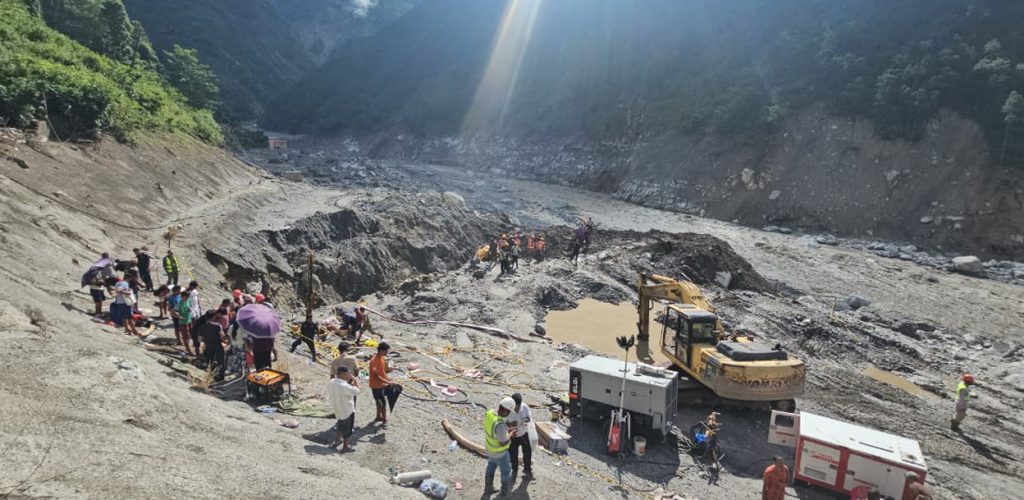
Public frustration has understandably focused on how long rescue is taking—whether enough equipment is available, whether the right technology is being used, and whether machinery can reach the sites.
But there is another problem that deserves attention: the behaviour of the sediment itself.
The assumption that mud will eventually drain or dry enough to allow extraction does not necessarily hold inside a confined, flooded tunnel. The mechanics of saturated soil, hydraulic conditions and the interaction between trapped sediment and concrete tunnel linings can make extraction far more difficult.
Understanding this is important not only for the current rescue effort but also for how Nepal designs hydropower infrastructure in the future.
When a tunnel becomes a trap
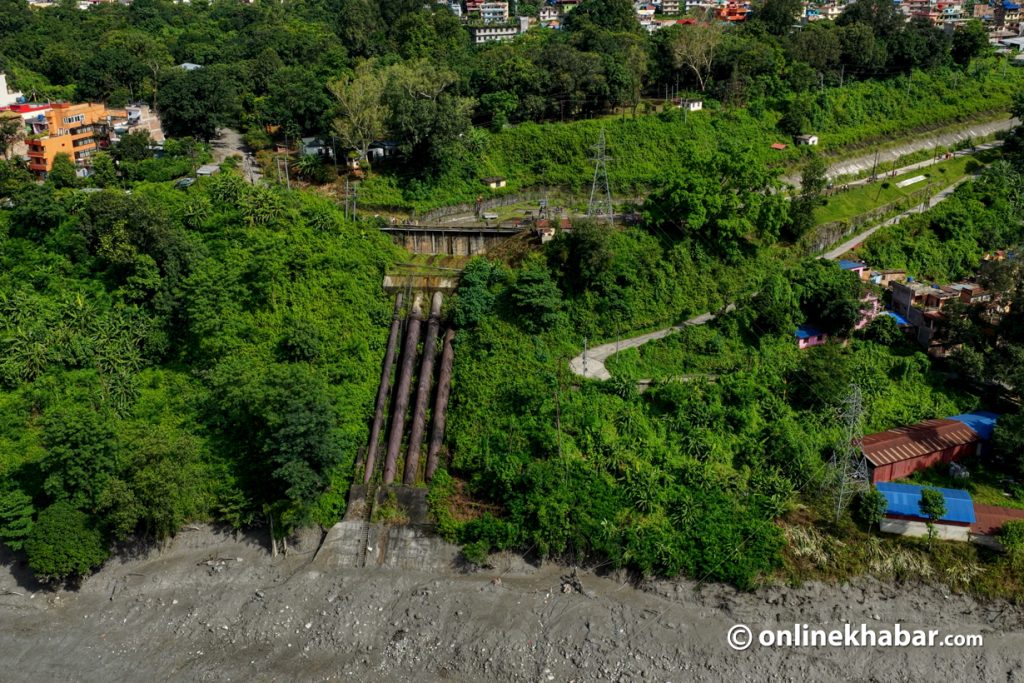
Most Himalayan run-of-river projects have surface headworks, desilting basins, underground headrace tunnels and underground powerhouses. Putting critical infrastructure underground protects it from many surface hazards, but the same arrangement can become a serious liability during a major debris flow.
Underground structures behave differently from surface buildings. They are governed largely by the deformation imposed by surrounding rock and by the interaction between the tunnel and the ground around it.
During a major debris flow, however, surface intake portals and access adits can become entry points for enormous volumes of water, sediment and rock. A hyper-concentrated debris flow entering these openings can damage gates, scour tunnel floors and carry sediment deep into electromechanical areas.
Once the material enters an underground facility, access becomes difficult and drainage can become the biggest problem.
Tunnels and underground powerhouses are generally designed around the stresses of surrounding rock, internal water pressure and normal operating conditions. They are not normally designed to withstand the combination of massive sediment loads, debris impact and the confinement created when a debris flow fills the underground geometry.
The result can be an underground facility that is extremely difficult to enter, drain or clear.
Why waiting for mud to dry is not a solution

Trapped sediment inside a flooded tunnel is governed by saturated soil mechanics. It does not simply behave like wet soil left outside in the sun.
A mass of glacial till or alluvium can effectively seal a tunnel. Ventilation may be lost, while trapped air quickly reaches maximum relative humidity, severely limiting evaporation. Without an open drainage path and sufficient hydraulic gradient, pore water cannot escape easily.
The sediment therefore remains saturated and can behave more like a highly viscous, non-Newtonian fluid than ordinary soil.
In such conditions, waiting for the material to dry naturally could take months. For workers trapped underground, that is obviously not a viable rescue strategy.
Mechanical intervention is therefore essential.
This is not simply a pumping problem
Standard dewatering pumps are designed primarily for clear water. They are poorly suited to dense sediment containing gravel and abrasive quartz-rich silts. Such material can rapidly damage impellers and mechanical seals.
The equipment required is closer to what is used in deep mining and dredging operations. Submersible slurry pumps fitted with rotating agitators can break up dense sediment at the intake, reducing its apparent viscosity and allowing it to be moved as a fluid.
The sequence matters.
Heavy loaders cannot simply drive into fluid mud because they cannot gain traction. Slurry pumps may first need to remove the finer, mobile material. Once the level falls, loaders or other machinery can begin removing larger boulders that exceed pump clearances. High-pressure hydro-vacuum equipment may then be needed to break up compacted zones.
Conventional excavators can also create problems in the early stages. Cutting a trench through weak, saturated sediment may simply cause surrounding material to collapse back into it because gravity exceeds the mud’s low yield strength.
Pumping too fast can also be dangerous
There is another complication. The problem is not only finding extraction equipment; it is getting heavy equipment into steep mountain terrain where roads may have already been destroyed.
Even after machinery reaches the tunnel portal, extraction cannot necessarily proceed at maximum pumping capacity.
If the initial debris flow has damaged the concrete lining or scoured the tunnel invert, the dense mud inside may be providing temporary radial confinement to the surrounding rock mass. Removing that material rapidly can cause a sudden drop in internal hydrostatic and lateral earth pressures.
The surrounding rock cannot necessarily drain or adjust immediately. A severe inward hydraulic gradient can develop, potentially leading to hydraulic heave at the invert, inward buckling of tunnel walls or roof collapse.
Rescue teams may therefore have to advance incrementally, balancing pumping rates with pore-pressure dissipation, managing continuing water ingress and installing temporary support before moving deeper into the tunnel.
This is a geotechnical problem as much as a rescue operation.
How did the disaster become so destructive?
The disaster itself also shows why conventional hazard assumptions are no longer enough.
The event originated with a massive ice-rock collapse on the northern slopes of Langtang Lirung at nearly 5,200 metres. The trigger was thermal degradation of high-altitude permafrost rather than a tectonic earthquake.
In steep alpine terrain, ice can act as structural cement within rock fractures. Warming and meltwater infiltration can increase fluid pressures along structural planes, reducing the frictional resistance holding fractured rock together. As ice melts, the cohesive bond between rock blocks is also weakened.
Once gravitational forces exceed that degraded resistance, the rock face can fail.
But the scale of downstream destruction is determined not only by the initial collapse. As the avalanche accelerated down the steep gorge of the Lhende River, it scoured the channel and incorporated saturated moraine, alluvial deposits and river water.
Field investigations of recent cascading Himalayan hazards by the Chinese Academy of Sciences have shown that such entrainment can multiply the initial landslide volume by orders of magnitude.
The moving mass can therefore transform from a solid avalanche into a hyper-concentrated fluid-solid mixture.
This kind of non-linear volumetric bulking is often poorly represented in conventional hazard models. As a result, underground intake portals and surge chambers designed mainly around normal hydrostatic water pressures may be poorly prepared for the dynamic loads produced by a massive debris slurry.
What Nepal must change
The lesson is not that underground hydropower is inherently unsafe. It is that future Himalayan infrastructure must be designed around cascading geological hazards rather than isolated load cases.
Major projects should require dynamic debris-hazard assessments and incorporate redundant access corridors, independent ventilation routes and dedicated evacuation provisions as part of a multi-hazard strategy.
Surface portals and access adits should not be treated simply as entry points. In high-risk locations, they may need to function as defensive structures capable of routing, deflecting or withstanding major debris impacts.
The change must also extend to rescue preparedness.
The geomechanical challenges of clearing confined, flooded tunnels can exceed the capabilities of conventional civil defence agencies. Safe recovery requires pre-established access to international mining expertise and specialised equipment capable of mobilising viscoplastic mud under difficult underground conditions.
Nepal cannot wait until the next disaster to build those connections.
The immediate priority is, of course, the people still trapped or missing. Rescue teams are advancing carefully through compromised underground spaces, where even a seemingly simple operation can trigger a secondary collapse.
But once the immediate crisis passes, regulators and hydropower developers must confront what this disaster has exposed.
Nepal’s engineering codes have traditionally placed strong emphasis on seismic hazards and clear-water hydrostatic conditions based on relatively localised hazard assessments. The failures now unfolding in the Himalayan environment show the need to account for cascading multi-hazard events, including extreme volumetric bulking caused by debris entrainment.
Hydropower infrastructure must be designed not only to operate safely under normal conditions, but also to remain accessible, recoverable and safe when the mountains behave beyond conventional assumptions.
Hydropower tunnels must be designed as safe workspaces, never again allowed to become sealed traps during a surface disaster.