
A photograph published by a national daily shows a student at Bageshwari Secondary School in Baireni, Dhading, searching through a mud-caked schoolbag. It was taken on August 31, five days after the Bhotekoshi flood, with dozens of other bags abandoned nearby. The caption says no more, and I will not invent more.
Yet every teacher knows what a schoolbag holds: a worn textbook, a half-finished exercise, a tiffin box, and the quiet certainty that tomorrow’s lesson will happen. My own hometown in Dhading lies close to the Trishuli; hence these are not distant rivers to me. As Dashain unfolds, two floods ask a harder question of Nepal: are we teaching our children to be ready before the river arrives?
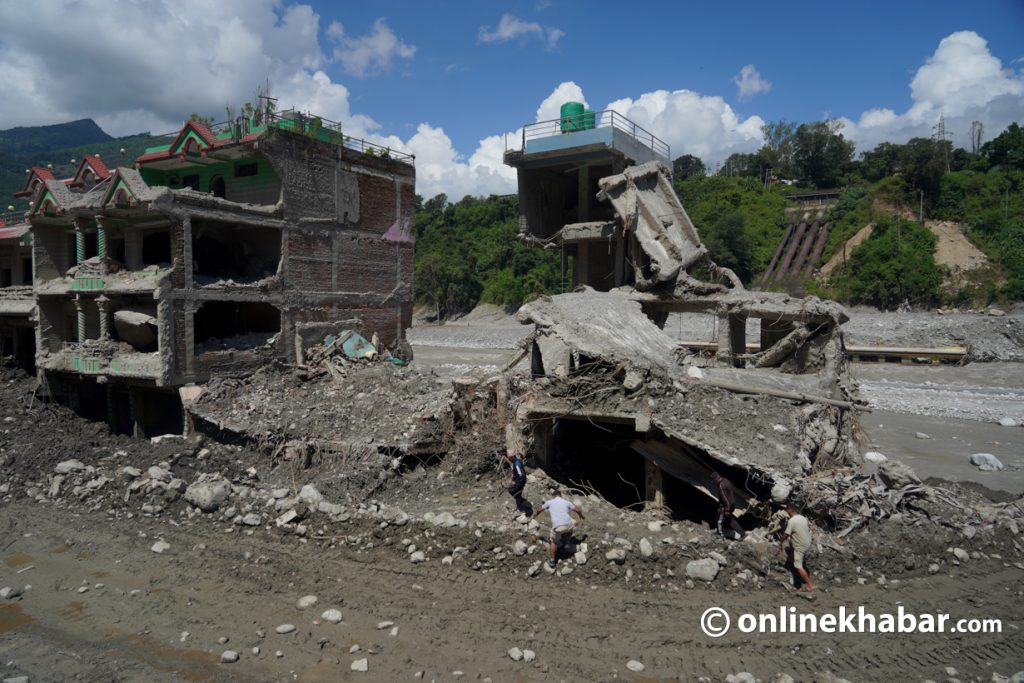
At 8:37am on August 26, a glacier collapsed near Langtang Lirung on the Nepal–Tibet border. The flood that followed tore down the Bhotekoshi and Trishuli valleys. By 18 September, the authorities had recovered 1,409 bodies, with 4,089 people still missing.
Less than seven weeks later, on Ghatasthapana, the first day of Dashain, a flash flood on the Budhigandaki in Gorkha swept away an estimated 35 to 40 houses and several bridges. It is suspected to have followed the breach of a landslide-dammed river. Five people were reported missing. Assessments continue, and these numbers will move.
Thus, Dashain, a festival of tika, jamara and reunited families, arrives with places missing at many tables. On 6 October, a minister told a parliamentary committee that officials hoped to resettle Rasuwa’s flood-affected families, ideally before the festival. Relief, understandably, keeps to the calendar. Learning needs a longer clock. The two floods differ in scale and cause, yet they pose one question: when the water recedes, what does Nepal actually learn?
What the flood took from schools
On schooling, the Bhotekoshi floods give a sobering answer. A government assessment found that more than 14,500 children at 63 institutions in Rasuwa, Nuwakot and Dhading had their learning disrupted. Of these, 9,430 were directly affected, having lost parents, homes or schools. Worse, 28 of the 29-temporary holding centres were in school buildings, so classes could not resume even where classrooms survived.
At Nepal Rastriya Basic School in Timure, 25 of 35 students and six of 11 teachers were unaccounted for. Radio Nepal reported that schools in four rural municipalities of Rasuwa closed completely before alternative arrangements restarted classes. Nor was the damage evenly spread. Three suspension footbridges to Shankhadevi Secondary School were swept away, and children in Timure, Syabrubesi and Betrawati could not reach school at all. Learning is seldom lost in a single stroke. It leaks away through a missing bridge, a crowded shelter or a lost parent, and children in remote settlements, with the fewest alternatives, are likely to wait longest.
Thirty-eight minutes
Then there is time. The flood swept away the Syabrubesi river gauge at 8:50am, and text alerts reached four districts at 9:15, 38 minutes after the collapse and 25 minutes after the gauge was lost. Experts quoted by the Post were blunt: sensors are not a warning system without risk assessment, communication and preparedness. Call it the preparedness gap, the distance between a sensor’s reading and a child’s reflex. Thirty-eight minutes is an eternity to a flash flood.
When neighbours were the alarm
The Budhigandaki widened the lens. According to the Post, residents began phoning one another at about 4:45am, and a Jagatbagar resident was livestreaming an appeal by 4:52am. The first official warning came from a police post at 5:30am, and mass SMS alerts followed at 6:40am. Residents said everyone in Chumnubri escaped. No machine told them. The nearest automated sensor sits at Arughat Bazar, roughly 65 kilometres downstream, as the forecasting division acknowledged. Neighbours did the work of an early-warning system.
One principal’s bell
Not every school was helpless. At Tribhuvan Trishuli Secondary School in Nuwakot, the Associated Press reported, principal Rajendra Dawadi acted on a warning that was not yet confirmed. He rang the school bell, sent students and staff uphill and redirected the buses. The three-storey building was swept away soon afterwards, and at least 900 students were saved. That is admirable, but a nation cannot rest its children’s safety on one principal’s instinct. Benjamin Franklin’s old maxim, that an ounce of prevention is worth a pound of cure, deserves a seat in our classrooms. Preparedness is like the jamara sown on Ghatasthapana: planted early, tended daily, never forced to sprout in a night.
Children in river settlements can learn their own hazard map, the signs of a landslide dam, the uphill route, whom to call, and how to tell a verified alert from a rumour, rehearsed until it becomes reflex. Elders who remember earlier floods belong in that classroom, because a village’s memory is a data set no sensor can replace. Schools cannot substitute for sirens, sensors or accountable institutions, though. They are one link in a chain that must hold at every point.
Five proposals
None of the following is, to my knowledge, an existing commitment. First, schools in hazard-prone valleys should teach a short, locally written risk curriculum, with hazard maps, safe routes and at least one drill a year, prepared with local disaster management committees and elders. Second, teachers need training to lead drills, counter rumours and offer psychosocial support, and some 216 teachers and school staff were themselves affected by the Bhotekoshi floods.
Third, warnings must be multilingual, place-specific and audible to people without smartphones, by siren and voice as well as text. Fourth, continuity must be planned before the crisis. That means designating shelters other than schools, keeping temporary learning spaces and hostels ready, and directing support first to children cut off by broken bridges. The Dashain break is the moment to begin: while classrooms are quiet, local governments can map which school buildings still shelter displaced families, so that reopening does not mean a second displacement. Fifth, every disaster should be followed by a published, independent review. A river-policy campaigner quoted by the Post argued that without such reviews, the lessons are lost.
Who owns what
Above all, this demands coordination with clear ownership, because every task needs a named owner. Local governments can hold the maps and the shelters; the education ministry and the disaster authority can set the standards. Universities can train teachers and test what works. Media can explain alerts plainly in local languages.
The Comprehensive School Safety Framework 2022–2030, developed by the Global Alliance for Disaster Risk Reduction and Resilience in the Education Sector, offers a template. In Dhading, a child searched through a mud-caked schoolbag. On Bijaya Dashami, 21 October, elders across Nepal will press tika on young foreheads and wish them long lives.
Let us add what a blessing cannot supply: a school that knows the way uphill, a village that hears the alarm in time, and a child who knows what to do when the phone rings at 4:45 in the morning. Rivers will rise again; no policy can promise otherwise. Mourning is not the lesson but the preparation is.