

Kathmandu, October 7
Every cricketing nation has its own set of dreams. After entering international cricket, the first goal is to establish an identity, followed by playing regularly in international competitions, defeating bigger teams and gradually reaching the biggest stage in world cricket.
These dreams are no different for Nepal. Since entering international cricket, Nepal has passed through several stages. Having established its own identity as an Associate nation, Nepal has now reached a level where it competes against Test-playing nations. But one dream remains unfulfilled—the ODI World Cup.
Nepal have yet to play in a men’s ODI World Cup. The country has already appeared three times on the biggest stage in T20 cricket. But reaching the 50-over World Cup has become an even longer wait for Nepali cricket.
Playing in a World Cup is not simply about participating in a tournament. It is the result of years of hard work, infrastructure development, player production, domestic cricket and international performances.
Nepal has also demonstrated its growing stature in international cricket in recent years. From playing against teams such as India and Pakistan in the Asia Cup to appearing in the T20 World Cup, Nepal has strengthened its presence on the world cricket map.
But the door to the ODI World Cup remains closed. Nepal has come close several times in the World Cup qualification process. It has played the ODI World Cup Qualifier three times—in 2014, 2018 and 2023—but has failed to progress to the World Cup.
This leaves one question hanging: How much longer will Nepal have to wait to play in an ODI World Cup?
Retaining ODI status is the first challenge
While Nepal continues to dream of reaching the World Cup, another important challenge at present is retaining its ODI status. Nepal is currently struggling to maintain that status, making the World Cup an even more distant prospect for now.
For an Associate nation, ODI status itself is a significant achievement. But maintaining it requires consistent international performances.
Nepal’s ODI performances have fluctuated in recent years. The team has produced impressive victories at times but has also delivered performances below expectations, preventing it from achieving consistency. Its ODI victories have often been isolated successes rather than part of sustained progress.
If Nepal wants to play in the World Cup, winning a few big matches will not be enough. It needs to become a team capable of performing consistently over a long period. Therefore, the immediate priority is not only the dream of reaching the World Cup but also establishing a permanent place in ODI cricket.
For this, Nepal needs to focus not only on T20Is but also on ODI cricket. Former Nepal captain Pawan Agrawal shares this view.
“There is no alternative to improving the domestic structure if we want to play in the 50-over World Cup. Because players play so much T20 cricket, they struggle to cope with the demands of the longer format,” Agrawal said. “Our development starts more with T20 cricket, which is why playing 50-over cricket has become difficult.”
Nepal have also struggled to perform consistently in overseas conditions. To play in a 50-over World Cup, the team needs to perform well not only at home but also in different conditions abroad.
“Wickets abroad are somewhat challenging. Nepal has also become accustomed to playing on relatively flat pitches, so the team has struggled to bat well on wickets overseas,” said another former captain, Raju Khadka.
As a result, Nepal has performed well at home in ODI series under the World Cup League 2 but has struggled overseas. This has had a direct impact on the points table and made the World Cup route more difficult.
Recent performances have already demonstrated that Nepal has talent. The question now is not simply about talent but about developing a structure capable of sustaining that talent at the international level.
A harder road for Associate nations
The reasons behind Nepal’s failure to reach the World Cup cannot be sought only within Nepal. The structure of Associate cricket itself presents significant challenges.
Fewer teams participate in the ODI World Cup than in the T20 World Cup. Ten teams played in the 2023 ODI World Cup, while the 2019 edition also featured only 10 teams. Fourteen teams participated in the 2015 and 2011 editions.
The number of participating teams was reduced from 2019, making it even more difficult for Associate nations to reach the ODI World Cup.
Fourteen teams are set to participate in the 2027 World Cup, but the main competition will effectively involve 12 teams. Hosts South Africa and Zimbabwe will qualify automatically, while India, Australia, New Zealand, England, Pakistan, Sri Lanka, Afghanistan and Bangladesh will also qualify directly based on rankings.
The remaining teams will be decided through the World Cup Qualifier. Of the teams finishing in the top four in the qualifier, the top team will qualify directly for the World Cup, while the remaining three will compete against each other for one additional World Cup spot.
This means that although 14 teams are officially listed as participants, two teams will see their campaigns end before reaching the main tournament. The limited number of World Cup spots therefore continues to make qualification difficult for Associate nations.
Full-member nations, meanwhile, have regular opportunities to play Test, ODI and T20I cricket. Their players compete consistently in high-level international competitions. Associate nations have far fewer opportunities to play at that level.
Nepal has faced the same problem. In a major qualification process, one poor performance can affect years of hard work.
For now, the main pathway to the World Cup for Associate nations is the Cricket World Cup League 2, in which the top eight Associate teams play 36 ODIs over a period of three to four years.
The route from League 2 leads to the World Cup Qualifier and potentially from there to the World Cup. The top four teams in League 2 qualify directly for the World Cup Qualifier, while the remaining four can also reach the qualifier by progressing through the playoffs.
Therefore, Nepal’s journey to the World Cup is not simply about winning matches on the field. Adequate international exposure, a strong domestic structure, regular high-level competition and an appropriate qualification system are equally important.
Test status: another big dream
What could be the next major target for Nepali cricket after the ODI World Cup? The answer is obvious—Test status.
Achieving Test status is one of the biggest accomplishments for any cricketing nation. But reaching that level requires even greater structural preparation than qualifying for the ODI World Cup.
Domestic first-class cricket needs to be strengthened. Players need opportunities to play four-day cricket. Regular high-level competitions are essential. Infrastructure, the player pool and cricket administration all need to develop together.
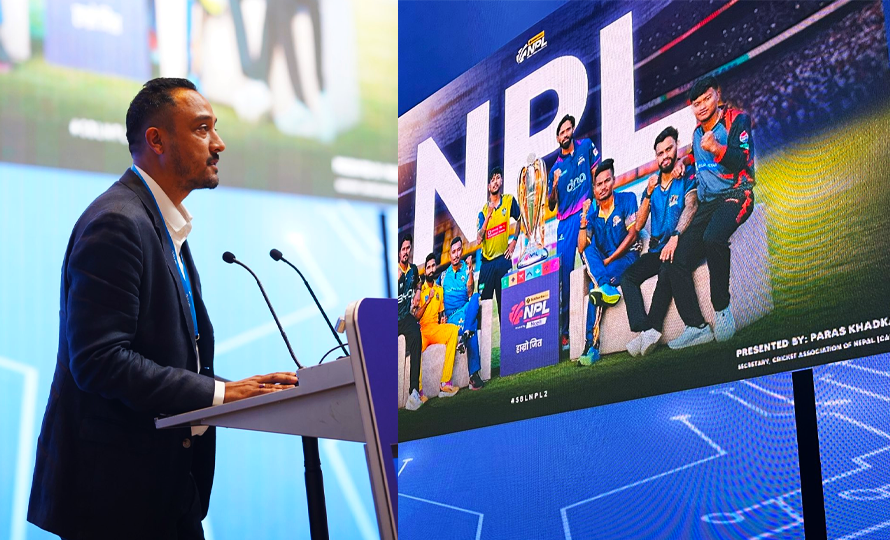
Test status, therefore, is less an immediate target than a long-term destination for Nepali cricket. At the ICC annual conference, Cricket Association of Nepal Secretary Paras Khadka said Nepal would soon become a Test nation.
“We have fans, and we have the support of the government and the ICC. We are playing a series against the West Indies for the first time. Nepal will soon become a Test nation, it is not just our dream, but our commitment,” Paras said.
At one time, even playing in the T20 World Cup and gaining ODI status seemed like distant dreams for Nepal. Today, Nepal has achieved both.
Nepal therefore has every right to dream bigger. Nepali cricket has demonstrated time and again that it can compete with major teams when given the opportunity.
But reaching the World Cup will require more than occasional victories over bigger teams. Nepal will have to establish itself as a team that consistently merits a place in major international tournaments.
A single World Cup qualification will not solve all the problems facing Nepali cricket. But earning that place could give the next generation of Nepali cricketers a foundation on which to build even bigger dreams.
The current generation has witnessed the T20 World Cup. The next generation could witness Nepal playing in an ODI World Cup. After that, the dream of Test cricket may no longer seem impossible.
But the question is no longer whether Nepal can play in the World Cup. The question is simply: When will Nepal’s dream of playing in the ODI World Cup finally come true?
The answer will have to be found on the field. And it will not be determined by one match, but by years of sustained performance.