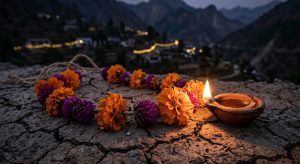


In my mother’s house, Dashain did not begin with the first jamara sprouts or the slaughter of the goat. It began at 3:40 a.m., with the soft clink of a steel pot in the dark kitchen.
She was always awake before the house was. By the time the rest of us stirred, the floor was already swept and smeared with cow dung and red clay; the puja thali gleamed; and the tika was mixed with rice, curd, and vermilion, each in its proper place. We woke to a festival that seemed to have arrived on its own, like weather.
I have spent years thinking about this, and about how many women in Nepal, and across South Asia, hold up the sky during festival season. We call it dharma, sanskar, tradition. Rarely do we call it what it is: unpaid, unthanked, relentless work.
The festival calendar is a labour calendar
Dashain means fifteen days of cooking for a house that swells with returning sons, daughters-in-law, uncles, and neighbours. Tihar means cleaning every corner, so Laxmi will enter, rolling out the sel roti, stringing the marigolds, and drawing the rangoli. Bhai Tika means the sister fasts, prepares, and prays for her brother’s long life. Rarely is there any prayer in the other direction. Across the border, the same story plays out at Lohri and Ganapati Visarjan, where women have been up since dawn making modaks before the procession begins.
Look closely at who does what. The men sit at the front of the house, receiving blessings and tika. The women stand at the back, in the smoke, in the heat, watching the rice. A father’s dakshina is recorded in the family’s memory. A mother’s fourteen-hour day is not.
She eats last, if she eats at all.
Ask any woman in your family when she ate during the festival. She will laugh and say she was tasting as she cooked. That is a lie we have all learned to accept. She feeds the guests first, then the children, then the men, then the elders again because they want seconds. When the last plate is washed, she eats the cold remains standing at the counter. Then she checks that the baby is asleep, the lamps are out, and the puja room is covered, and she lies down knowing the alarm will ring again in four hours.
We call this sacrifice, and we praise it so that we never have to share it.
Nobody in the family is a villain. The sons are not cruel. The fathers are not monsters. The mother-in-law who barks instructions from the cushion was once a new bride herself, carrying the same pots at the same hour, and she is only handing down what was handed to her. That is how patriarchy survives in our homes. It rarely arrives through anger. It arrives through habit, and through the sentence “that’s just how it’s done.”
Meanwhile, the bahu who has a job, a degree, and a body that aches returns home for Dashain and is expected to switch from professional to servant at the doorstep. The daughter who flew in from Doha or Sydney or Kathmandu finds her brother already on the sofa. No one says she must work. No one needs to. The expectation is as quiet and as heavy as the air.
What would it look like to change?
It would not require abandoning the festivals. The festivals are beautiful. They hold our memory, our faith, and our belonging. But a tradition that is joyful only for half the household is not fully a tradition. It is an arrangement.
So this year, let the men enter the kitchen, not to “help,” a word that still frames the work as hers, but to share it. Let the sons chop, stir, and wash. Let the father serve his wife first and watch her sit down. Let the family fast from the idea that exhaustion is a woman’s natural state. Teach the little boy to carry the thali and the little girl that she is allowed to rest.
And if you are a woman reading this, unable to change your house this season, let me say what no one says to you enough: your work is not invisible to everyone. Some of us see it. Some of us are ashamed it took us so long.
A last memory.
On Bijaya Dashami, after the elders had given their blessings and the house was loud with laughter, I found my mother sitting alone on the kitchen step. Her tika had smudged. Her hands, still smelling of ginger and ghee, were resting open in her lap, as though they didn’t know what to do with stillness.
“Aama,” I said, “Come and sit with us.”
She smiled and said, “Soon. First let me see if everyone has eaten.”
Everyone had. She had made sure of it.
I sat beside her on the step, and for the first time in my life, I did not ask her for anything.
This festival season, may we learn to do the same, and may the ones who light every lamp finally sit in their glow.