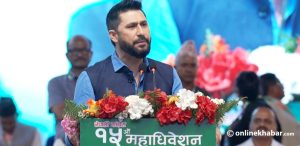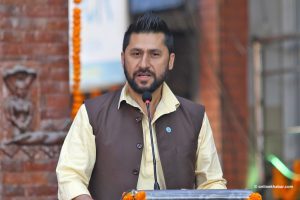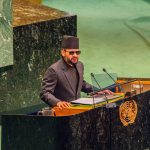

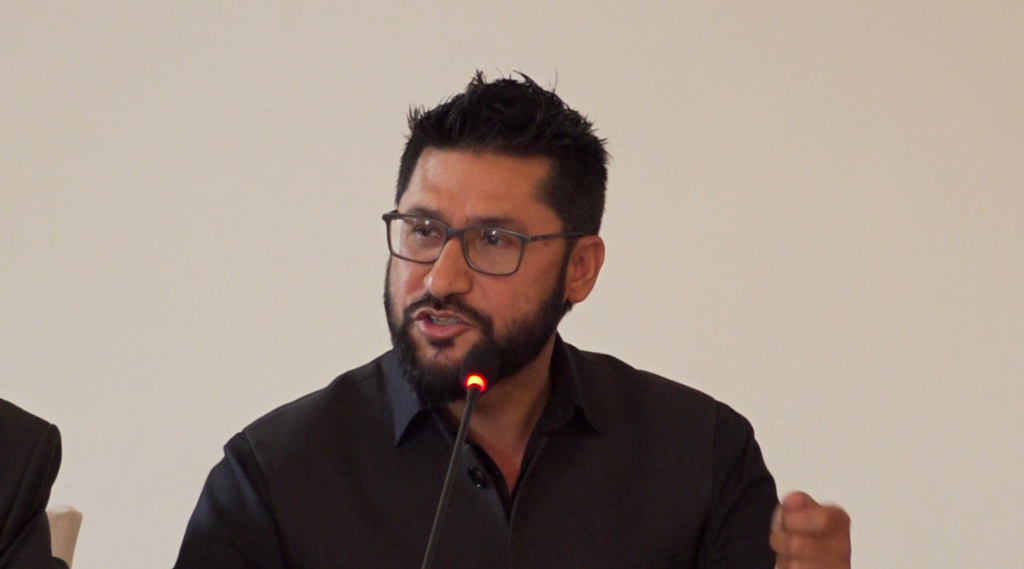
Even after completing its first general convention, the RSP still has not held its Madhesh convention. To address this, party leaders gathered at party headquarters in Chamati on Tuesday to work out convention dates for 7 districts of Madhesh and a visit schedule for Chairman Rabi Lamichhane to those districts.
Co-general secretary Purushottam Yadav coordinated the effort. According to party sources, although it was said on Tuesday that the district conventions and the chairman’s travel plans would be finalized, the date has not yet been made public.
Because of disputes over party membership and representation, the general conventions of Madhesh’s 7 districts and its provincial committee could not be held before the RSP plunged into its central general convention.
At that time, a convention was held in Parsa, forming a new committee under Hari Panta’s leadership. However, district conventions could not be held in Bara, Rautahat, Sarlahi, Mahottari, Dhanusha, Siraha, and Saptari.
Leaders have cited factionalism in leadership selection and interference by lawmakers as reasons the conventions could not take place in these districts. They also say tension between the party’s old cadres and those who joined just before the elections, competing for leadership, contributed to the postponements.
Madhesh Province Chairman Tapeshwar Yadav says managing the situation has been difficult due to the surge of people joining the RSP from other parties before the elections. He said that people who once competed against each other in different parties are now in the same party, and rivalry over leadership has resulted from members of other parties joining and having to contest one another.
The competition for leadership positions reportedly escalated to physical altercations in some places. According to Provincial Chairman Yadav, conventions could not be held in 10 to 15 of Madhesh’s 136 local units, and ad hoc committees have been formed in those places instead.
Since Madhesh holds a large share of the population, party central leadership has taken the initiative after conventions failed to take place there. Chairman Rabi Lamichhane himself has said he will visit the districts of Madhesh Province to build an environment conducive to holding conventions.
Two days ago, while training central members, Chairman Lamichhane said he would go to Madhesh for the conventions. He said he is preparing to travel to Madhesh himself, within a week to ten days or two weeks, and that conventions need to be held there.
The party has assigned co-general secretary Hari Dhakal the responsibility of studying the disputes in places where conventions could not be held and submitting a report. Dhakal said he has been unable to focus on Madhesh due to family difficulties and work in his own constituency.
Madhesh leaders say a clear factional divide within the party is also a reason conventions have not been held smoothly there. According to one provincial-level leader from Madhesh, party ranks are polarized between the party chairman and Prime Minister Balen Shah’s camp.
According to Provincial Chairman Yadav, since having someone from Madhesh study the disputed areas could raise questions, the party assigned the responsibility to an outsider instead. He said giving the responsibility to a Madhesh native could invite controversy, whereas the party believes a report from an outside person is less likely to create problems.
The Madhesh convention has also been discussed in connection with the upcoming provincial and local-level elections. One Madhesh lawmaker said that cadres holding the mistaken belief that whoever leads the local-unit, municipal, district, and provincial structures will distribute election tickets is behind the friction seen around the conventions.
He said cadres have not been made to understand that the leadership sitting on party committees does not decide ticket distribution, the party has set up a “candidate club,” and cadres are not aware that becoming a candidate requires completing a set procedure. He added that many cadres believe that municipal, district and provincial chairs are the ones distributing tickets, which is the mindset that has made holding conventions difficult.
The RSP has opened applications, from August 17, for those wishing to become candidates at the rural municipality level. Registering with the candidate club is the first step in the selection process to become a candidate.
The RSP has devised a system under which candidates are chosen only after evaluating a person’s capability, organizational activity, public image, qualifications, and performance in a candidate academy presentation.
Chairman Lamichhane has reiterated that candidate selection cannot happen outside this system. He told central members two days ago that during the House of Representatives election, adjustments meant the party’s own selection system could not be fully implemented, and he urged party ranks not to believe anyone who promises to make them a local-level candidate.
Selecting representatives for the first general convention held in Chitwan proved most difficult in Madhesh. Because Madhesh’s representation could not be finalized in time, the voting process at the general convention could not start on schedule.
The general convention’s total number of representatives was reported at 4,211. It later emerged that the final representative count from Madhesh, the most disputed region, stood at 540.
According to Madhesh leaders, efforts are underway, as far as possible, to select leadership by consensus. Last week, some Madhesh leaders held internal discussions on matters that needed to be settled at both the provincial and district levels.
According to one leader, discussions on some names for potentially widely acceptable candidates took place from the provincial down to the district level.
Madhesh leaders say a clear factional divide within the party is also behind the difficulty in holding conventions smoothly there. According to one provincial-level Madhesh leader, party ranks are polarized between the party chairman and Prime Minister Balen Shah’s camp.
That leader claims that of Madhesh’s 39 lawmakers, 32 are close to Prime Minister Balen, and that at conventions, lawmakers naturally try to push forward those close to them.
The inability to hold Madhesh’s conventions even after scheduling dates has also been attributed to lawmakers exerting excessive influence. Leaders say disputes arose, and the convention process was disrupted, because of attempts to bring favored individuals into party structures.
Provincial Chairman Yadav sees the possibility of consensus-based leadership selection in some places but considers it unlikely in most. He said that pursuing consensus can create the appearance of favoritism toward a particular person, making an election the most appropriate method.
He said voting is ultimately the last resort, since it removes any allegation of who made whom leader. Provincial Chairman Yadav said he himself wishes to continue in the same post, adding that he did not contest at the general convention in order to continue as provincial chairman.
One Madhesh lawmaker said that since Chairman Lamichhane’s travel dates to Madhesh have not been finalized, and since co-general secretary Dhakal, tasked with studying the disputed areas, has not yet begun his work, it will be difficult to start the convention process soon. With festival season approaching, the lawmaker said the Madhesh convention will likely only be possible around mid-November to mid-December.