Kathmandu, October 11
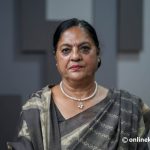
In the eight-decade history of the Nepali Congress, only two women have risen to the post of vice-president — Shailaja Acharya and Pushpa Bhusal. However, the two reached the position through different routes.
Acharya was nominated vice-president by Girija Prasad Koirala, who became party president at the Congress’s ninth general convention in 1996. Twenty-nine years after Acharya assumed the role, Bhusal reached the same position through the party’s special general convention.
Under the statute endorsed by the special general convention, Bhusal became vice-president as part of the new leadership team. At the time, however, the party statute did not reserve a separate quota for women in the vice-president position. Bhusal was placed third in the party hierarchy when the leadership was selected unanimously.
Eight months after the special convention, Bhusal has retained the vice-president position following the party’s 15th general convention. The amended statute provides for five vice-presidents, including a senior vice-president.
Pushpa Bhusal contested for the vice-president position under the women’s quota. She was elected unopposed after no other candidate registered a nomination against her.
Bhusal said she had prepared for a competitive election and had not expected the position to be filled unanimously.
“I cannot say why others did not file their candidacies. If someone else had contested, I would have competed fairly. I did not believe that the position had to be filled unanimously,” she said.
Under the statutes in force during the 14th and special general conventions, there were no separate contests for vice-president and general secretary positions based on reserved categories. For joint general secretaries, however, the earlier statute had provided for the election of one woman among eight office-bearers under the inclusion provisions.
The latest amendment has expanded guaranteed representation for women to senior party positions. It also makes women’s representation of at least one-third mandatory in the 297-member Central Working Committee.
The amended statute provides separate contests for women for the positions of vice-president, general secretary and joint general secretary. Party president Gagan Thapa said the arrangement was designed to open a pathway for women to eventually compete for the top party post.
“The door to positions above joint general secretary, such as vice-president and general secretary, had almost been closed. That is why places have now been guaranteed for women in the vice-president and general secretary positions,” Thapa said. “This has opened the way for a woman to become president of the Nepali Congress one day, because women now have access to competition at the higher levels.”
A long political journey
Pushpa Bhusal’s unopposed election as vice-president follows a long political career, shaped in part by her family background.
Born in Pokharathok, Arghakhanchi, Bhusal grew up in a family with a strong connection to the Nepali Congress. Her father, Kashinath Gautam, was active in Congress politics and served as health minister in Nepal’s first popularly elected government in 1959.
After King Mahendra dissolved the multiparty system in 1960, her family went into exile in India.
Bhusal began her political journey in 1971 and joined the Nepal Students’ Union, the Congress-affiliated student organisation, in 1979. She later held responsibilities in the Nepal Women’s Association and the party’s women and law department.
She entered the party’s Central Working Committee at the 12th general convention and was re-elected as a central member at the 13th and 14th conventions.
Bhusal also served twice as a member of constitution-drafting committees. In 2006, she joined the committee that drafted the Interim Constitution. She was also a member of the Constitution Drafting Committee of the first Constituent Assembly, elected in 2008.
From parliament to party leadership
Bhusal’s parliamentary career began in 2008, although she had first contested a parliamentary election in 1999 and lost.
In 2008, she was directly elected to the Constituent Assembly from Arghakhanchi-2. She lost the 2013 election but entered Parliament in 2017 through the proportional representation system.
During the 2017–2022 parliamentary term, she served as the Congress parliamentary whip.
In July 2022, Bhusal was elected deputy speaker of the House of Representatives with the backing of the then-ruling coalition. Her tenure was short, however, and she lost the 2022 parliamentary election.
Her rise through the special and 15th general conventions has since marked a significant step up in her party leadership role.
Bhusal was also entrusted with leading the Congress’s Election Bureau, a body tasked with studying candidates and developing electoral strategies for the party. The bureau was formed to help select candidates and improve the party’s prospects in elections.
Ahead of the upcoming local elections, the bureau conducted studies and surveys and held discussions with experts. Details of its findings and strategy have not been made public.
“We have gathered information about potential Congress candidates for local-level elections and studied what kind of candidates could help the party win,” Bhusal said. “The Election Bureau carried out its work in two phases across all seven provinces.”
She said the new committee would continue the bureau’s work.
Bhusal is recognised as the first woman from Arghakhanchi to reach such a senior position in a political party. Alongside politics, she has a background in law and teaching. She holds a bachelor’s degree in law and a master’s degree in political science, has experience in both teaching and legal practice, and is a senior advocate.
She has also served as a central member of the Nepal Bar Association.
Pushpa Bhusal said she would use her position as vice-president to make the party’s structures more inclusive and strengthen its connection with the public.
“The 15th general convention has committed to connecting the Nepali Congress with ordinary people. Alongside that work, I will focus on public concerns and issues affecting women,” she said.