
Kathmandu, August 25
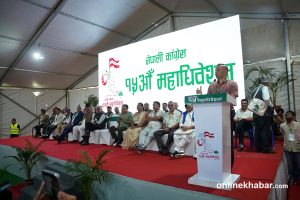
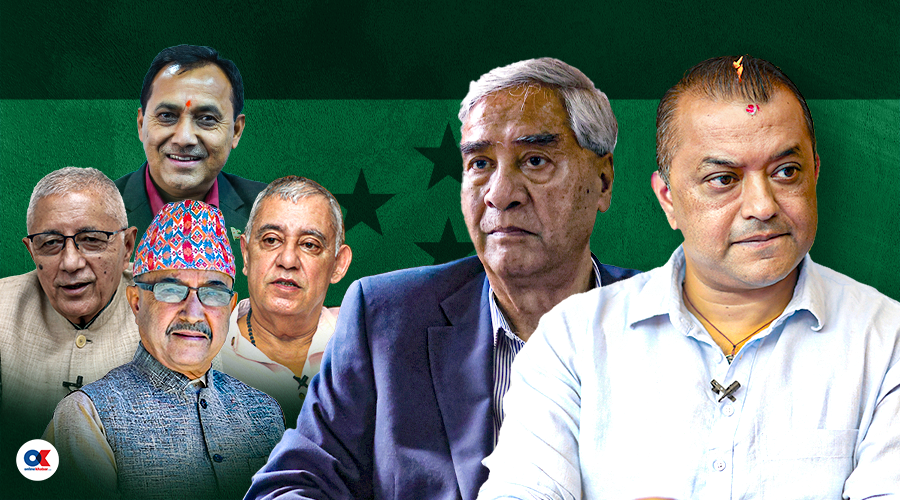
With the scheduled date for the Nepali Congress’ 15th General Convention drawing closer, the party has yet to resolve its political and legal disputes.
While one faction is waiting for the Supreme Court’s decision, another is calling for a political agreement to settle the dispute before the court ruling and create an environment for the general convention.
The Nepali Congress has scheduled ward-level conventions for September 9 as part of the 15th General Convention. However, the establishment-opposing faction has demanded that all convention activities be halted until the Supreme Court delivers its final verdict.
The faction has taken this position after the Supreme Court allowed a review of its earlier verdict in a case concerning the party’s official status.
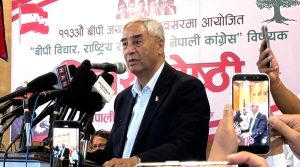
Former vice-president Purna Bahadur Khadka said the Central Working Committee’s decision to move ahead with the 15th General Convention was against both the need for party unity and the Supreme Court’s decision to review the case.
“The decision recently taken by the Central Working Committee formed through the special general convention to move ahead with the 15th General Convention is clearly against both the historic need for complete party unity and the Supreme Court’s order to review the case,” he said.
Min Bishwakarma, coordinator of the publicity committee of the establishment-opposing faction, also said the convention process could not be unilaterally advanced while the case was sub-judice.
“When a case is pending in court, one side cannot naturally move the matter forward unilaterally,” he said. “But the process has been taken forward. Our side will file an application with the court on the matter.”
Little progress in dialogue
Although efforts are reportedly underway to resolve the dispute through dialogue, there has been little substantive communication between the leadership that emerged from the special general convention and the former leadership.
President Gagan Kumar Thapa has said he sought time for dialogue, but that it was not made available. Former president Sher Bahadur Deuba, meanwhile, appears to be waiting for the court’s final decision before engaging in discussions.
A conversation Deuba had with leaders who visited his Chundevi residence on Sunday also indicated his position on dialogue with Thapa. Nain Singh Mahar, who has recently taken on a mediating role, wrote on Facebook on Sunday that he had raised the need for a meeting between the two leaders.
“I also pointed out the need for a meeting and dialogue between President Gagan Kumar Thapa and him,” Mahar wrote. “He said he was making efforts to resolve the issue and suggested that we move forward after the court’s decision.”
The establishment faction expects former president Deuba to play a coordinating role in resolving the dispute.
General Secretary Pradip Paudel said efforts were being made to engage Deuba in dialogue and that the party was hopeful he would help with coordination.
“We are trying to meet and have a dialogue with the outgoing president. We are somewhat more hopeful about him,” Paudel told Onlinekhabar. “We expect that after meeting him, he will do something for coordination. We are also talking to others.”
Paudel stressed that the dispute should be resolved through political agreement rather than the courts.
“Our position is that we should resolve the party’s problems through mutual agreement and hold the convention at the scheduled time, rather than through the judicial process,” he said. “We will try to hold discussions and reach an agreement during the remaining 14 days.”
Paudel also said it was not appropriate for a political party to take its internal disputes to court.
“A party that advocates for the rule of law and the system of governance cannot naturally take its own internal problems to court,” he said.
Arguing that the party’s problems should ultimately be resolved through the general convention, Poudel said the establishment faction was ready to take any necessary steps to ensure a fair convention.
Nepali Congress leadership has recently appeared open to forming an organising committee to ensure the convention is conducted fairly.
Asked whether the party was prepared to form such a committee, Poudel said, “The leadership should be under the current president. We agree on everything else.”
‘A mechanism can be formed for management, not an organising committee’
Nepali Congress spokesperson Devraj Chalise said the party has no tradition of forming a general convention organising committee. However, he said a mechanism could be created for convention management and coordination.
“There is no provision for an organising committee in our party tradition. An organising committee will not be formed,” Chalise said. “But it can be given any name. The point is to seek advice and guidance from the leaders.”
He said any mechanism formed to facilitate an agreement would still have to operate within the party statute.
“If we use the provisions already in the statute, whatever name we give it, the issue ultimately concerns its role. We are ready to give that role,” he said. “Neither leaders nor cadres have the flexibility to amend or go beyond the statute.”
Chalise also said leaders and party workers who were left out during the membership update could be collectively included on the basis of a political agreement before the ward conventions begin.
‘General convention should be held under Deuba’s leadership’
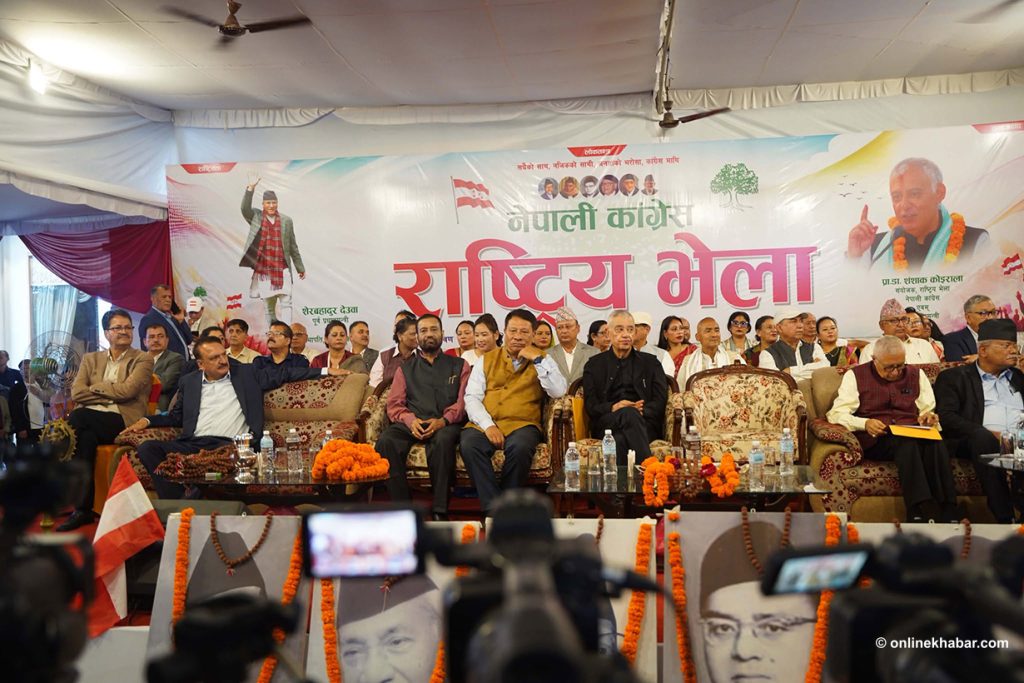
The establishment-opposing faction has maintained that the 15th General Convention should be held under the leadership of former president Deuba as part of efforts to restore party unity.
The faction had also decided at a national gathering held in the final week of Shrawan to organise the convention under Deuba’s leadership.
NP Saud, a leader considered close to Deuba, said the current dispute should be resolved by using the 14th General Convention as the basis.
He said that because both sides had participated in the 14th General Convention, it should be recognised as the legitimate basis for moving ahead and creating an environment in which all sides could be included in the next convention.
“The case is before the court for review. Before it is settled, if an agreement is to be reached, both sides should be included since both participated in the 14th General Convention,” Saud told Onlinekhabar.
He also said holding the convention under Deuba’s leadership would provide a level playing field because the former president would not contest the upcoming election.
“Another important point is that Sher Bahadur Deuba, the president elected by the 14th General Convention, is not contesting himself,” Saud said. “Therefore, everyone gets an equal playing field. Everyone gets equal ground for competition.”
Saud said party unity could be achieved by recognising the leadership elected by the 14th General Convention. Otherwise, he said, the party would have to proceed according to the Supreme Court’s final decision on the party’s official status.
“The leadership elected by the 14th General Convention should be established. That will bring unity,” he said. “Otherwise, we will proceed according to whatever conclusion the review reaches.”
Three options proposed for unity
Nain Singh Mahar, who is leading the ‘Connecting Country and Congress’ campaign, believes the political leadership should take steps to resolve the dispute before the court delivers its decision.
He said he proposed three options to President Thapa during a recent meeting aimed at promoting party unity.
“I met Gagan in Gyaneshwar on the evening of the 20th. We spoke for around 25 minutes,” Mahar said. “I put forward three proposals to him.”
According to Mahar, Thapa expressed doubts about the possibility of reaching an agreement before the Supreme Court delivers its final decision.
“He kept saying, ‘What can happen before the court’s decision?’” Mahar said. “I told him it has to be done before the court’s decision.”
Mahar’s first proposal was to bring former president Deuba and President Thapa together for dialogue and resolve the party’s dispute.
“You two need to sit together. Whatever either of you has to give up, you should do it and unite the party,” Mahar said he told Thapa.
Mahar expressed optimism that direct dialogue between Deuba and Thapa could resolve the dispute.
“If the two of them sit together, they will reach an agreement. The dispute will be resolved,” he said.
His second proposal is to appoint a third person acceptable to both sides to oversee the general convention. His third is for both sides to publicly commit in advance to accepting the court’s decision and reach an agreement on the entire convention process.
“The second option is to give responsibility to a third person acceptable to both sides and hold the convention,” he said. “The third is to commit beforehand to accepting the court’s decision and reach an agreement on the entire convention process. That could also prevent a possible dispute after the court’s verdict.”
Mahar said the ‘Connecting Country and Congress’ campaign has continued discussions with various party leaders on party unity. He said he had also met former vice-president Purna Bahadur Khadka and leader Dr Shekhar Koirala to discuss the issue.
In Mahar’s view, the crisis in the Nepali Congress is linked less to a desire to split the party than to ego and mistrust among its leadership.
“No one appears to want the party to split. There is a little bit of an ego problem,” he said. “If a person or group works to reduce that ego problem, a solution can be found.”
He said the campaign was also engaging district presidents to build pressure from the grassroots for party unity.
Mahar stressed that the party should prioritise its institutional existence and future rather than who leads it.
“There is no alternative to uniting the party for the country and the people,” he said. “Even now, 99.9 percent of people want to see the party united. They want to see the party remain united.”