
Nepal’s education system is shaped by factors such as gender, ethnicity, caste, disability, geography, language, poverty, health, and other forms of social and economic disadvantage. To promote equity in education, Nepal’s public education financing has adopted targeted interventions, including scholarships, free textbooks, sanitary pad distribution, Gender Equality, Disability, and Social Inclusion (GEDSI)-friendly infrastructure, and residential schools.
The Constitution of Nepal recognises education as a fundamental right and guarantees the rights to equality, children’s rights, and social justice. These constitutional provisions are further reinforced by the Act Relating to Free and Compulsory Education, the National Education Policy, the Sixteenth Periodic Plan, and the Children’s Act and Regulations.
Nepal has also committed to Sustainable Development Goal (SDG) 4 on quality education, SDG 5 on gender equality, and SDG 10 on reducing inequalities. Nepal is a party to the Convention on the Rights of the Child, the Convention on the Elimination of All Forms of Discrimination against Women (CEDAW), the Convention on the Rights of Persons with Disabilities (CRPD), the International Covenant on Economic, Social and Cultural Rights, the Education 2030 Framework for Action, the Incheon Declaration, the Salamanca Statement on Inclusive Education, and the Addis Ababa Action Agenda on Financing for Sustainable Development. These frameworks consistently emphasise the importance of adequate, equitable, and inclusive financing.
An examination of education budgets from FY 2078/79 to FY 2083/84 reveals several important trends. While the education budget increased from Rs 180.04 billion to Rs 218.30 billion over the period, the education sector’s share of the national budget steadily declined from more than 11 per cent to only 10.28 per cent. This trend is not aligned with the internationally accepted benchmark of allocating at least 15–20 per cent of total public expenditure and 4–6 per cent of GDP to public education.
From FY 2078/79 to FY 2083/84, Nepal’s education budget shows a steady increase in absolute terms, rising from Rs 180.04 billion in 2021/22 to Rs 218.30 billion in 2026/27. However, its share of the national budget gradually declined, falling from approximately 11.27 per cent in FY 2080/81 to 10.28 per cent in FY 2083/84. FY 2079/80 also reflected a distributed financing structure across federal (Rs 70.05 billion), provincial (Rs 5.32 billion), and local governments (Rs 121.01 billion). This indicates that although fiscal allocations to education expanded in nominal terms over the six years, the sector’s relative priority within national spending weakened.
This declining priority is particularly significant because Nepal is implementing the ten-year School Education Sector Plan while simultaneously preparing for graduation from Least Developed Country (LDC) status. As external assistance gradually decreases, stronger domestic investment will become increasingly essential for sustaining public education. Instead, education is receiving a smaller proportion of national resources despite growing demands for digital transformation, inclusive education, teacher development, and climate-resilient school infrastructure.
The evolution of budget priorities over the six years also illustrates changing government strategies. FY 2078/79 largely focused on post-pandemic recovery and infrastructure development. The Presidential Educational Reform Program allocated Rs 10 billion for the construction of classrooms, laboratories, libraries, drinking water systems, and disability-friendly facilities across 1,500 community schools. Simultaneously, Rs 17.73 billion was invested in school meal programs to reduce dropout rates among approximately 3.5 million children, while digital learning platforms and educational television programmes were introduced to address learning disruptions caused by COVID-19.
In FY 2079/80, the emphasis shifted towards implementing federalism. Of the Rs 196.4 billion education budget, Rs 121.01 billion was transferred to local governments, reinforcing municipalities’ responsibility for managing school education. Teacher capacity-building initiatives received Rs 8.88 billion, while technical and vocational education continued to receive significant attention with an allocation of Rs 8.3 billion. The introduction of school-level discretionary grants also provided local school leaders with greater autonomy to improve school management.
FY 2080/81 marked the beginning of a new policy direction focused on research, innovation, and modernisation. The establishment of a dedicated Research and Innovation Fund represented an important institutional reform, while investments continued in technical education, digital learning, and scholarships for marginalised students. Nevertheless, these new initiatives remained relatively modest compared with the system’s recurrent expenditure.
The FY 2081/82 budget introduced stronger social inclusion measures. The government allocated Rs 2.5 billion for disability-friendly and gender-sensitive classrooms, expanded scholarships to students in Grades 6 to 12, strengthened technical education scholarships for disadvantaged students, and increased investment in higher education through the restructuring of the University Grants Commission and the development of Tribhuvan University as a centre of excellence. These initiatives reflected greater attention to equity and educational quality.
FY 2082/83 focused primarily on strengthening recurrent financing. Conditional grants for Early Childhood Education and Development (ECED) facilitators and school staff increased to Rs 10.16 billion. Mid-day meal allocations also increased to Rs 10.19 billion, while targeted scholarships continued for students from remote regions and historically marginalised communities such as the Musahar, Dom, and Chamar. Performance-based incentives were introduced for high-performing community schools to mentor neighbouring schools, signalling an effort to improve accountability and peer learning.
The FY 2083/84 budget represents the most significant turning point in the six-year trend. Although the education budget increased to Rs 218.30 billion, the distribution of expenditure reveals substantial structural imbalances. Teacher salaries alone account for Rs 133.8 billion, or 61.3 per cent of the total education budget.
Administrative salaries consume another Rs 11.5 billion, meaning that approximately two-thirds of the entire education budget is devoted to human resources. Operational costs, higher education, textbooks, and school meal programmes account for an additional 25.7 per cent. Consequently, only 3.9 per cent remains for targeted scholarships, 1.83 per cent for research and innovation, 1.47 per cent for teacher mentoring and professional development, and a mere 0.46 per cent for school infrastructure audits and maintenance.
This expenditure pattern reflects a structural financing trap. While teacher salaries are a necessary and legally protected expenditure, their growing share increasingly limits fiscal space for investments that directly improve learning conditions. The 21 per cent salary adjustment announced in FY 2083/84 was politically and administratively justified; however, the overall education budget did not increase proportionately to accommodate these additional costs, resulting in the compression of quality-enhancing investments.
The comparison with FY 2078/79 is particularly revealing. Infrastructure development received Rs 10 billion under the Presidential Educational Reform Program, equivalent to approximately 5.5 per cent of the education budget. By FY 2083/84, infrastructure funding had effectively declined to only Rs 1 billion for audits and repairs, representing just 0.46 per cent of total expenditure. This dramatic reduction raises concerns about the government’s ability to ensure that community schools meet the Basic Learning Conditions outlined in the School Education Sector Plan, including safe classrooms, drinking water facilities, disability-accessible infrastructure, science laboratories, libraries, and gender-responsive sanitation facilities.
Teacher professional development demonstrates a similar trend. Nepal’s education reforms consistently recognise teachers as the most important determinant of learning outcomes. However, current allocations for mentoring, coaching, and continuous professional development represent only about 1.5 per cent of the education budget. International evidence suggests that high-performing education systems typically allocate between 2–3 per cent of education expenditure to sustained teacher development. Nepal’s comparatively limited investment risks are undermining classroom quality despite improvements in teacher remuneration.
The budget for research and innovation also deserves attention. Allocating less than 2 per cent of total education expenditure to research and innovation is unlikely to support the development of a competitive, technology-driven economy or strengthen university-based research. As Nepal seeks to transition towards a knowledge-based economy, greater investment in research capacity and innovation ecosystems will become increasingly important.
UNESCO recommends allocating 15–20 per cent of total public expenditure or 4–6 per cent of GDP to public education. Nepal’s FY 2083/84 allocation of 10.28 per cent remains significantly below this benchmark.
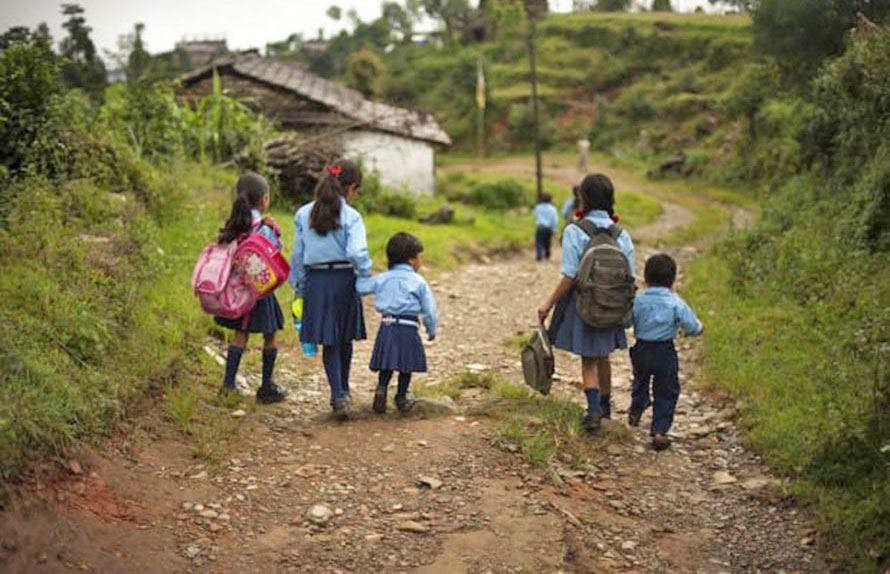
Uniform financing often reproduces unequal outcomes because schools and learners begin from vastly different starting points. Municipalities with stronger local revenue bases can supplement federal transfers, while poorer local governments struggle to finance even basic educational services. Consequently, children living in remote regions or economically disadvantaged municipalities experience systematically lower educational opportunities.
Gender-responsive interventions, including free sanitary pad distribution and scholarship programmes, have contributed to reducing barriers for girls. However, menstrual hygiene products alone cannot eliminate gender disparities when schools lack separate toilets, safe transportation, female teachers, or adequate protection from gender-based violence.
Similarly, disability-inclusive education requires much more than the construction of physical ramps. Effective inclusion demands accessible learning materials, sign-language interpretation, Braille resources, assistive technologies, individualised learning support, and adequately trained teachers. These investments remain insufficient within current financing structures.
Children from Indigenous Peoples and linguistic minority communities continue to face challenges because mother-tongue education, culturally responsive curricula, and multilingual teaching materials remain underfunded. Without systematic financing for linguistic inclusion, constitutional guarantees regarding language rights will remain only partially realised.
If education continues to receive a shrinking proportion of national expenditure while recurrent obligations continue to expand, Nepal risks entering a fiscal cliff where quality improvements become increasingly difficult to sustain. Such a scenario would jeopardise implementation of the School Education Sector Plan, weaken human capital development, and undermine the country’s long-term economic competitiveness.
Education should therefore be understood not as consumption expenditure but as a productive public investment that generates long-term economic returns through higher productivity, improved health outcomes, reduced inequality, enhanced social cohesion, and greater resilience to future shocks.
The education sector’s share of the national budget should progressively move toward the internationally recommended benchmark of at least 15–20 per cent. Increased investment must prioritise quality improvement alongside expanded access. Financing formulas should explicitly incorporate indicators of multidimensional vulnerability, including poverty, disability, gender, caste, ethnicity, language, remoteness, and climate vulnerability, rather than relying primarily on enrolment figures.
Investments in teacher professional development, mentoring, coaching, and instructional leadership should be substantially expanded. Teacher quality remains the strongest school-level determinant of student learning, yet continuous professional development currently receives a disproportionately small share of public expenditure.
Capital investment should prioritise disability-inclusive, gender-responsive, climate-resilient, and digitally connected schools that meet the Basic Learning Conditions established under the School Education Sector Plan. Targeted scholarships should evolve from isolated social assistance programmes into integrated equity packages that address multiple barriers simultaneously through transportation support, assistive devices, digital access, nutrition, psychosocial services, and academic mentoring.
Education financing should incorporate systematic Gender Equality, Disability, and Social Inclusion (GEDSI) budgeting and equity expenditure tracking, enabling governments to assess not only how much money is spent but also who benefits from that spending and whether investments are effectively reducing disparities.
Closing this gap will require more than incremental annual increases in existing budget lines. It requires a strategic shift that raises education’s share of the national budget toward international benchmarks, adopts financing formulas that reflect multiple and overlapping forms of disadvantage rather than single categories, and treats expenditure on infrastructure, teacher development, and targeted equity programmes as long-term investments rather than areas to be reduced during fiscal constraints.
Overall, recent budget trends suggest that Nepal has been largely focused on maintaining and operating the education system. However, the more important unfinished task is to invest more deliberately and strategically in educational quality, fairness, and equity so that all learners can benefit from meaningful and inclusive educational opportunities.