
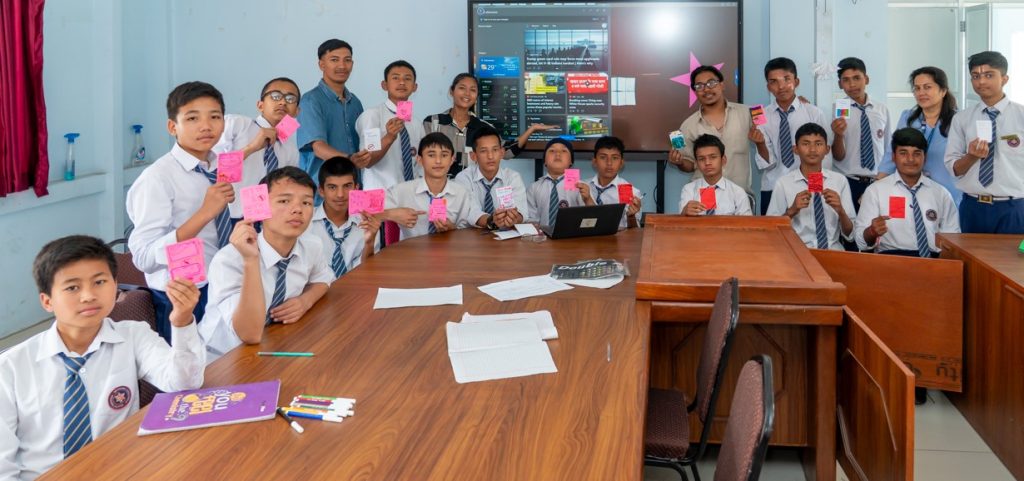
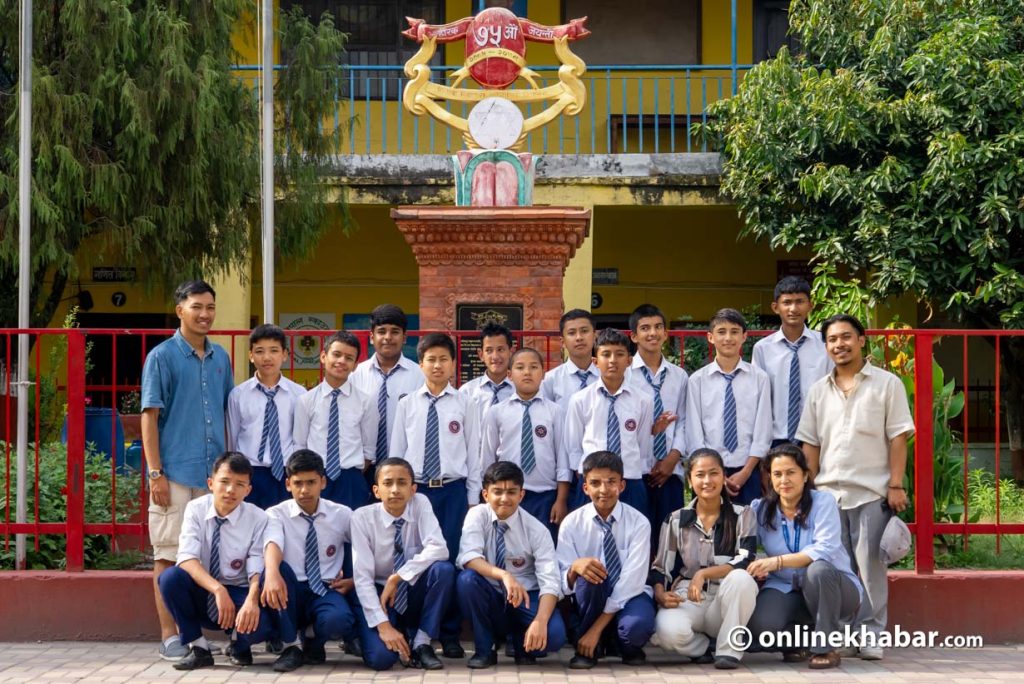
The “We Men Club” is being run in various community and private schools in Lalitpur and Kathmandu. The program gives schoolboys practical knowledge about gender equality, respect, consent, awareness against violence, emotional expression, and social responsibility, going beyond textbook learning through dialogue, games, group activities, and shared experiences. Participants say it has already begun to change students’ thinking, behaviour, and even family relationships.
For Riwaj Adhikari, a ninth grader, the club became more than an extracurricular activity, a chance to understand himself and society differently. He says he now understands why discrimination occurs and how it can be changed, whereas before he saw society only in ordinary terms. He learned to question the idea that boys must always be strong and tough.
For Ram Bahadur Adhikari, a grade 7 student, the club became a means of building confidence. He used to be hesitant about everything, but now he can speak up. He says the club’s discussions on behaviour, respect, and social relationships changed his thinking about household roles.
“I used to think housework was only for women, but now I believe both men and women should share responsibilities.”
Student Anshad Chaudhary said the club helped him understand the difference between “equality” and “equity”: giving everyone the same thing is equality, while giving opportunity and support according to need is equity. He noted society still strongly holds onto ideas of “boys’ work” and “girls’ work,” when in fact both can do all kinds of work. He now tries to challenge discriminatory attitudes among his friends when they separate things by gender.
Why focus only on boys?
According to Prajay Shrestha, facilitator of We Men Club Junior, some schools initially ran the program with both boys and girls, but since it didn’t bring the expected openness, the focus shifted to boys. He explained that making men responsible for gender equality also means thinking about what kind of environment to create for women, so girls aren’t neglected; rather, facilitators regularly meet with girls, parents, and teachers to share what the boys are learning and observe what changes appear in them.
He said they created a separate safe space for boys to understand what they’re really feeling. The club runs 25 sessions covering topics like gender-based violence, patriarchy, toxic masculinity, diverse gender and sexual identities, online violence, and climate justice, using practical methods like games, videos, and activities rather than theory.
“Gender equality also understands boys’ pain”
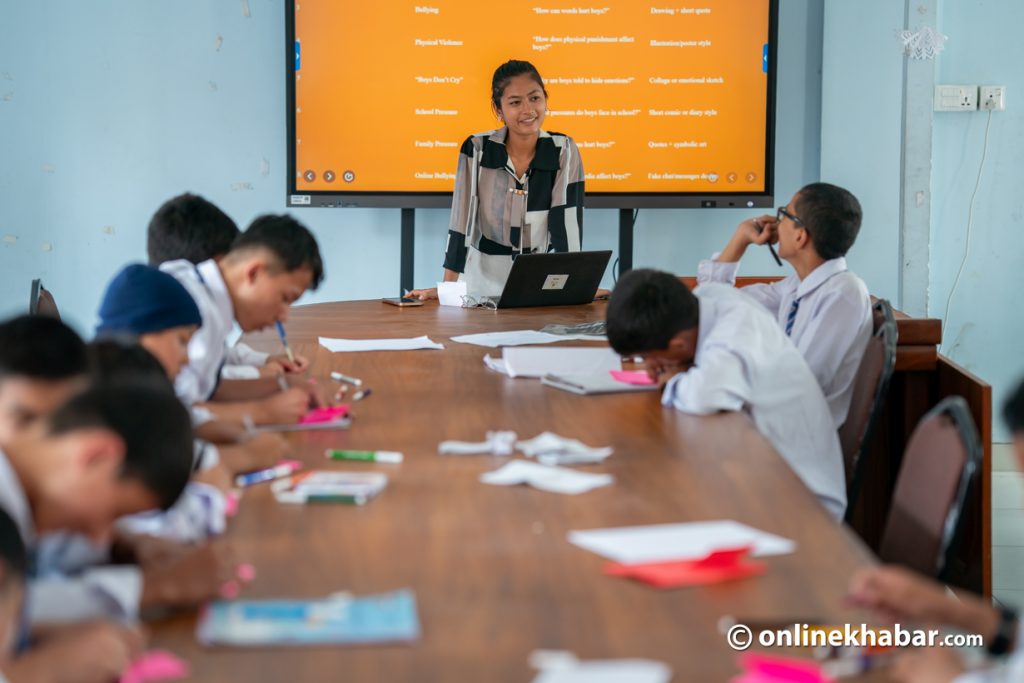
Mandira Shrestha, another facilitator of We Men Club Junior, says the program plays a major role in surfacing boys’ inner experiences and the expectations society places on them. While gender equality discussions are often girl-centred, boys also face their own pressures and mental stress that often go unnoticed.
She explains that ideas like “boys shouldn’t cry,” “boys shouldn’t appear weak,” and “boys must take full responsibility for the family” place pressure on them from a young age, preventing them from expressing emotions openly.
“The club’s main goal is to understand and discuss these pressures and create a safe environment where boys can speak without fear,” says Shrestha to Onlinekhabar.
Many students initially hesitated to express feelings but have gradually opened up. Many shared that their concerns at home, school, or in society were never taken seriously. The club teaches boys not just about gender equality, but to accept and express their emotional side, conveying that strength means expressing emotions properly, not hiding them. Many students have started talking more openly with parents and siblings at home, and family attitudes are gradually becoming more positive too.
Changes seen in schools and families
Parent Narayan Prasad Paudel, whose son Prabodh Paudel is in grade 9, has noticed changes in thinking and behaviour at home since his son joined the program.
Goma Bhujel, a teacher at Tri-Padma Vidyashram, said most school programs were previously girl-centred, but “We Men Club” was the first to start a dialogue centred on boys. She said boys are going through things different from what was expected; they too carry pressure and pain inside. She added the program has taught teachers too, not just one-way teaching, but an opportunity to learn from students.
According to school headmaster Hari Prasad Khanal, the club has boosted students’ confidence and participation.
“What’s in textbooks is one thing, but here students are learning practically,” says Khanal.
Changes girls have noticed
Grade 8 student Kanchan Shrestha said changes are visible in the behaviour of boys participating in the club.
“The old habit of belittling girls has decreased, and now they get along and treat others respectfully,” says Shrestha.
Grade 9 student Sofia Rai has also noticed a change in how boys speak.
“They used to speak irritably, but now speak more gently and in a friendly manner,” says Rai.
“We Men Club” hasn’t just taught boys to respect women; it has taught them to understand themselves. Questioning old ideas like “boys shouldn’t cry,” “housework is women’s job,” and “men must always be strong,” these teenagers are now practising equality, empathy, and cooperation. Serving as a bridge for dialogue between school, family, and community, the program signals that changing mindsets during adolescence can pave the way for broader social change.