

Growing up in the rural hills of Parbat, Madan Subedi was close to nature from his school days. After passing his SLC in 2009, he studied science for his plus-two at Golden Gate College in Kathmandu. He then completed his bachelor’s and master’s degrees in agriculture at the Agriculture and Forestry University in Rampur, Chitwan.
A government officer whose heart stayed in research
It was during his undergraduate studies that he first got a close look at entomology. While most students focused on how to control crop pests, his interest moved in a different avenue, toward identifying and classifying insects rather than eliminating them. He pursued a master’s in entomology, with his thesis in taxonomy, a field with only a handful of active researchers in Nepal at the time.
While still studying for his master’s, he applied for and was selected as a permanent agriculture officer at the Agriculture and Forestry University. Since December 17 2019, he has been posted at the Agriculture Science Centre under the university in Ghyalchok, Gorkha, where he still works today. Alongside his official duties, he began devoting his spare time to research, not on crop production, fertilisers or pest control like most others, but on the tiny creatures hopping through the grass. His master’s thesis examined the diversity and taxonomy of grasshoppers found in paddy fields at different elevations across Nepal, around 258, 758, 1258 and 1758 metres, revealing that species varied by altitude. That study opened the door to a whole new world for him.
Research from scratch
Although entomology had seen considerable study in Nepal, taxonomy remained a largely neglected field, with no experts available to correctly identify insects or explain the science behind identification. The work itself wasn’t easy either; distinguishing between two species that look identical to the untrained eye can come down to a single tiny spine, the pattern of wing veins, or the shape of genitalia, requiring specialised microscopes that were scarce in Nepal.
DNA sequencing facilities were also inadequate, and legal restrictions meant samples couldn’t be sent abroad for testing, though he learned that PCR products (amplified copies of a sample’s DNA) could legally be sent out. Even so, the cost of outsourcing PCR work made research difficult.
“There are a few limited labs in Nepal that offer gene sequencing. I understood that one lab does the PCR and sends it to Korea for gene sequencing,” Subedi says. “There were many such reasons that made the research complicated, but I didn’t give up.” Resources, funding and mentors were all scarce, but his curiosity to learn and discover kept him going. Interestingly, he has named the “ground hoppers” he’s discovered after notable Nepali figures, the mentors who supported his research, and specific places.
An email that reached Germany
With no local support available, he began seeking out international researchers, eventually coming across the name of a well-known German orthoptera researcher, Sigfrid Ingrisch, who had conducted extensive research on Nepal’s grasshoppers from 1987 to 2006 and alone had documented around 311 species, having discovered roughly 60 of them himself.
Madan wrote Ingrisch an email, not expecting much of a reply, but the response came within days. Ingrisch sent him research papers, discussed samples, and taught him the finer points of classification. A small piece of research that started in Nepal became connected to Germany. Later, Madan also got in touch with another German researcher, Tömring, who had compiled a checklist of Nepal’s ground hoppers.
Through the Orthopterists’ Society, Subedi reached out to the wider international research community and found support from Croatian researchers Josip Skejo and Niko Kasalo, among others. He also received a $1,500 grant from the Orthopterists’ Society for his grasshopper research.
“That was around 2019. I spent about 145,000 rupees from that fund to buy a Canon camera. I didn’t even know how to use a camera; I taught myself,” Subedi told Onlinekhabar. “I used that camera instead of a microscope for my grasshopper research. I still keep it safe today.”
He continued his research with the help of video calls with mentors abroad and Google Docs. At the time, just over 65 species of ground hoppers were on record in Nepal; his research has since pushed that number past 80.
New genera and species discovered — and given Nepali names
During his master’s, he travelled from Koshi to the far west collecting grasshoppers, carrying a net and transparent plastic containers, gathering anything that looked unfamiliar, studying its life cycle, and publishing his findings in science journals once confirmed as new.
“In the beginning I used to collect all kinds of grasshoppers and give them grass to feed on. Later I focused only on ground hoppers within the Tetrigidae family,” Subedi says. “I’ve given the Nepali name ‘bhuinphadke’ to ground hoppers in the Tetrigidae family, because they didn’t have a Nepali name before.”
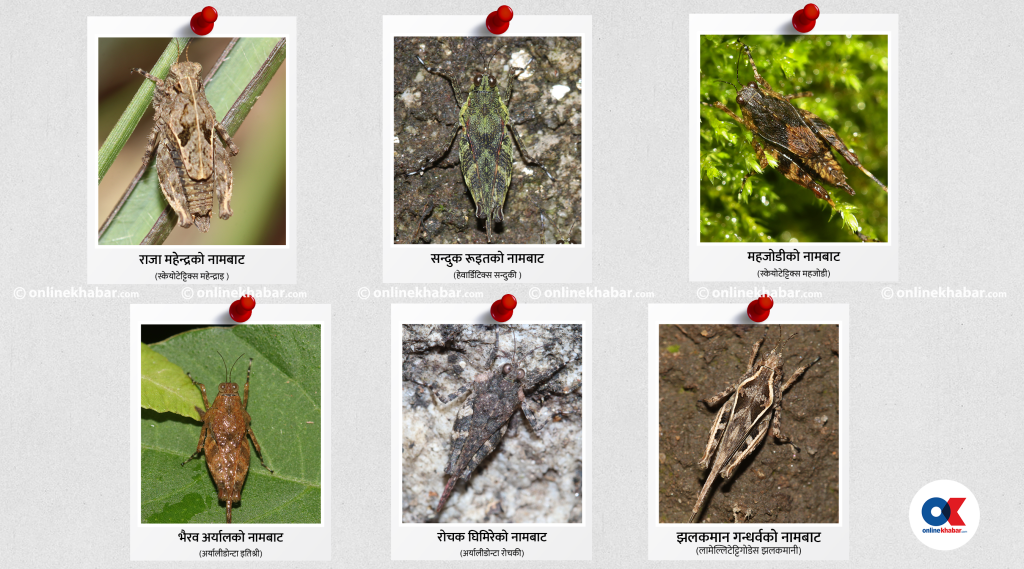
For example, around 2020 he first found a new ground hopper near Netrajyoti Basic School in Ghyalchok, Gorkha, and named it “Skejotettix netrajyoti,” combining the names of Josip Skejo, who supported his research, and the school. It took a year to confirm it as a new species, and he published a research paper on it in 2022.
He found a second new species near his own home in Bajung, his home district of Parbat, and named it “Skejotettix kasalo” after another supporter of his research, calling it “Bajung’s bhuinphadke” in Nepali.
A third species, found near Tirtire Khola in Ghyalchok, Gorkha, was named “Aryalidonta itishreea” after Bhairav Aryal, a towering figure in Nepali satirical writing. “I’ve read Bhairav Aryal’s essays and drawn inspiration from his life, so I named this in his honour,” Madan says.
Similarly, he named another new species “Aryalidonta rochaki,” combining it with the name of Rochak Ghimire, Bhairav Aryal’s friend and a writer and journalist, “so that their names would always stay together,” he says.
Likewise, he has named species after King Mahendra Bir Bikram Shah (“Skejotettix mahendrai”), the comedy duo Madan Krishna and Haribansha Acharya (“Skejotettix mahajodi”), folk singer Jhalakman Gandharva (“Lamellitettigodes jhalakmani”), and eye specialist Sanduk Ruit (“Hebarditettix sanduki”).
“I named them this way so the world would come to know these people,” Subedi says.
Another new species found near Brijtal while visiting Kapilvastu to celebrate Holi with friends was given the local Tharu name “Motbotwa”, “mot” meaning fat and “botwa” meaning grasshopper in Tharu.
“I discovered this one two years ago, and its research paper was published about a month and a half ago,” Subedi says.
Another species found in Ramaroshan, Achham, was named “Hedotettix samitae” after his wife, Samita, who currently works as an agriculture extension officer in Kankai Municipality, Jhapa.
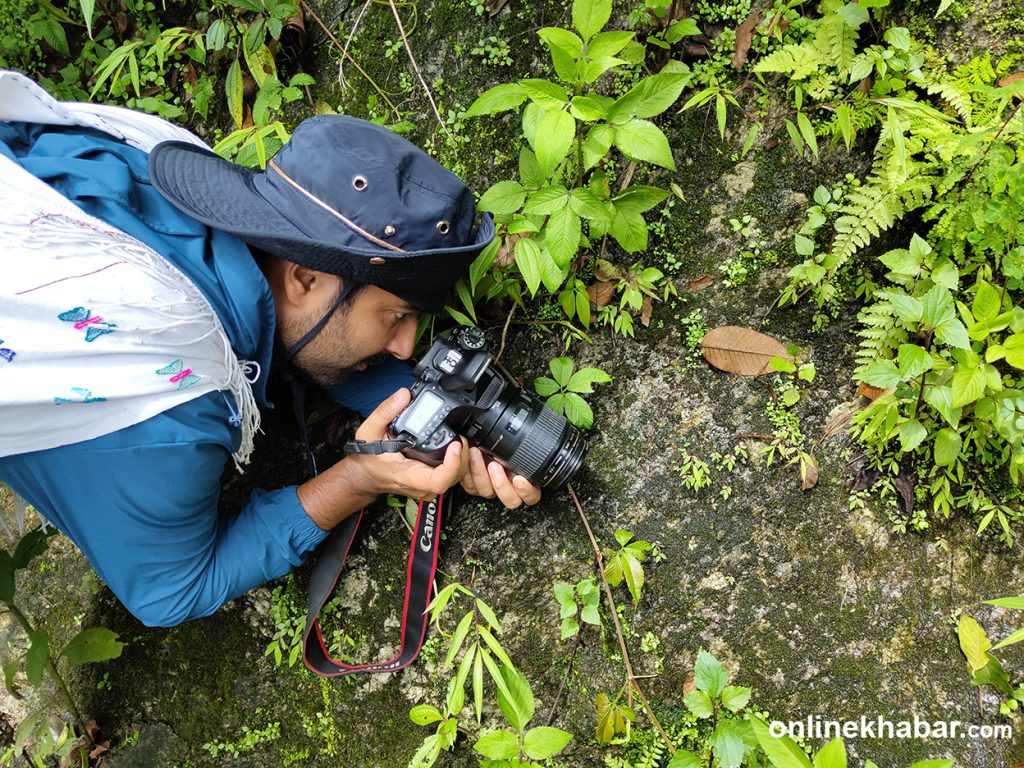
His search for grasshoppers has taken him from Kapilvastu, Chitwan, Parbat and Gorkha to Ramaroshan in Achham. In Shivapuri Nagarjun National Park alone, 11 species of ground hoppers have been found, five of which he discovered himself — the species named after King Mahendra, the comedy duo, Jhalakman Gandharva, Sanduk Ruit and Rochak Ghimire were all found within this park.
So far, Subedi has discovered 12 new species and 3 new genera of grasshoppers, introducing them to the world. In recognition of this contribution, a newly discovered grasshopper species in Australia was named after him.
His most recently discovered species of ground hopper has been named “Hyboella rampuriana,” after the Rampur area of the Agriculture and Forestry University campus where it was found. Another species was discovered at a herbal processing centre in Tamaghadi, Bara district, and named “Thotebhutle bhuinphadke.”
The new genera he discovered are Skejotettix, Aryalidonta and Ingrischana. His new species include Skejotettix netrajyoti, Skejotettix kasalo, Aryalidonta itishreea, Hedotettix samitae, Aryalidonta rochaki, Hebarditettix sanduki, Lamellitettigodes jhalakmani, Skejotettix mahajodi, Skejotettix mahendrai, Ingrischana motbotawa, Ingrischana aspinosa, and Hyboella rampuriana, most recorded from various locations in Gorkha, Parbat, Achham, Kapilvastu, Kaski, Sankhuwasabha and Chitwan.
He has also recorded nine grasshopper species for the first time in Nepal, including Phlaeoba antennata, Bibracte burmana, Caryanda cachara, Gonista bicolour, Acanthalobus curticornis, Acanthalobus inornatus, Coptotettix problematicus, Euparatettix balteatus and Bolivaritettix insignis.
The first two new species he found are preserved at the Annapurna Natural History Museum in Pokhara, with others kept at his office in Ghyalchok, Gorkha. His work has significantly expanded the scientific record of Nepal’s grasshopper diversity and contributed to the country’s insect taxonomy research.
A new Australian species carries Subedi’s name
In recognition of this contribution, a newly discovered grasshopper species found in Australia has been named after Madan Subedi. Croatian researchers discovered the new species in an Australian forest and named it Peraxelpa subedi.
“I’ve never even been to Australia, but hearing that a species bearing my name is roaming some corner of the world makes me feel happy and amazed,” Subedi says.
Croatian researchers Josip Skejo and Niko Kasalo discovered 11 new species in Australia, one of which was named after Subedi.
Balancing challenge and satisfaction
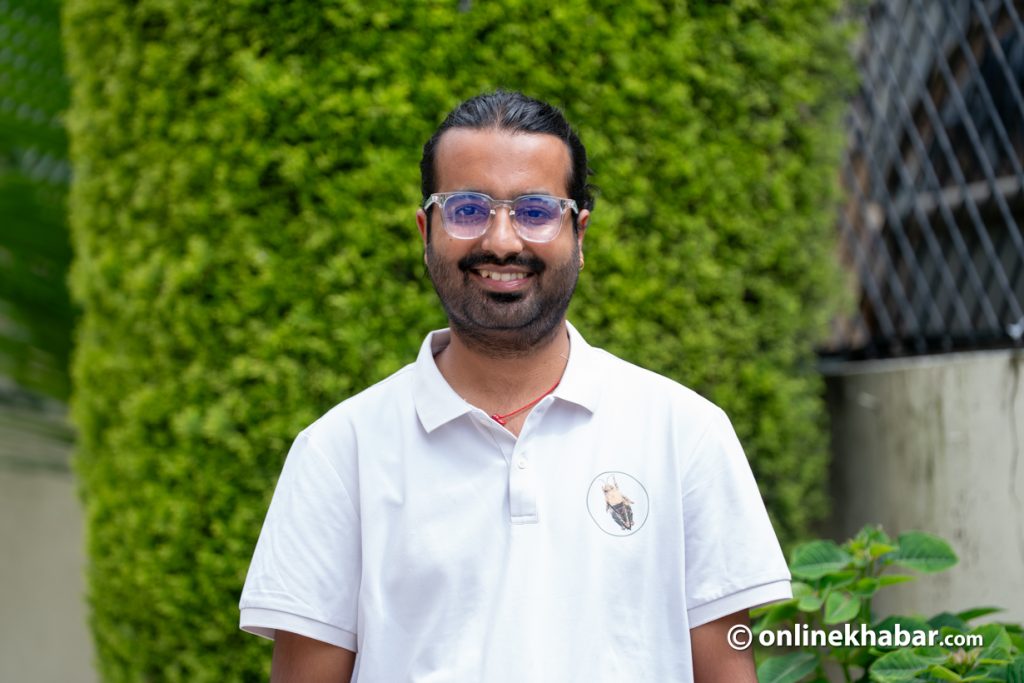
According to Subedi, ground hoppers are usually found in damp areas, near water sources and in paddy fields, feeding on fertile soil, algae and moss. They don’t harm crops; rather, they become food for spiders, frogs and birds.
“These ground hoppers aren’t enemies of crops; they’re important bio-indicators of the ecosystem,” says Subedi, who has travelled from Koshi to the far west researching them.
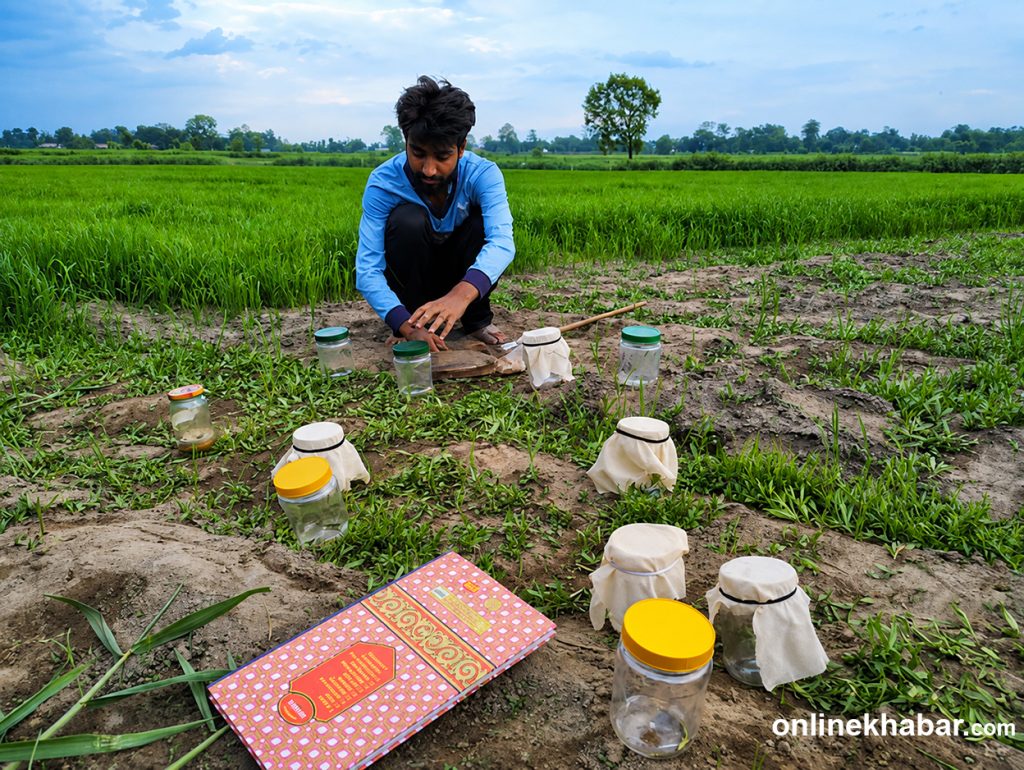
During his master’s thesis work, his bag always held a camera and transparent plastic containers. Whenever a grasshopper looked new, he’d place it in a container, occasionally feeding it the grass species grasshoppers typically eat, and cover the opening with breathable cloth secured with a rubber band, letting the grasshoppers get oxygen and survive longer. He used a net to collect larger numbers, one woven for him by the Magar community near his village in Parbat.
Now he follows a more scientific process. During his thesis, he mainly studied larger grasshoppers, most from the Acrididae and Pyrgomorphidae families. Now he focuses on ground hoppers of the Tetrigidae family, which are much smaller, typically under 2 centimetres.
“I currently use a ‘killing jar’ with a chemical called ethyl acetate, which helps kill the insects painlessly,” Subedi says. “The dead insects are then pinned with rust-proof insect pins and preserved, and their morphology, external structure, is studied.”
He devotes his time outside office hours and on public holidays to research. This year, he plans to conduct research in national parks and has applied for permission from park offices. The path of research, especially on grasshoppers, isn’t easy, but because it’s his passion, he remains active in it. Despite all the difficulties, he says he finds more joy in the process of discovery than in the results themselves.
While serving farmers as an agriculture officer in Ghyalchok, Gorkha, Madan Subedi is also adding new facts to the world’s understanding of grasshopper classification, contributing, brick by brick, to Nepal’s biodiversity record. In his own words, he sums himself up simply: “I am just a ground person searching for ground hoppers.”