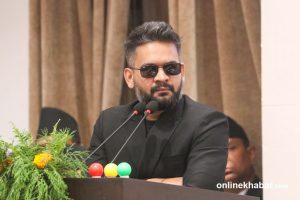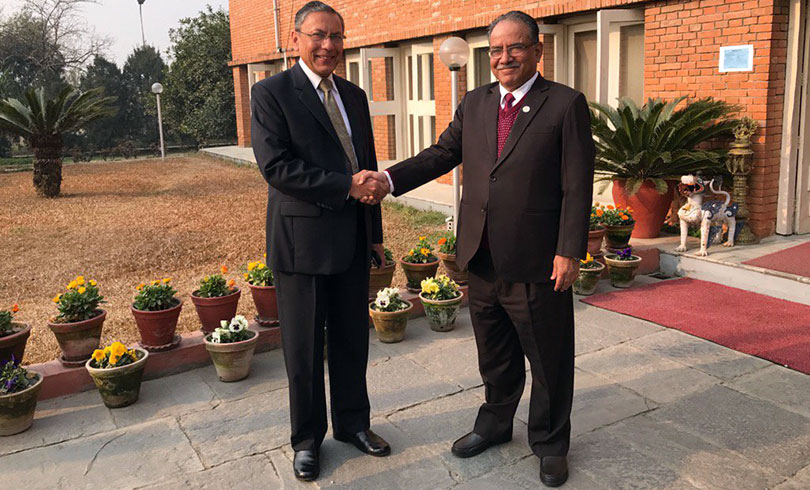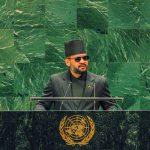

The statement made by Prime Minister Balendra Shah in the House of Representatives regarding the Nepal-India border has caused waves in Nepali politics. Meanwhile, Rabi Lamichhane, the chairman of the ruling Rastriya Swatantra Party (RSP), and Foreign Minister Shishir Khanal have visited India.
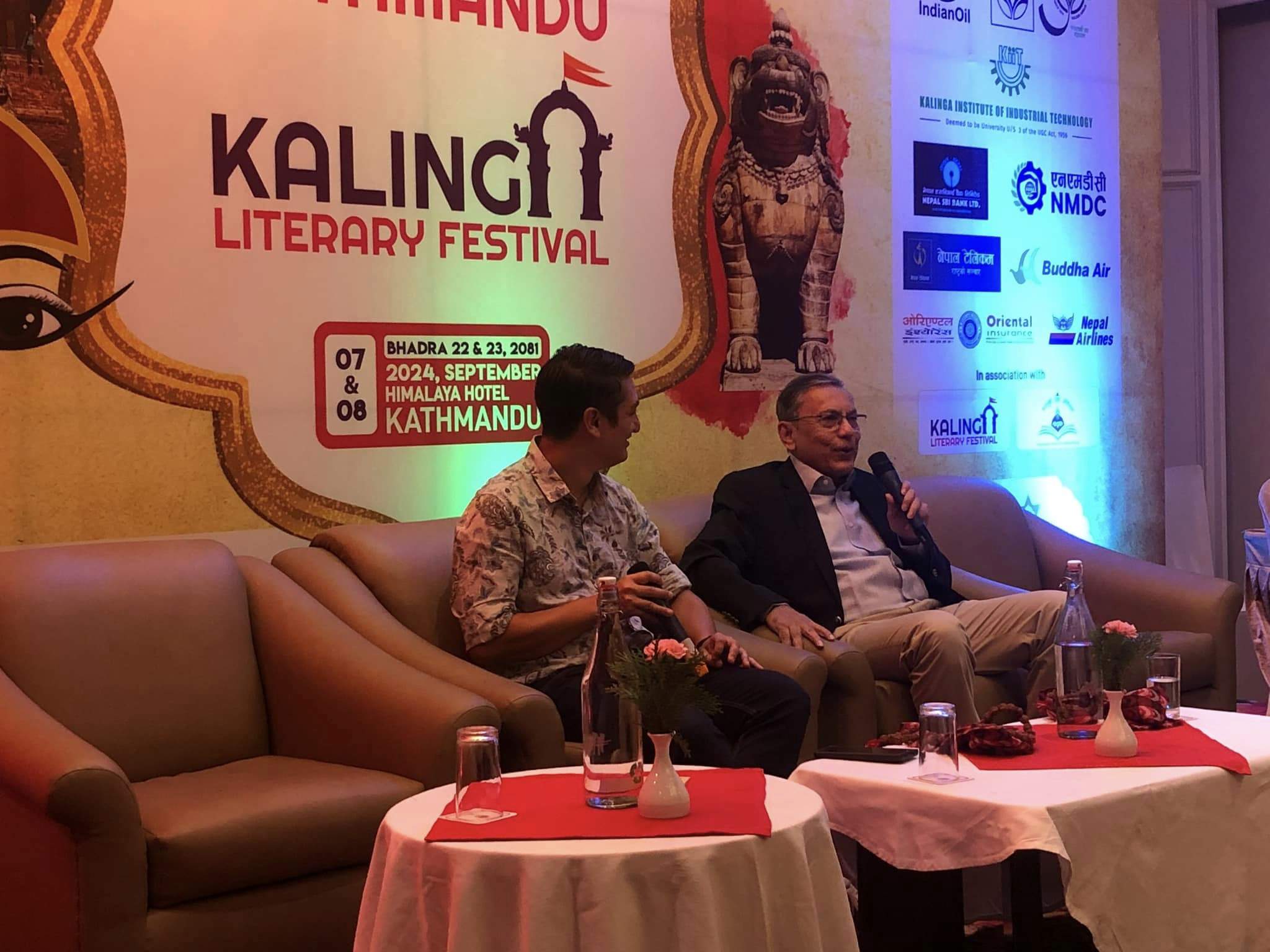
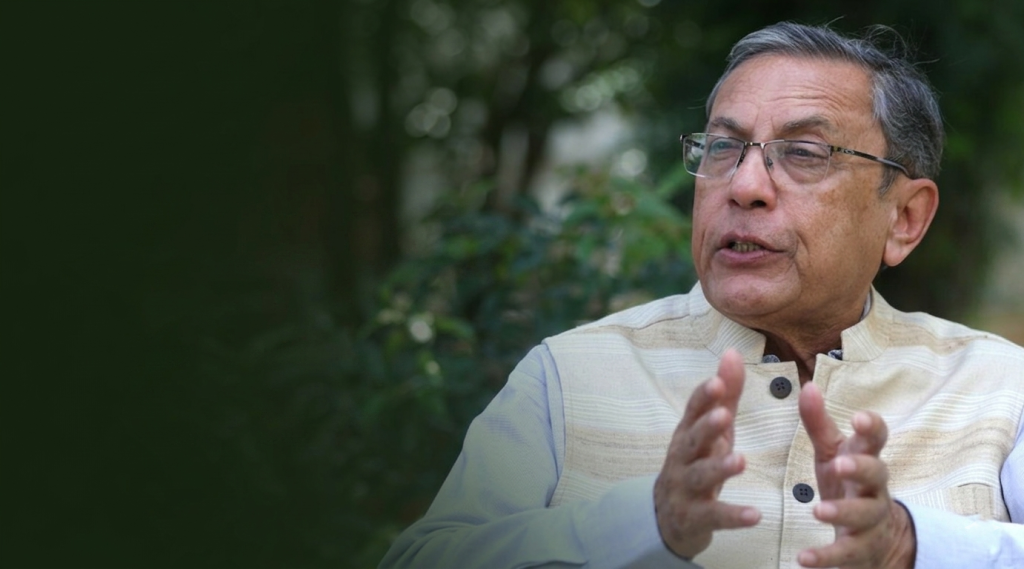
In this context, Onlinekhabar spoke with Ranjit Rae, the former Ambassador of India to Nepal.
Excerpt:
Historically, there has been a trend where the newly elected Prime Minister of Nepal visits India as their first overseas trip. Recently, however, the President of the Rastriya Swatantra Party (RSP), Rabi Lamichhane, visited India before the Prime Minister and was received with significant honour by the Indian establishment. How do you analyse these developments?
Well, you know the nature of the relationship between India and Nepal. It is a very important relationship for both countries, from both development and security perspectives, and we share very cordial, warm relations. Naturally, whenever there are changes in the political leadership or in the government, exchanges and visits take place. Nepal has gone through a major transformation following the People’s Movement. As a result, you have a new set of political leaders and new political parties, so we must establish good relations with this new leadership.
I think you have to see RSP Chairman Rabi Lamichhane’s visit from that perspective. While the regular business of strengthening relations goes on at various levels, it is crucial to have a political push at the highest levels.
So, we are very happy that Rabi Lamichhane visited India and that it was a very successful and productive visit.
Since the visit of the Prime Minister is not happening in the immediate future, can we interpret this as Track II diplomacy?
No, I would not look at it like that. As far as I know, the Prime Minister of Nepal has accepted the invitation to visit India; it is only that the dates have not been finalised yet.
Yes, and as your Foreign Minister recently mentioned, he is quite preoccupied with domestic priorities.
Exactly. Perhaps the visit will take place at a later date, and we respect that. But what I am trying to say is that, given the nature of the relationship, we should look forward to interactions at the highest political level between our two countries. The visits of Lamichhane and Foreign Minister Shishir Khanal should be viewed from that perspective. I am certain the Government of India is looking forward to the visit of the Prime Minister whenever it is convenient for both him and India.
As you mentioned, following the RSP President’s visit, Nepal’s Foreign Minister, Shishir Khanal, also visited India and had a highly fruitful engagement. How do you view the achievements of his visit?
Very positively. For me, two major issues stand out. One is his focus on development diplomacy, and the second is his statement that his party does not carry the political baggage and prejudices of the past. They are starting from a clean slate and want to focus heavily on economic partnership and economic development.
These are highly significant statements coming from both RSP President Rabi Lamichhane and Foreign Minister Shishir Khanal. I believe these statements prepare the ground for rapid momentum in the economic partnership between our two countries. Lamichhane also wrote a very comprehensive article in one of our newspapers before his visit, laying out the vision of the Nepalese side and how they want to take this cooperation forward. This has been very well received both at the highest political levels in India and by the public.
So you mentioned that Rabi Lamichhane and Shishir Khanal publicly stated that they would not carry the old baggage of the past. What could be the inherent message of this statement regarding the Nepal-India relationship?
I think the clear message, as I understand it, is that the priorities today are truly focused on economic development. They will not allow issues that have caused difficulties in the relationship in the past to hamper this economic cooperation. Secondly, the RSP holds a commanding majority in parliament, making it a very stable and confident government that doesn’t require the support of other parties to survive. Therefore, they don’t need to play the kind of anti-India nationalism card that we have seen some political parties and leaders use in the past to strengthen their domestic political positions. The RSP is in a much more comfortable position. That is how I interpret these remarks.
How might the Indian establishment and government interpret it? Would they view it the same way you mentioned, or might they interpret it differently?
Well, I am not in the government, so I can only give you my personal interpretation. However, I believe these remarks have been taken very positively by the Indian establishment. You can see that from the nature of the reception given to both visiting leaders, as well as the huge interest on the Indian side. I do not recall any prior Foreign Minister of Nepal giving this many interviews to electronic media and newspapers. There was an immense amount of interest in India, which highlights the significance and importance of this relationship.
Regarding the border issues, the disputes between the two countries, particularly concerning Kalapani, have come to the forefront again following the India-China agreement to use the Lipulekh Pass for trade and the Kailash Mansarovar pilgrimage. Since both Nepal and India acknowledge Kalapani and Susta as disputed territories, shouldn’t these bilateral disputes be resolved before India makes such arrangements with China?
You know, the arrangements we have with China have been ongoing for many decades, so there is nothing new there. The use of the Lipulekh Pass for pilgrimages and border trade has been happening for a long time. As far as the boundary issue is concerned, the only dispute in that sector that India accepts is the limited area of Kalapani. What happened in 2020 is that Nepal expanded the area of the dispute to include the Lipulekh Pass and Limpiyadhura. This is something India has never accepted. Furthermore, this specific issue was raised by Nepal after more than 200 years. It was raised once after the Treaty of Sugauli was signed in 1816 with the British East India Company, but it was not accepted by the British Governor-General at the time. Now, suddenly, this issue has resurfaced in 2020. So you can imagine, after 200 years, if my arithmetic is correct, we have not accepted these additional areas as disputed.
As for Kalapani and Susta, the only way to resolve these issues is through bilateral negotiations and discussions based on data, evidence, and historical material available to both countries. I am in complete agreement with what Foreign Minister Khanal said: it basically has to be resolved through negotiations. I personally feel the time has now come to hold these talks. For your viewers, I want to emphasise that 98% of the India-Nepal boundary has already been finalised and agreed upon. Strip maps have been signed and initialled at the technical level. Only 2% remains, and this 2% can absolutely be resolved through political negotiations. We have an established mechanism at the Foreign Secretary level. This mechanism should be convened, dates should be fixed for the meeting, and now you have a government in Nepal with almost a two-thirds majority. It is a very strong government, and we hope that whatever the outcome of the negotiations is, it will be accepted and endorsed by your parliament, especially given that the new map of Nepal was endorsed through a constitutional amendment.
You mentioned that there have been border issues for more than 200 years. A decade ago, in 2015, India successfully resolved a highly complex border dispute with Bangladesh. However, despite historically good relations, the longstanding border dispute between Nepal and India remains unresolved. What could be the reason behind this?
First of all, I don’t think it is a longstanding dispute. As I mentioned, Nepal raised this specific claim after 200 years; it hadn’t been raised for over two centuries and suddenly came up in 2020. So it is a very new dispute in that sense.
As for the Kalapani dispute, I believe that came up when I.K. Gujral was the Prime Minister of India, raised around the late 1980s or early 1990s- I am not sure of the exact date. The dispute over Kalapani and Susta has not been resolved at the technical level by surveyors over these years. Therefore, as I said, while 98% of the boundary has been resolved technically, Kalapani and Susta must be resolved at the political level. That is why Foreign Secretary-level talks are so crucial. I am confident both sides will be able to find a mutually acceptable solution. Why keep these issues as continuous irritants forever? It is far better to negotiate and resolve them, and the time has come to start these discussions at the Foreign Secretary level.
Rabi Lamichhane, Nepal’s Foreign Minister Shishir Khanal, and even the Indian External Affairs Minister S. Jaishankar have all recently stated that development diplomacy, as you mentioned, is the foremost priority between the two countries. Could you explain what development diplomacy entails in the context of Nepal-India relations?
Oh, this is absolutely a critical area, and I am very happy that economic diplomacy and development diplomacy are priorities for both countries. From India’s perspective, if we can integrate the sub-region- Bangladesh, Bhutan, India, and Nepal- as one economic space where each country can exploit its full comparative advantage and where there are seamless trade and investment opportunities, then all these countries will grow together very substantially.
We have already done a lot of work on connectivity issues, whether it is roads, railways, integrated check posts, digital connectivity, cultural and tourism connectivity, or religious circuits. A lot of work has been done on infrastructure development, and the legal frameworks are already in place, whether it is double taxation avoidance agreements or the bilateral and legal infrastructure that enables our private and public companies to take advantage of these opportunities. Really, I think in our region, we all have to grow together. We can grow individually as well, but if we grow together, our growth will be much more rapid.
I think this is the way to go. This is what is so important about the message from the RSP Chairman and the Foreign Minister of Nepal- that their priority is economic development and the prosperity of the people of Nepal, just as it is for the people of India. With this kind of economic cooperation, some of the political issues and irritants that may have existed in the past will be much easier to resolve when both countries benefit from each other’s growth. So, I think this
is truly the way forward, and it is receiving a huge political push at the highest level today.
And I have one last question. The report prepared by the Eminent Persons Group (EPG) has not been formally received by the Prime Minister of either country, despite being completed a long time ago. What could be the reason behind this delay?
I really don’t know what the exact reason is, but obviously, even after so many years, the report has not been endorsed or accepted. My understanding is that the key issue in the report is the review of the 1950 treaty. On this issue, I think both countries are completely willing to begin negotiations. So, instead of focusing on why the report has not been received or what the administrative problem is, we should focus on the core issue, which is the review of the 1950 treaty. For this, too, we have the established Foreign Secretary-level mechanism. The easiest thing to do is to convene a meeting of the Foreign Secretaries to discuss the 1950 treaty. What is the ultimate significance of whether the physical report has been formally received or not? For us, the important thing is the main substantive issue of the report, which is the 1950 treaty, and both countries should start discussions on reviewing it. I honestly don’t understand why these discussions have not started, because both sides are willing. When our Prime Minister went to Nepal, he said very clearly that India is prepared to discuss, negotiate, and look at how the treaty is to be reviewed, or look at any proposals that Nepal has in this regard. So, I really think dates should be fixed for the Foreign Secretary-level mechanism to meet, and formal discussions should begin.
Since the report was prepared unanimously, receiving the report would be a good gesture, don’t you think?
Perhaps. But the point is that this report has not been received, and it has been many years now. There is obviously some underlying reason as to why it has not been received. I don’t see the purpose of continuously repeating, “receive the report, receive the report, “it is clearly not going to be received in that manner. It is better to focus on the actual content of the report and start negotiations and discussions on that. In Hindi, we have a saying: essentially, what is the ultimate objective? If the objective is to revise or review the 1950 treaty, let the meetings of the two Foreign Secretaries begin.