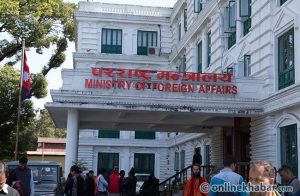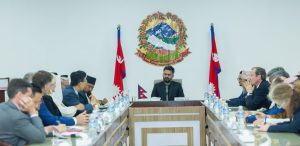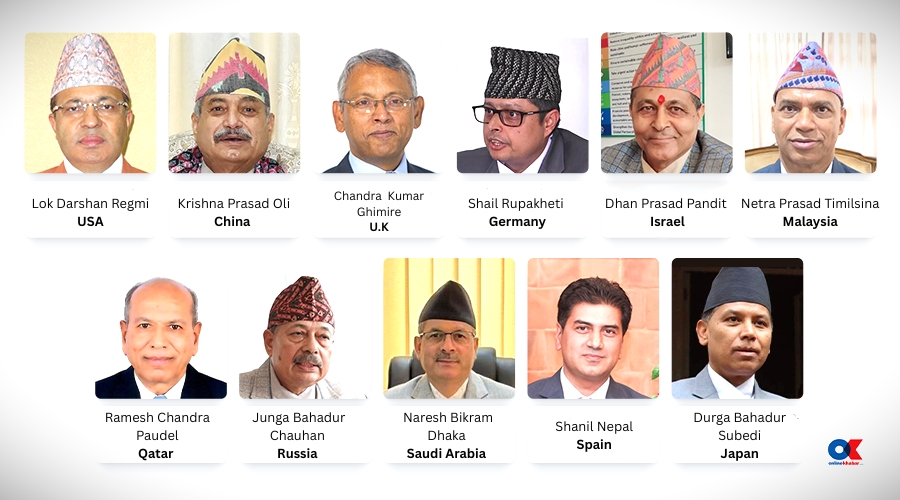

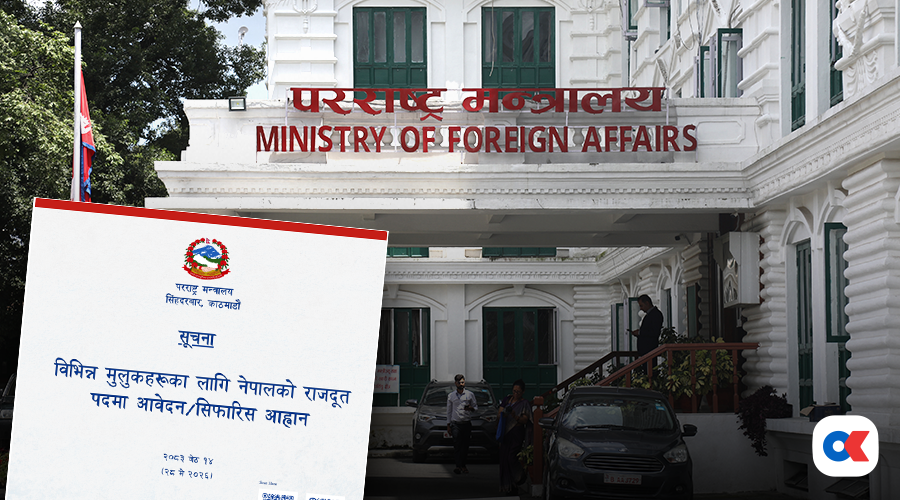
On May 28, the government invited applications for ambassadorial appointments through an open competition process. The Ministry of Foreign Affairs issued the “Terms of Reference: Ambassador of Nepal” and called for applications from qualified Nepali citizens for ambassadorial posts in 13 countries, including China, the United States, and India. The application deadline has been set for June 5.
Applicants must be Nepali citizens at least 35 years of age and hold a bachelor’s degree from a recognised university.
Individuals convicted of corruption, moral misconduct, or dismissed from government service are ineligible to apply. Likewise, those holding permanent or temporary foreign residency permits and those employed by internationally funded non-governmental organisations are also disqualified.
The ministry has identified experience in foreign policy, international relations, and diplomacy, proficiency in English, and high moral character as mandatory qualifications.
The move to select ambassadors through an application process has been interpreted as a departure from the traditional appointment system. The Ambassador Appointment Guidelines, 2018, provide for two methods of appointment.
First, the Cabinet may select ambassadors from among potential candidates. Second, at least 50 per cent of ambassadorial positions may be filled by serving special-class or first-class officers of the foreign service. Ambassadors selected from serving officials are generally referred to as “career diplomats.”
The newly published “Terms of Reference: Ambassador of Nepal” also outlines the appointment process.
The Ministry of Foreign Affairs will initiate the process by seeking nominations. It will prepare a preliminary list of potential candidates, conduct screening, and then create a shortlist based on qualifications, competence, and suitability for specific postings before recommending candidates to the Cabinet.
Under existing legal provisions, candidates nominated by the Cabinet must appear before the Federal Parliament’s Parliamentary Hearing Committee. After the hearing process is completed, the Ministry of Foreign Affairs will seek the host country’s consent, known as an “agrément,” for the proposed ambassador.
Once agrément is received, the President of Nepal will formally appoint the ambassador on the recommendation of the Cabinet. The appointed ambassador will assume office only after taking the oath of office and secrecy before the Prime Minister, as stipulated in Schedule 1 of the guidelines.
However, questions have been raised regarding the qualifications of ambassadors selected through this process. Some experts argue that selection by the Prime Minister or Cabinet may still be more appropriate than an application-based process. Others have expressed concerns that candidates without political appointments may face difficulties obtaining agrément from host countries.
Foreign Ministry spokesperson Lok Bahadur Paudel dismisses such concerns. He says the government has introduced the new system to establish a new practice and that unnecessary doubts are unwarranted.
“Such concerns have arisen only because this is a completely new process. There have been instances in the past when politically appointed ambassadors also failed to receive agrément. Therefore, the assumption that ambassadors selected through the new process will not receive agrément is baseless,” Paudel said.
In 2008, during the premiership of Pushpa Kamal Dahal, the Cabinet decided to appoint Maoist leader Pampha Bhusal as Nepal’s resident ambassador to France and permanent representative to UNESCO. Although her nomination was approved by the Parliamentary Hearing Committee and Nepal sought agrément from the French government, France did not approve her appointment for a prolonged period.
A similar incident occurred in 1992 during the first term of Girija Prasad Koirala. Nepali Congress leader Pradeep Khatiwada was recommended as ambassador to Myanmar, but the then military government of Myanmar rejected his agrément.
Nepal’s diplomatic history contains several examples of politically appointed ambassadors whose agrément requests were rejected.
Former ambassador to Russia Milan Tuladhar says it is too early to predict the outcome of the new system. He describes it as experimental and says its effectiveness remains to be seen.
“For Nepal, this system is still in an experimental stage. Talented individuals may come forward and demonstrate their abilities. However, talent without experience can sometimes fall short. This aspect deserves careful consideration,” Tuladhar said.
He also warns that individuals without political experience could be selected under the new system, a risk that should not be overlooked. Particular attention, he says, is needed when appointing ambassadors to strategically important countries such as China, India, and the United States.
“It is not necessary that every ambassadorial post be filled through political appointments. However, when appointing ambassadors to countries of special importance to Nepal through open competition, greater caution is required,” he said.
Questions over the selection process
Other concerns have also been raised regarding the appointment process. The ministry is responsible for preparing a preliminary list of candidates, conducting screening, and creating a shortlist based on qualifications, competence, and suitability before forwarding recommendations to the Cabinet.
Some observers argue that the new mechanism, introduced as an alternative to political appointments, still leaves room for political influence. Spokesperson Paudel rejects this interpretation, saying the process should not be compared with the traditional system of political appointments simply because the Cabinet remains involved.
Political and international relations expert Sanjeev Humagain, however, believes it is misleading to portray the process as non-political. He argues that diplomacy and ambassadorial appointments are inherently political because they involve representing national power and interests on the international stage.
“The appointment process has been presented as non-political. However, since the Cabinet itself conducts the screening and shortlisting, it cannot realistically be considered non-political,” Humagain said.
While he does not see major reasons to doubt the government’s new arrangement, he cautions that appointing candidates without political experience could create additional diplomatic challenges.
“The relationships Nepal has with countries such as China, India, and the United States can no longer be viewed in conventional terms. These relationships have become exceptional in nature. In such contexts, ambassadors who maintain close personal ties with the Prime Minister, Foreign Minister, and even opposition leaders are often better positioned to advance national interests,” he said.
Referring to international practice, he added, “This is precisely why many countries appoint political figures as ambassadors to key neighbouring states. If ambassadors selected through the current process are unable to develop that level of influence and access, Nepal could end up paying a significant diplomatic price.”