Every year, Nepal’s budget arrives with big promises. The government announces new roads, hospitals, tax changes, subsidies, allowances, and support for different groups. Political parties claim victory. Social media becomes full of instant opinions. For a few days, the budget becomes the most discussed document in the country.
But in all this noise, we often fail to ask one simple question: where does the government’s money actually come from?
The answer seems obvious. Yet we forget it every budget season. The government does not create wealth by itself. Its spending power ultimately comes from citizens, businesses, public assets, natural resources, and borrowing against future taxpayers. Every rupee the government gives to one group must first come from somewhere else.
As such, the public should understand how public finance works everywhere in the world.
The basic truth about government money
There is a truth every taxpayer instinctively understands: government can only spend what the people and the economy first produce. Governments collect money through income tax, corporate tax, VAT, customs duties, fees, dividends, royalties, grants, and loans. They then distribute that money according to national priorities. But the economic source is always the same: the productive capacity of the nation. Every rupee spent by the government comes from one of four main places, and they are as follows:
- Today’s consumers pay VAT and import duties on goods and services.
- Today’s workers and businesses — through income tax and corporate tax.
- Future generations — through government borrowing that tomorrow’s taxpayers must repay.
- All of us quietly — through inflation, which slowly reduces what our money can buy.
There is no fifth source. There is no magic account. There is no free money. Margaret Thatcher once said, “There is no such thing as public money; there is only taxpayers’ money.” Whether one agrees with her politics or not, the statement captures an economic truth that every budget debate should remember.
Why budget excitement can mislead us
Budgets create visible winners. A tax cut benefits one group. A subsidy helps another. A new road improves one district. The people who benefit are easy to see. The people who pay for it are harder to identify. This is why budget season feels exciting. But it can also mislead us.
When taxes are reduced, people celebrate. But few ask how the government will replace that lost income. When new programmes are announced, beneficiaries are happy. But few ask whether the spending will produce lasting results or simply be consumed and forgotten. We focus on what we are receiving. We rarely ask who is paying, and whether the benefit is worth the cost.
There is no such thing as a free benefit
Many people believe that if the government announces enough programmes, everyone can receive more without anyone paying more. This is not how economics works. Suppose the government cuts taxes and, at the same time, increases spending on social programmes. On paper, it looks like everyone is better off. But unless the economy actually grows and produces more wealth, the government will soon face a shortfall.
It will then have to borrow more, raise taxes later, reduce other services, or allow inflation to quietly reduce purchasing power. The bill does not disappear. It only moves. Sometimes it arrives in five years. Sometimes in ten. But it always arrives — through higher taxes, higher prices, or reduced services for our children. Costs can be delayed. They cannot be erased.
Spending money and investing money are not the same thing
This is one of the most important ideas in any budget discussion. Not all government spending is equal. Some spending is consumed immediately and leaves little behind. Paying salaries, covering administrative costs, and running daily government operations are necessary, but they do not directly create new wealth.
Some spending is investment. Building roads, transmission lines, schools, hospitals, irrigation systems, digital infrastructure, and hydropower projects can create value for many years if they are properly selected and executed. A family that borrows money to buy productive farmland may be making a wise investment. A family that borrows money to pay for groceries every month is heading towards trouble. The debt may look similar, but one creates future income while the other does not.
Nepal’s fiscal challenge is serious because a large part of government revenue is absorbed by recurrent expenditure — salaries, pensions, administration, interest payments, and daily operating costs. This leaves limited domestic fiscal space for development. As a result, a significant share of capital spending depends on borrowing, grants, and external support.
This is not automatically wrong. Borrowing for productive investment can be sensible. But borrowing becomes dangerous when it finances consumption, leakages, delays, or projects that do not generate economic returns.
Borrowing is fine if we use it wisely
Borrowing is not automatically bad. Every country borrows. The real question is: what do we borrow for?
Borrowing to build a hydropower project that will generate electricity, export revenue, and tax income for decades can make sense. Borrowing to pay routine expenditure makes little sense. The debt remains, but nothing new is created to repay it.
Nepal has another weakness we must honestly confront. Even when money is allocated for good purposes — roads, irrigation, power, public buildings, or local infrastructure — we often fail to spend it properly and on time. Too often, development funds remain underutilised for much of the fiscal year. Then, in the final weeks, spending is rushed to meet budget deadlines.
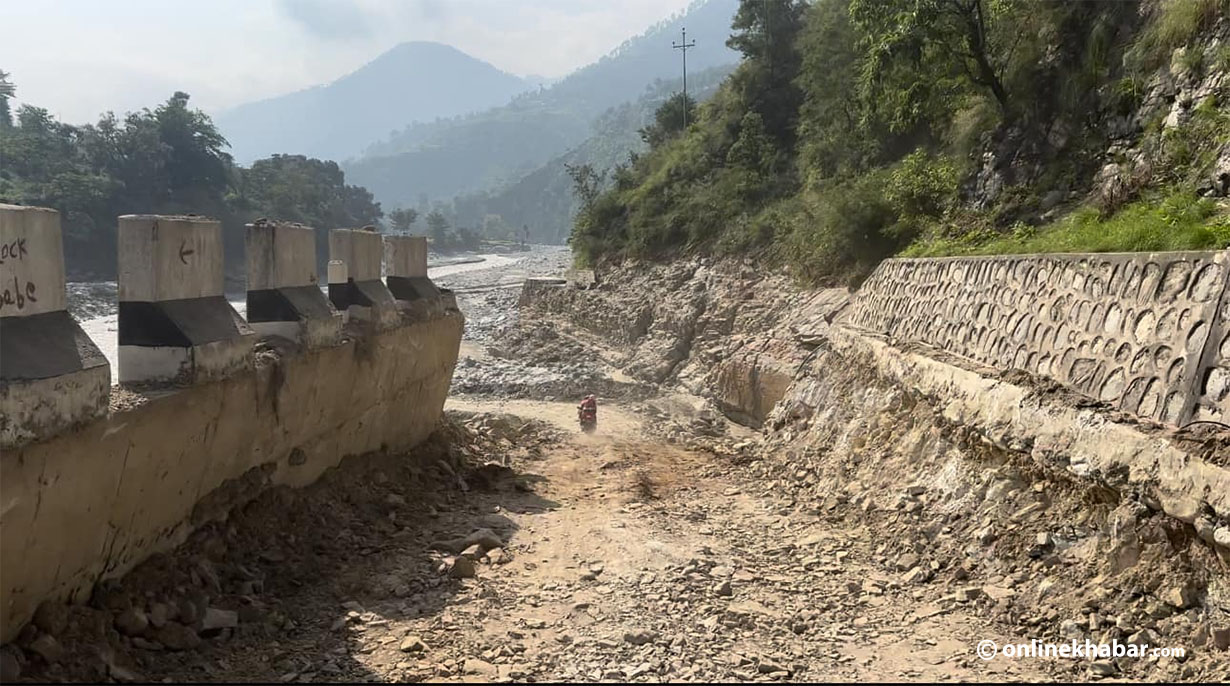
This frantic year-end spending, commonly known as Asare Bikas, weakens quality, reduces accountability, and wastes public money. Borrowing wisely only works if we also build wisely. A half-finished road is not an asset. It is an expensive liability.
Nepal’s particular challenge
Nepal faces a problem that we do not discuss honestly enough. A large part of household consumption in Nepal is supported by remittance income. Nepali workers leave the country to work in Qatar, Malaysia, South Korea, the Gulf, and other destinations. They send money home to their families. Those families spend the money on food, clothing, construction materials, electronics, transport, education, and daily needs — many of which are imported.
The government then collects customs duties, VAT, and other taxes from this consumption. That revenue helps pay salaries, run offices, and finance government operations. Think about that for a moment. We are partly funding the state by taxing the consumption of families whose sons and daughters had to leave Nepal because the domestic economy could not provide enough jobs.
This is not a development strategy. It is a holding pattern. And it cannot last forever. Real, lasting prosperity requires growing our own productive economy. That means:
- Supporting Nepali businesses and entrepreneurs so they can grow and create jobs at home.
- Developing tourism seriously, with infrastructure, service quality, and year-round product diversification.
- Exporting more electricity from our rivers instead of importing more fuel.
- Modernising agriculture so it feeds our cities, reduces imports, and earns export income.
- Making Nepal a credible and predictable place for foreign and domestic investors.
Without real economic growth, we are simply dividing the same small pie into smaller and smaller pieces.
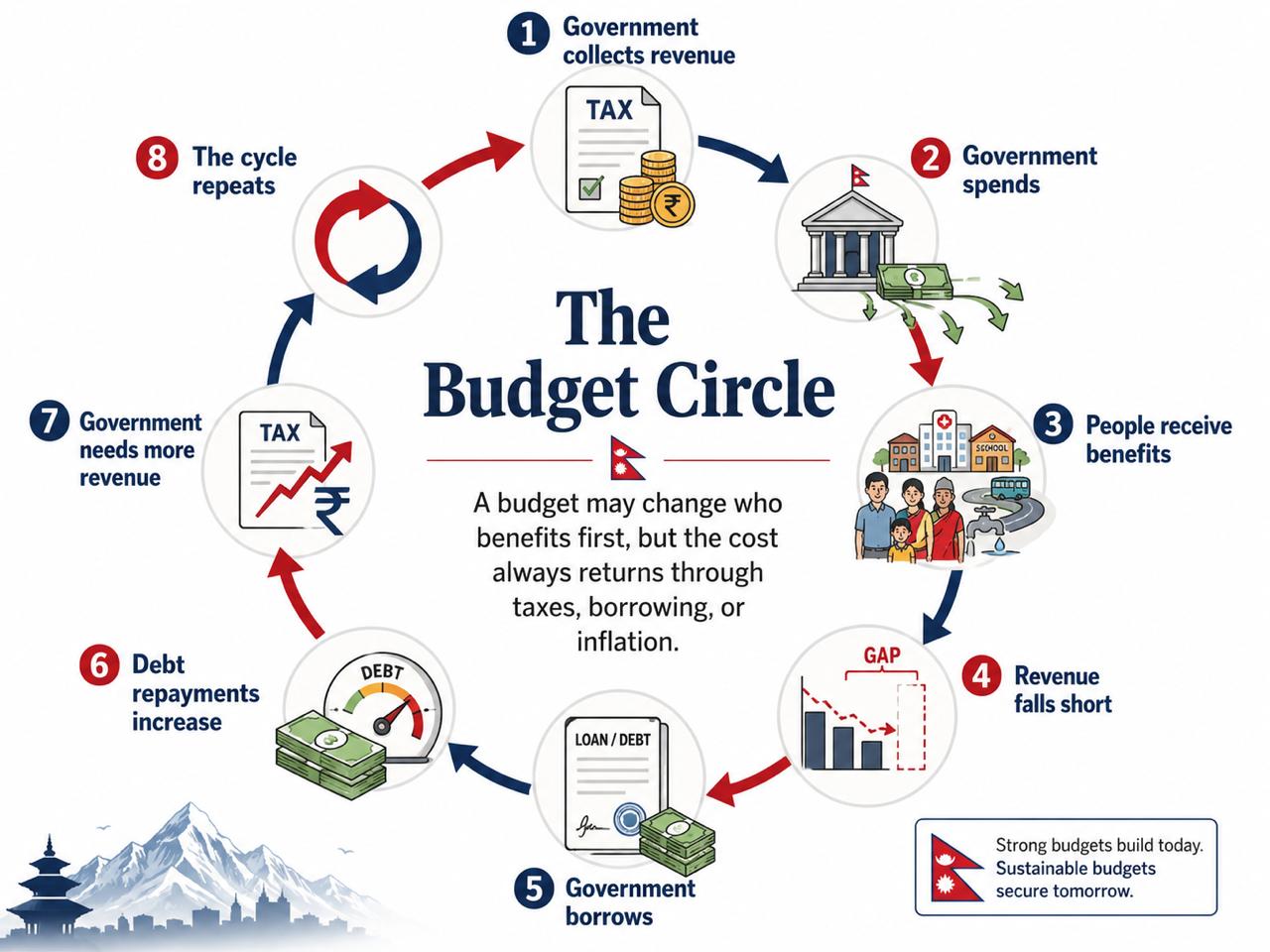
The budget circle
I describe this as the Budget Circle:
Government collects revenue → Government spends → People receive benefits → Revenue falls short → Government borrows → Debt repayments increase → Government needs more revenue → the cycle repeats.
Every government runs some version of this cycle. That is normal.
The question is whether each round of the cycle leaves Nepal stronger. Is the economy growing? Are more people employed? Are businesses more competitive? Are we exporting more? Are taxpayers getting better services? Are borrowed funds creating assets that can repay themselves?
If yes, the cycle is working. If not, we are simply going deeper into debt with too little to show for it.
What we should actually be excited about
We have become too excited about what the budget gives us today. We should be more excited about what it builds for tomorrow.
A good budget is not measured by how many announcements it contains. It should be measured by honest answers to simple questions:
- Will this help Nepal sell more goods and services to the world?
- Will this bring new businesses and investors to Nepal?
- Will this create jobs that our young people do not have to leave Nepal to find?
- Will this make it cheaper and easier to run a business here?
- Will this produce enough economic growth to pay for itself over time?
- Will this improve the capacity of the government to deliver services more efficiently?
These questions matter far more than the size of any individual subsidy or announcement.
Growing the pie, not just dividing it
The most successful countries learned one lesson above all others: it is better to grow the economy than to endlessly argue about how to divide what already exists. When an economy grows, almost every problem becomes easier. Tax revenue increases without necessarily raising tax rates. Jobs become available. Debt becomes manageable. Schools and hospitals become easier to fund. Investor confidence improves.
When an economy stagnates, every decision becomes painful. Giving more to one group means taking from another. Arguments become louder. Trust breaks down. And the people who can leave, leave. Nepal cannot afford to stay in that second category.
Reading the budget differently
When the next budget is announced, I encourage every Nepali citizen to read it differently.
Do not only ask: ‘What am I receiving?’ Also ask: ‘Who is paying for this, and is it worth it?’
Do not only celebrate tax cuts. Ask whether productivity will actually improve.
Do not only welcome new programmes. Ask whether they will generate real results or simply disappear into the system.
Do not only note the borrowing figures. Ask whether what we are building with those loans will be worth more than what we will owe.
Nepal is a country of enormous potential. We have water, mountains, culture, young people, and entrepreneurial energy. But potential only becomes prosperity through honest choices, disciplined investment, and the courage to ask difficult questions.
The budget is not just a government document. It is a statement of what we value, what we are willing to pay for, and what kind of Nepal we are building for our children.
Nepal does not need a budget that only distributes hope. It needs a budget that builds capacity — capacity to produce, export, employ, invest, and repay. The real success of a budget should not be judged on budget day. It should be judged five years later by asking one question: Did it make Nepal stronger?
Budgets come and go every year. The choices we make with them shape generations.