
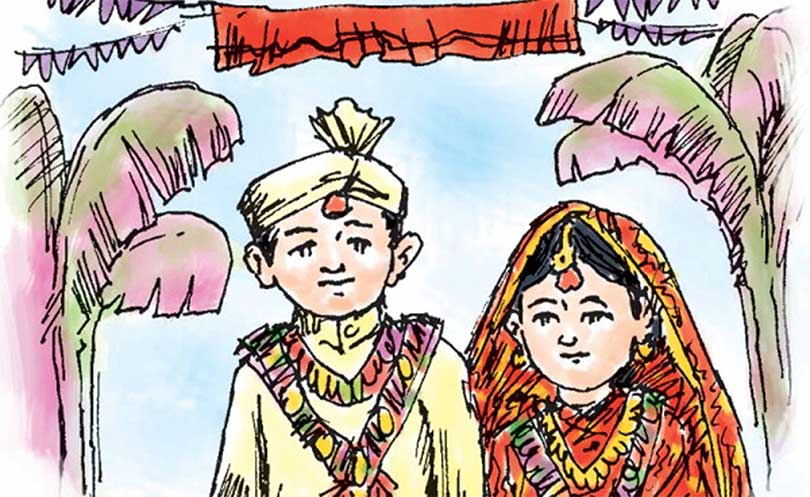
In Nepal, child, early and forced marriage (CEFM) exists despite strong legal provisions. The legal age of marriage is 20 years, and Nepal has committed to SDG 5.3, which aims to eliminate harmful practices like child marriage by 2030. However, the reality on the ground tells a different story.
In many socio-economically disadvantaged and remote communities, early marriage remains common. This shows a clear gap between what policies promise and what is there in daily lives. Laws alone are not enough if the enforcement is weak and deep-rooted social norms continue to influence behaviour.
CEFM in Nepal is closely tied to long-standing social beliefs and gender inequality. In many communities, daughters are still seen as an economic burden. Still, a few families feel that investing in a girl’s education has little return because she will eventually marry and leave the house. Dowry practices further reinforce that thinking.
As a result, marriage is becoming a way for those families to shift responsibility to another household. Alongside this, girls are closely tied to family honour. Parents fear social judgment if their daughters form relationships, do self-initiated marriage and inter-caste marriage. To avoid shame or gossip, those families sometimes arrange early marriage, child marriage, or forced marriage as a form of protection.
Cultural and religious beliefs also play a role in sustaining that practice. Traditions such as ‘Kanyadan’ or the idea that marrying girls early brings religious merit still influence decisions in some remote communities. These beliefs are passed down from one generation to another and are reinforced by community expectations, even though people are aware that early marriage can have harmful consequences.
Economic hardship is another major factor. For many families, especially in rural areas, early marriage is seen as a practical solution to financial challenges. Marrying a daughter early can reduce household expenses and sometimes lower dowry expectations. When families struggle to meet basic needs, education for girls is often not prioritised. Instead, marriage is viewed as a safer and more immediate option.
At the same time, there is evidence that if families have better economic opportunities, child marriage automatically decreases. When girls or adolescents have access to jobs, skills training or small business opportunities, they are more likely to delay marriage. However, not all economic programs are becoming effective now. Short-term training without links to real jobs or markets often leads to failure. For real change, economic support needs to be practical, connected to local markets and connected with government systems.
Education plays a critical role in preventing child, early or forced marriage, but there are still many challenges. Currently, most of the children are attending school for more than 10 years, but still, many girls are dropping out during adolescence or transitioning to the next level. If a girl leaves school, marriage often becomes the next step. Several factors are contributing to this, including unsafe school environments, a lack of proper facilities such as toilets and menstrual hygiene support, and weak law enforcement systems to address harassment or discrimination. Social pressure is also increasing during the transition, which is pushing girls or adolescents out of school.
Another issue is how education is delivered in schools. Topics like ‘Sexual and Reproductive Health and Rights (SRHR)’ are included in the curriculum, but they are often taught in a theoretical way. Mostly, students are learning to pass the exams, but they hardly gain real insights, knowledge or life skills. This is leaving many adolescents or girls confused or misinformed and making them more vulnerable to early relationships and marriage decisions influenced by curiosity or peer pressure. When schools are safe, inclusive, and supportive, the results could be different, or girls or vulnerable children might stay longer, and dropout rates decrease.
Social pressure within communities plays a powerful role, too. In many cases, fear of gossip or social exclusion is shaping CEFM decisions. Interaction between boyfriend and girlfriend is often restricted in some communities, and relationships before marriage are discouraged. Parents may feel that early marriage is the safest way to protect their children from criticism. There is also a growing trend of self-initiated marriages among young people influenced by mobile phones, social media, and limited freedom to interact. This is creating a CEFM situation or contributing to early marriage.
Although Nepal has strong laws against child marriage, enforcement remains weak. Local governments often lack the resources and training to act effectively. Many families are not fully aware of the legal age of marriage or the penalties involved. Systems for reporting and responding to child marriage are not fully functional. Birth and marriage registration processes are also inconsistent, making it easier to misreport age. In addition, budgets for child protection and gender equality are often limited, which is reducing the ability of local governments to act as expected.
Efforts for addressing child, early or forced marriage seem fragmented. Many programs are short-term and limited to donor interest areas. These projects have some positive results, but they do not continue long enough to create lasting change. In some cases, more attention is being given to administrative processes than to real community engagement. Lack of coordination between government bodies, implementing organisations, and development partners is leading to duplication and reducing impact. For sustainable changes, efforts need to be integrated into government systems and supported as per contextual realities.
Another important issue is awareness. Many families and young people are not aware on the long-term effects of early or child marriage on health, education, and economic independence. In some cases, early or child marriage is still seen to protect girls from harm, such as harassment or unsafe relationships. However, early or child marriage often increases risks, including health complications and limited opportunities.
Nepal has set clear targets to end child marriage by 2030. These include reducing the number of marriages before 18, encouraging marriage at the legal age of 20 or above, keeping girls in school, and improving their ability to make decisions about their lives. Achieving these goals requires strong action, such as improving completion of education, reducing dropout rates, expanding SRHR services, and strengthening birth and marriage registration systems. Local governments have a key role to play by including these priorities in their plans and budgets.
There is growing evidence that child marriage can be reduced through coordinated and long-term efforts. Education systems need to be safer and more supportive, with flexible options for girls who are at risk of dropping out. Economic programs should focus on real opportunities, linking skills training with jobs or business support. Communities need to be engaged through dialogue, involving parents, religious leaders and local influencers to gradually shift social norms. Empowering adolescents with life skills, confidence, and support networks is equally important.
At the same time, government systems must be strengthened. This includes improving law enforcement, building the capacity of local institutions, ensuring proper registration systems, and using data to guide decisions. Most importantly, successful initiatives must be integrated into local planning and budgeting processes so that they continue beyond short-term projects.
The evidence is clear. If girls are educated, economically empowered, and supported by strong systems, early or child marriage declines. The challenge now is not finding solutions but implementing consistently and at scale. Without this, child marriage will continue to limit opportunities for girls and slow down Nepal’s broader social and economic development.
Nepal is at an important moment. The country has the policies, commitments, and knowledge needed to end child marriage. However, real progress will depend on how well these are translated into actions or integrated into the local government’s planning and budgeting. Child marriage is not just about early unions but also a mirror of the deeper inequalities of our society. Addressing CEFM requires a long-term political commitment, sufficient resources, and strong collaboration between communities and government institutions.