
Kathmandu
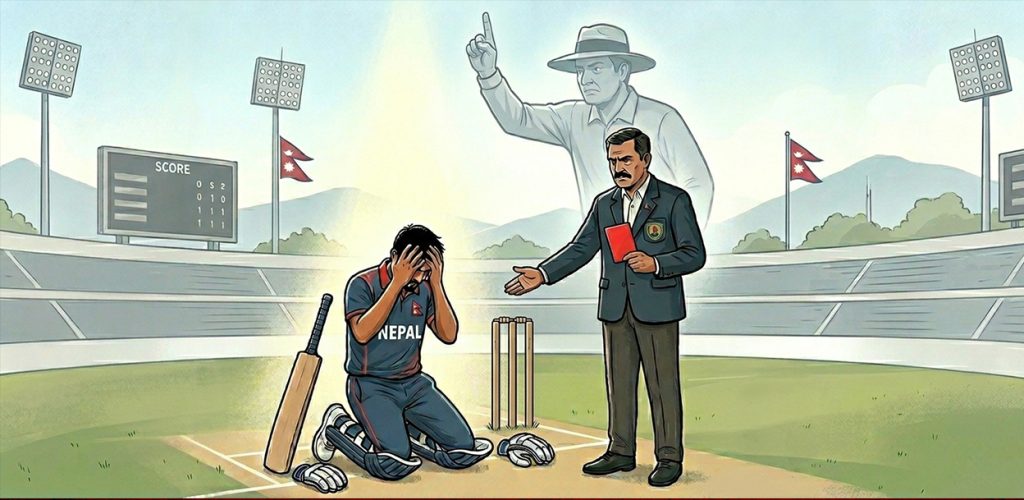
Lumbini captain Dev Khanal was handed a one-match suspension after expressing dissatisfaction with an umpire’s decision during a PM Cup one-day match against Madhesh Province.
On the final ball of the eighth over, Dev attempted an upper cut off Rupesh Singh’s delivery and was given out following a catch by the wicketkeeper. Dev protested the decision and remained on the field briefly, leading the match referee to impose the suspension as disciplinary action.
In a similar incident during the second edition of the Nepal Premier League (NPL), Rijan Dhakal of Chitwan Rhinos showed dissent after an LBW appeal was turned down by the umpire, which also resulted in disciplinary action.
The latest edition of the league has faced strong criticism over multiple questionable umpiring decisions.
Last year, during the Jay Trophy, cricketer Sandeep Lamichhane publicly stated on social media that umpiring standards in Nepal require significant improvement. He warned that long-standing issues, if left unaddressed, could cause many players to suffer due to incorrect decisions. He, too, was handed a one-match suspension following his remarks.
Despite repeated controversies, while players have been punished, no action has been taken against umpires or their decisions. The Cricket Association of Nepal has also remained largely silent on the issue.
Some umpires themselves have expressed dissatisfaction. A senior umpire said that while players are penalised for mistakes, repeated errors by umpires go unchecked. He questioned how umpiring standards could improve if no accountability is enforced.
Lumbini head coach Basant Shahi also expressed concern, stating that not just his team but almost all teams are unhappy with the standard of umpiring in the PM Cup, and that improvements are necessary.
Teams regularly provide feedback on umpiring decisions after matches. Ideally, such feedback should be used to penalise underperforming umpires and encourage those performing well. However, there appears to be little attention from CAN in this regard.
Another senior umpire pointed out that Nepal lacks an independent committee to evaluate umpiring standards. He added that appointments are often influenced by affiliations, whether at the club, district, or provincial level, and continue to create such issues.
Coach Shahi argued that umpires should be evaluated just like players, based on performance reports. He said good performers should be promoted while underperforming officials should be replaced, warning that without such measures, neither umpiring nor cricket standards will improve.
President of the Cricket Umpires and Scorers Association Nepal (CUSAN), Sameer Khan, acknowledged that errors do occur. He said mistakes are unavoidable and not unique to Nepal, as even international cricket witnesses such issues. Umpires, being human, often have only seconds to make decisions, which can sometimes lead to errors. He added that various programs are being implemented to minimise such mistakes.
Although umpires are not subject to immediate punishment like players, Khan claimed that action can be taken after tournaments based on match reports reviewed by the board.
Coach Shahi reiterated that umpires should be assigned responsibilities based on performance, similar to players in the national team. He said no player can continue without performing, and the same principle should apply to umpires to ensure accountability and professionalism.
Grading based on evaluation
The issue of umpiring errors is not unknown to CAN. However, a pattern of reacting during controversies and then neglecting the matter has hindered progress in raising umpiring standards.
The topic was recently discussed in a CAN board meeting. The association is now preparing to introduce a grading system for umpires based on their work and contributions.
CAN spokesperson Chhumbi Lama said that, for the first time, a grading system is being planned to improve umpire quality. He explained that CAN will implement grading based on reports from its technical committee, which is currently monitoring umpire performance.
According to Lama, the technical committee evaluates umpiring through discussions with match referees and reviews, and then provides recommendations to CAN on how to move forward.