


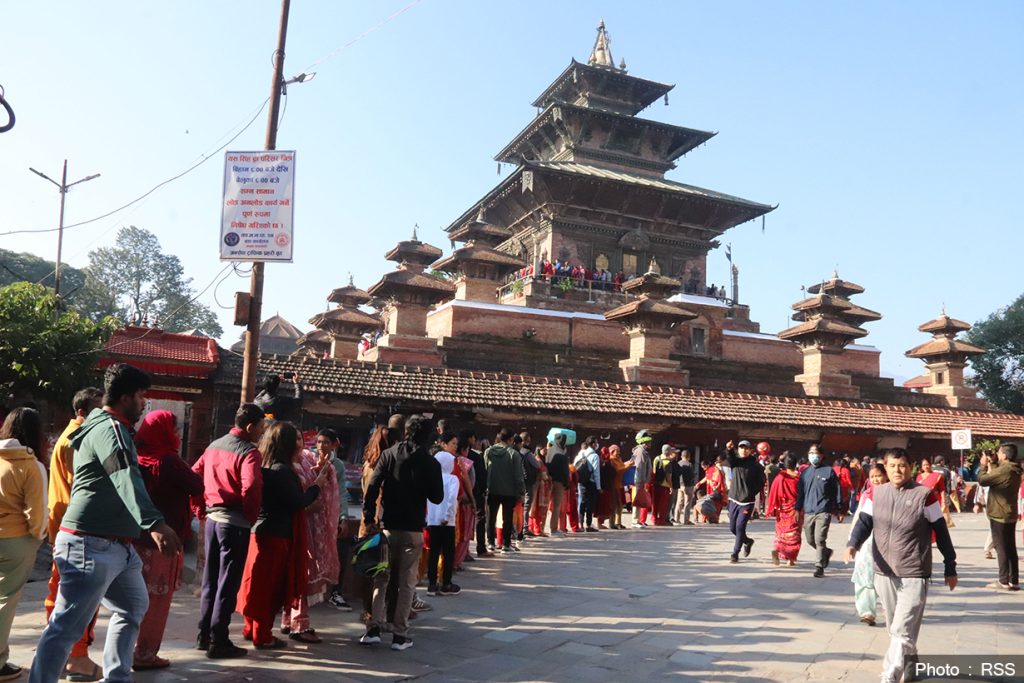
The Taleju Bhawani Temple stands tall above the maze of temples, courtyards and historic monuments surrounding Kathmandu Durbar Square. Its tiered pagoda roof and imposing structure distinguish it from the other monuments in the square, while its religious significance has made it one of the most revered shrines in the Kathmandu Valley.
As I sit near the temple, a woman walks towards its gate, bows her head and seeks the goddess’s blessings. There is a quiet satisfaction on her face as she turns away.
I ask her how long she has been visiting the temple and what it means to her.
“I have been coming here since I was a child. My Dashain isn’t complete until I visit this temple. Taleju is a part of me now, and she will be forever,” she says.
Her words capture something that extends beyond the temple’s towering architecture and centuries-old history. For many devotees, Taleju Bhawani is not merely a goddess to be worshipped during festivals, but an enduring presence woven into their lives, traditions and identities.
Located within the Hanuman Dhoka Palace complex in Kathmandu Durbar Square, a UNESCO World Heritage Site, the temple is dedicated to Taleju Bhawani, the royal patron goddess of the Malla dynasty. King Mahendra Malla is credited with building the prominent temple in 1564, although the goddess’s association with the rulers of the Kathmandu Valley dates back to the 14th century.
Over the centuries, the temple has become a place where history, religious devotion and mythology intersect, with stories of divine appearances and royal encounters continuing to shape its significance.
A temple built on divine instruction
The origins of Taleju Bhawani and her arrival in the Kathmandu Valley are surrounded by several legends. One tradition traces her worship to the Karnata dynasty of Simraungadh in present-day southern Nepal, with the goddess’s sacred yantra, or mystical diagram, eventually brought into the Valley. Taleju is also widely associated with the Hindu goddess Durga and her powerful protective form.
According to popular legend, King Mahendra Malla received instructions from the goddess to build a temple in her honour. The structure is said to have been designed in the shape of a yantra, a sacred geometric diagram believed in tantric traditions to embody divine power.
Another legend recounts that Taleju Bhawani made a special appearance during the temple’s consecration ceremony, disguising herself as a bee. Such stories have helped establish the goddess not only as a spiritual protector but also as a divine presence closely associated with the monarchy.
Taleju eventually became the tutelary deity of the Malla kings, who sought her blessings and protection for their kingdoms. Even after the Shah rulers conquered the Malla kingdoms, they continued to worship Taleju as a royal deity. Her continued patronage under the new rulers reflected the enduring religious and political importance of the goddess.
For centuries, the temple has remained a symbol of this relationship between divine authority and royal power.
A monument that has endured

The Taleju Bhawani Temple is among the most striking structures in Kathmandu Durbar Square. Built in the traditional Nepali pagoda style, it rises above a twelve-tiered plinth, giving it a commanding presence over the surrounding palace complex.
Its elevated platform, intricately carved wooden elements and carefully arranged subsidiary shrines reflect the architectural traditions of the Kathmandu Valley. Twelve miniature temples stand around the main structure, while four additional shrines occupy a higher level. The temple complex also features four elaborately decorated gates guarded by stone lions.
Beyond its architectural grandeur, the temple has also demonstrated remarkable resilience. It survived the devastating earthquake of April 2015 with comparatively minor damage, although the disaster affected parts of its structure. Its pinnacle collapsed, and the building sustained cracks and other damage. Subsequent restoration and structural reinforcement helped preserve the historic monument.
For some devotees, the temple’s survival is itself a source of faith, with its resilience attributed to the protective presence of the goddess. Such beliefs form part of the temple’s living mythology, adding another layer to its significance.
Despite the damage and restoration work, the temple continues to stand as a reminder of Kathmandu’s architectural heritage and the traditions that have survived alongside it.
The goddess behind closed doors
Unlike many temples in the Kathmandu Valley, Taleju Bhawani Temple remains closed to the general public for most of the year. Access is traditionally restricted, with the temple opening to Hindu devotees on Mahanawami, the ninth day of Dashain.
Within the complex, the principal shrine is associated with the goddess’s powerful, multi-armed form. The temple also holds a special connection to Kumari, Nepal’s Living Goddess, who is regarded in Kathmandu’s religious tradition as a human manifestation of Taleju Bhawani.
The restricted access adds to the temple’s mystique. For much of the year, visitors can admire its exterior from the surrounding square, while devotees wait for the annual opportunity to enter and offer their prayers.
Yet the temple’s significance extends beyond the rituals performed within its walls. Its relationship with the Kumari tradition connects the goddess to one of Nepal’s most distinctive religious and cultural practices.
Taleju Bhawani and the Living Goddess

The connection between Taleju Bhawani and Kumari is explained through several legends, the most popular of which concerns King Jayaprakash Malla, the last Malla king of Kathmandu.
According to the story, the king regularly played tripasa, a traditional dice game, with the goddess. During these encounters, Taleju Bhawani would offer him counsel and guidance. She agreed to continue visiting him at night on the condition that their meetings remained secret.
One night, however, the king’s wife saw the goddess. Angered by the breach of secrecy, Taleju stopped visiting the palace.
Before departing, the goddess is said to have told the king that if he wished to see her again and retain her protection over his kingdom, he would have to seek her among young Newar girls. She would return in the form of a young girl, allowing the king to worship her through a human manifestation.
Hoping to restore his relationship with his divine patroness, Jayaprakash Malla began searching for the girl who would embody the goddess. This legend is widely associated with the origins of the Kumari tradition, in which a young girl is selected through established religious and cultural criteria and worshipped as a living goddess.
The tradition continues to this day, with the Kathmandu Kumari holding a central place in the Valley’s religious life.
Each year on Mahanawami, the Living Goddess visits the Taleju Bhawani Temple as part of the Dashain rituals. The visit reinforces the longstanding connection between Taleju, the Kumari and the religious traditions of the former royal court.
An annual pilgrimage during Dashain
For devotees, Mahanawami offers a rare opportunity to enter the temple and pay homage to Taleju Bhawani. The occasion draws hundreds of worshippers, many of whom wait patiently in long queues that can extend from the temple entrance towards Kumari Ghar in Basantapur.
The annual opening transforms the temple from a monument admired from the outside into a living centre of worship. Families, elderly devotees and younger generations gather to seek blessings, fulfil religious obligations and continue traditions passed down through the years.
For many, the visit is an inseparable part of Dashain. The festival, which honours the victory of good over evil and celebrates the power of Goddess Durga, provides a fitting setting for paying homage to Taleju Bhawani, one of the Valley’s most revered deities.
The woman I meet near the temple expresses this connection in simple terms. She has been visiting since childhood, and her words suggest that the ritual is about more than fulfilling a religious duty. It is a way of maintaining a bond with the goddess, her family’s traditions and the cultural landscape of Kathmandu.
As devotees gather for the temple’s annual opening, Taleju Bhawani remains more than a figure from the past. Her temple continues to bring together faith, history, architecture and legend, preserving a tradition that has endured through changing dynasties, devastating earthquakes and generations of worshippers.
For those who visit year after year, Dashain would not be complete without standing before the gates of Taleju Bhawani and seeking her blessings.