(This piece is based on an interview conducted by Onlinekhabar’s Lilu Dumre with Rasuwa Customs Officer Tilak Parajuli.)
It had been a month and a half since I was transferred to the Rasuwa Customs Office. I had to go to Kathmandu when my father fell ill, and I had only returned to my post on Tuesday.
We had 35 staff, including contract employees, at the office, and we regularly went on morning walks. On the day of the flood, Hari Khadka, who has been unreachable since the flood, and I had gone on our usual walk together. Afterwards, I was getting ready for the office and waiting for Hari on the third floor when I heard someone shout that an earthquake had hit. I never imagined a flood, let alone one this massive.
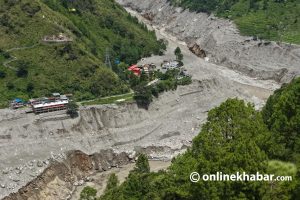
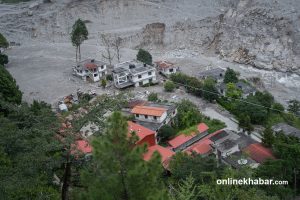
Suddenly there was a loud rumbling sound. At first I thought it was a landslide. People panicked and started running. Hari headed downstairs while I tried to get to another room, but by then, the muddy floodwater full of rocks had already reached us. Within seconds, the room was filled with mud pouring through the window; there was nothing to see anymore. I grabbed the hands of two others and held on.
The flood swept over us from head to toe. It felt like I couldn’t breathe, like this was the end. The force even broke through walls. The three of us holding hands were flung into a whirlpool. I spun around inside it, thinking I likely wouldn’t survive, but still tried to protect my head.
I went in and out of consciousness. Part of me thought it would be easier if the flood just took me. I kept praying: “God, I have a small child, save me for his sake, if nothing else.”
I spun in that whirlpool for what felt like 20 minutes. Containers and gas cylinders spun around with me; sometimes I struck a container, sometimes a cylinder, and sometimes rocks hit my body. I drifted between consciousness and unconsciousness, fighting to survive.
When the swirling finally stopped, I saw a green hillside nearby and tried crawling toward it, still fearing another wave might come or that I’d fall into a pit. As I crawled forward, I found myself grabbing someone’s head; I saw two or three people with head injuries. Even as I struggled to survive myself, I wished I could help them too.
Driven by the will to live, I dragged myself up the rocky slope. Two people who’d reached safety were searching for their own missing relative and may not have noticed me. With a battered body, I kept crawling up the rock face until I raised my hand; my friend Om Joshi spotted me. I had to tell him it was me, Tilak, since I was unrecognisable. He had been searching for his nephew, Rajendra.
Om helped me climb higher and tried to get me water by breaking open a pipe with a rock; only a little came out. There was also a young woman nearby whose forehead was badly cut; she drank some water too and was also trying to climb higher.
Still hoping for government rescue, I kept crawling upward until Bikram Shrestha spotted me; he’s the one who took the early photos that have since circulated. He recognised me and rushed over, then took me to a house. Aside from my lower clothing, nothing else covered my body; I was so covered in mud that I was unrecognisable. Bikram washed me off, which caused unbearable pain from all my injuries; I nearly passed out. Someone gave me clothes to wear.
Seeing that terrain, everyone wonders how an injured person made it that far up, but the hope of survival brings its own strength.
Once I escaped the whirlpool, I first hoped simply that I could survive. Then I hoped that if a helicopter came, I could make it. But the weather wasn’t favourable; the sun hadn’t come out. Still, after some time, I heard a helicopter, an army one, but it couldn’t land. I thought I wouldn’t survive after all; by then more than an hour and a half had passed since I’d been desperately awaiting treatment.
Once the helicopter finally came, I believed rescue was certain; even if I couldn’t stand, I thought they’d pull me up by rope if needed. On its last pass, the helicopter did land, but slightly below where I was. It picked up the injured there and flew off. Seeing my panic, Bikram tried to get me on that first flight, but the helicopter left anyway, worsening my situation. Since there was no landing space where I was, I had to climb back down; though I couldn’t be carried, there wasn’t a single part of my body without an outer injury.
With two friends’ help, I barely made it down to a spot where a helicopter could land. After being washed off, the pain intensified hugely. I’d survived this far through my own struggle; now I just hoped the government would complete the rescue.
After some time, a helicopter did arrive. The injured awaiting treatment were furious with the wait; one man with a head injury died while waiting for the helicopter, and people around him wept. Watching someone die while my own condition worsened was agonising. Kamal, a hotelier from Surkhet, and another man named Sanchit held onto me; even though Kamal’s own father and sister were unreachable, he still looked after me.
Eventually the helicopter came. I lost consciousness after boarding it, assuming I’d be flown straight to Kathmandu for treatment, but I was actually dropped at an army camp in Nuwakot, which I only realised while semi-conscious.
I dimly recall hearing that critical patients would be sent to hospital immediately. Once there, an army official asked if I could give a family member’s number. I gave my wife’s; it was off. I gave my brother Toran’s; no answer. Then I remembered my childhood friend Yuvraj’s number, which worked. I asked him to get word to my family quickly that I was alive; one of his friends came immediately to Chakradev Hospital.
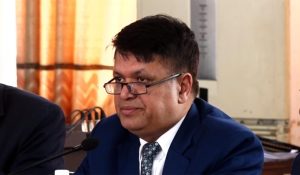
Since helicopters were needed for the flood zone, I was given first aid and sent to Kathmandu by ambulance. I initially thought I’d been brought straight to a hospital, but later learned I was at Norvic Hospital. I’d arrived around 4 pm Wednesday. I was aware of some things around me, unaware of others. Finance Minister Dr Swarnim Wagle came to check on my condition the same day I was rescued; I vaguely recall speaking with him. The Director General of the Customs Department also visited. I was admitted to the ICU, and by the next day (Thursday), my condition had improved somewhat.
According to doctors, there’s no internal damage. My right rib is broken, and I have external injuries all over, but no brain damage. Doctors say the rib will take some time to heal fully, but recovery is expected, just gradually.