Kathmandu, August 21
Rastriya Swatantra Party (RSP) Chief Whip Kabindra Burlakoti has said his party is fully committed to federalism and will move ahead with its full implementation.
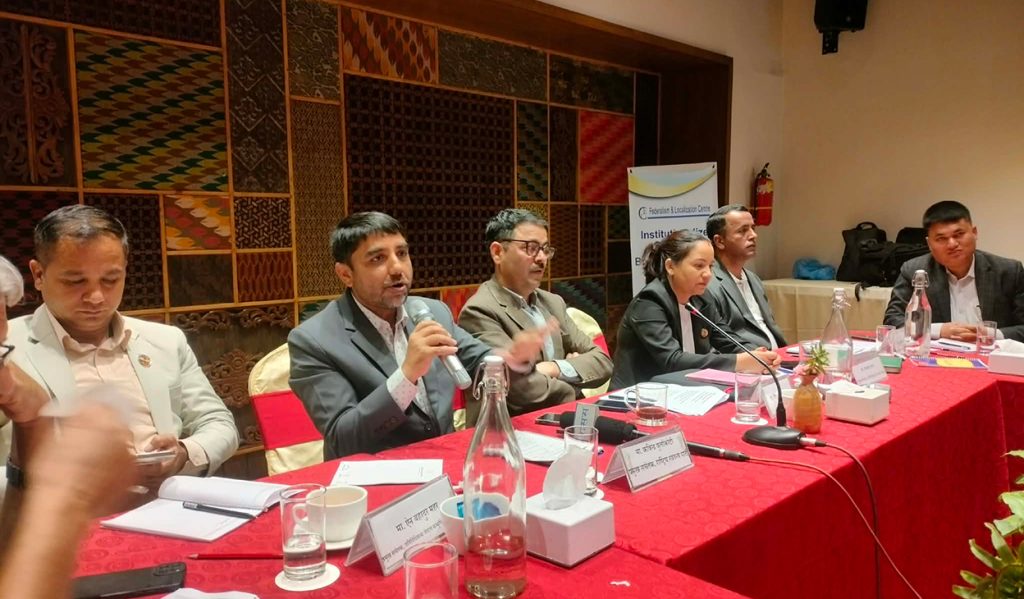
Speaking at an interaction on “Federalism: Constitutional Amendment and Unbundling of Functions” on Friday, Burlakoti said the party had no compromise on federalism and democracy.
“We are fully committed to the Constitution, democracy and federalism. There is no compromise when it comes to democracy or federalism. We will move ahead with their full implementation,” he said.
The interaction was organised by the Federalism & Localization Centre.
Burlakoti also said the Constitution could be amended as circumstances and needs change, while stressing that democratic practices must also be strengthened.
He said any review of the Constitution should examine where democratic practices had fallen short and where the state had failed to deliver on the principles of public welfare.
“We need to strengthen these practices over time. I am personally and, as a party, we are committed to that,” he said.
Recalling his earlier involvement in campaigns for decentralisation of power, Burlakoti said political leaders across parties needed a better understanding of federalism and its implementation.
He said the contributions made by political parties to the Constitution and the federal democratic system should always be recognised.
“We were also part of this process,” he said.
Burlakoti recalled the 2006 People’s Movement and other movements, including the Madhes and Tharuhat movements, saying the achievements of those movements should be reflected in any constitutional amendment.
“I injured my leg during the 2006 movement, and my shoe was lost amid the rush,” he said, recalling his participation in the movement.
He said constitutional amendment could also incorporate new ideas and experiences that had emerged over time.
However, Burlakoti stressed that constitutional reform should be based on consensus and should not be treated as the agenda of any particular party or government.
“The Constitution concerns the entire nation. It concerns all forces within the country. The concerns of minorities must also be addressed, but they must also be acceptable to the majority,” he said.
He said discussions on federalism should take a broader perspective and focus on strengthening rights and autonomy at all three levels of government.
‘There is confusion over who does what’
Burlakoti said improvements were needed in the distribution of responsibilities among the federal, provincial and local governments.
He pointed to the confusion over which level of government should be responsible for development projects and other functions.
“Recently, what I have seen is that there is enormous confusion over who should do what in development and construction,” he said.
He said the problem was evident in the budget allocation of the previous fiscal year, with the federal, provincial and local governments spending money on projects in the same areas.
He questioned whether such duplication was consistent with the principles of federalism.
“We talk about federalism and brought federalism, but what is happening now is not even consistent with the decentralisation concept that existed before federalism,” he said.
Burlakoti said responsibilities should be clearly divided among the three levels of government.
“For example, the authority to remove a fallen tree should not remain with the federal government,” he said.
He acknowledged that necessary laws for implementing federalism had not yet been enacted and called for legislation to address the gaps.
Burlakoti also said lawmakers were ready to discuss reform proposals coming from local governments.
“If proposals for this kind of reform come from the local level, the chief whips and parliamentary leaders are here at the lawmaking level. We can sit together, discuss them and move them forward,” he said.
He said the RSP would approach the issue positively rather than through a partisan lens.
‘Local level should be strong, provincial level intelligent’
Burlakoti said Nepal’s federal structure should aim for strong local governments, capable provincial governments and a decisive federal government.
“The local level should be strong, the provincial level should be intelligent and the federal level should be decisive. Decisions at the federal level should be made properly,” he said.
With elections approaching, Burlakoti said reforms that can be implemented before the elections should not be delayed.
“We should not hold back the things that can be done before the elections. We should do what can be done. The longer we delay these issues, the longer the implementation will take,” he said.
He also urged political parties to play a role in resolving disputes rather than creating them.
He called on political leaders to take responsibility for resolving disagreements surrounding federalism and its implementation.