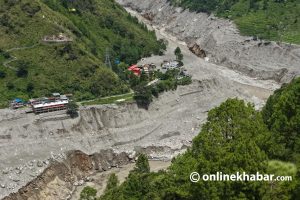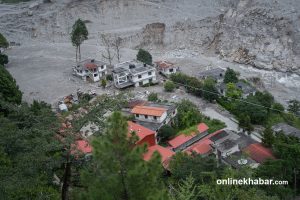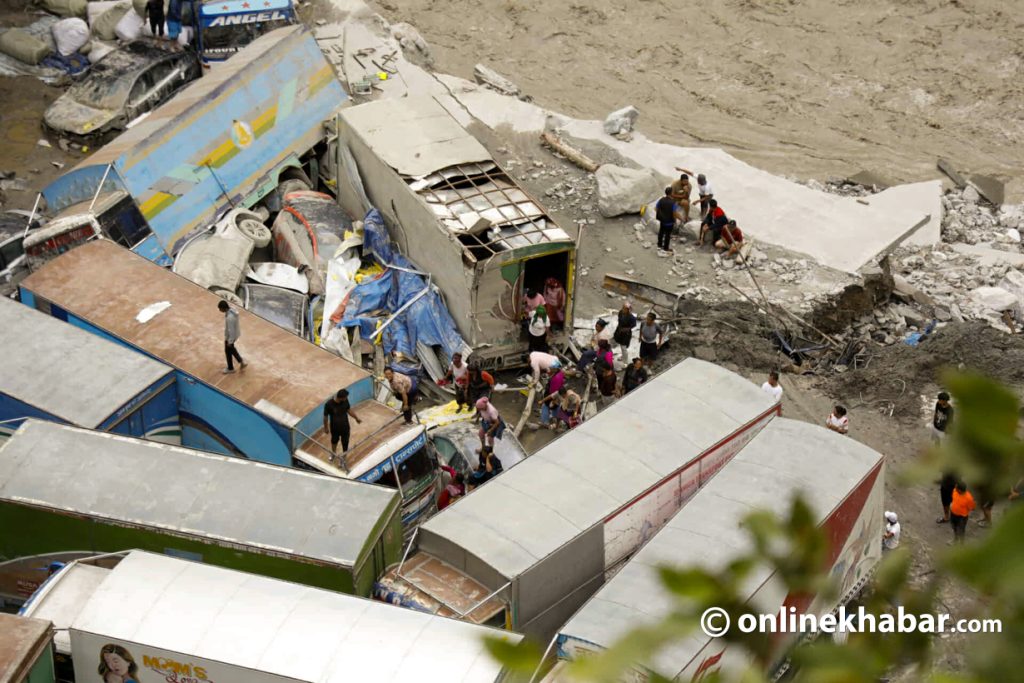


Forty-year-old Hari Prasad Mainali went missing in the Rasuwa floods. His fate remained unknown after he was caught in the flood on August 26.
After many days of search operations with no results and hope of his return faded, the family had to give up hope that Hari Prasad would come back. Since his body was never found, the family performed his last rites using a symbolic effigy made of kush grass.
But amid the pain of losing a loved one, the Mainali family faced another problem: a lack of space to perform the mourning rites (kriya).
According to Hari Prasad’s brother Hem Chandra, most of the mourning-rite houses in Kathmandu’s Tarakeshwar area were full. The municipality then allowed the family to use an under-construction mourning-rite building temporarily, where they are now staying to complete the rites.
“There’s already the pain of losing someone close to us, and on top of that, finding a place to sit in mourning was a huge struggle. Most places were full. Right now we’re staying in an under-construction building to perform the rites,” Hem Chandra says.
Hari Prasad’s family’s situation has now become a common problem for many families who lost relatives in the disaster. After a large number of families lost loved ones at once following the floods in the Bhotekoshi and Rasuwa-Nuwakot areas, pressure has also mounted on Kathmandu’s mourning-rite houses.
Even the 42-room Kiryaputri Service Centre at Pashupati filled up, requiring alternative arrangements. According to an official at the Pashupati Area Development Fund, an approximately 80-room building in the Vanakali area, previously used for flower sales, has also been arranged for temporary use as a mourning-rite building. The official claims there is no longer an immediate shortage of space for mourning rites in the Pashupati area.
Similarly, Tarakeshwar Municipality has allowed an under-construction mourning-rite building to be used temporarily. Pressure has also increased on mourning-rite houses in Kathmandu’s Basundhara, Dhapasi, Bansbari, Nepaltar, and Kandaghari areas.
When the body isn’t found
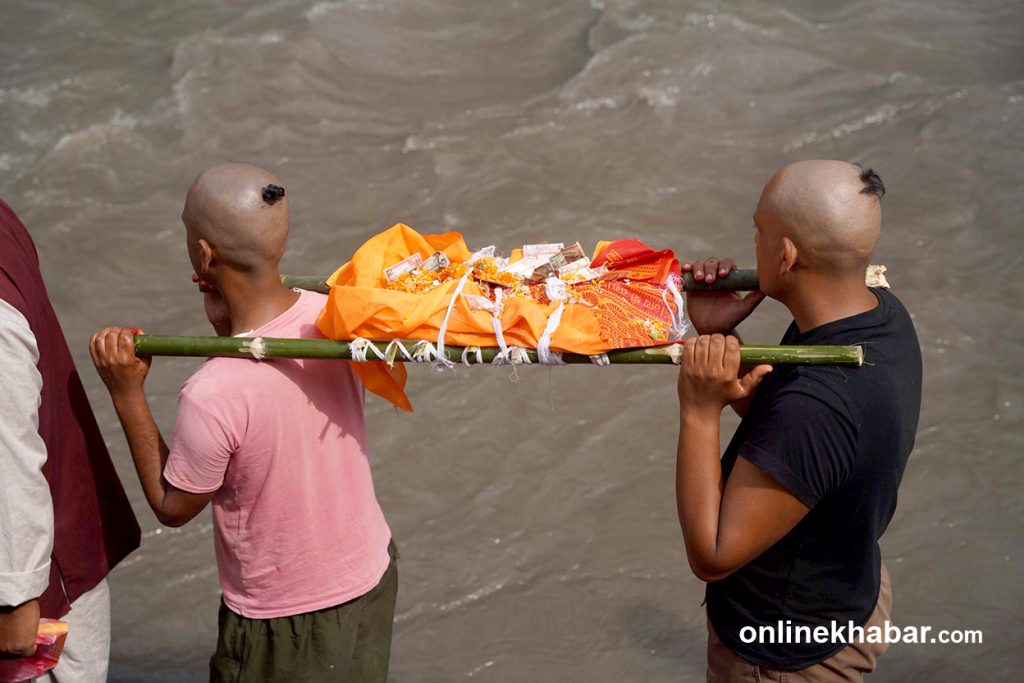
When the body of someone missing in a disaster cannot be found, families face the added complication of how to perform last rites. As with Hari Prasad’s family, some families may eventually have to perform funeral rites using a symbolic kush-grass effigy after prolonged searching and waiting.
When a body is not found, it can take families a long time to even accept the death. On one hand, hope remains that the person might still be found; on the other, the uncertainty of searching and waiting leaves families mentally exhausted. In such situations, completing the last rites according to religious and social tradition can be emotionally significant for the family.
But even after deciding to proceed with the funeral, issues such as finding a place to sit in mourning, accommodation, food, toilets, sanitation, and financial arrangements can add further stress.
Grieving families shouldn’t face additional stress
Psychologist Grishma Paneru says that disaster or sudden death is itself a deep psychosocial trauma, and that grief becomes even more complicated when families then face further difficulties in body management, funeral, and mourning-rite processes.
“When families lose a loved one, they are already in a state of shock, disbelief, fear, guilt, and deep grief. At that very time, difficulty identifying the body, delays in receiving it, inability to manage it safely, or lack of arrangements for the funeral can increase their mental anguish,” Paneru says.
Psychologists say such circumstances can heighten traumatic grief, potentially causing problems like repeatedly reliving the event, nightmares, fear, or panic.
“Many decisions, body management, funeral, mourning rites, accommodation, financial arrangements, and informing relatives, must be made in a short time. Since family members themselves are in grief and under stress, disagreements can arise over what to do, who should do it, and where,” she says.
She noted that the feeling of not having been able to give the deceased a dignified farewell can make the grieving process even more complicated.
According to a relative of one deceased person who came to Kathmandu for the mourning rites, a grieving family’s first need is to steady themselves mentally and complete the funeral according to tradition, but when finding a place becomes difficult, families fall into further distress.
“We’re already struggling with how to cope with losing our own person. On top of that, having to call around and search for a place to sit in mourning makes it so much harder,” he says.
He said the problem is even greater for families who have come to Kathmandu from outside the city, unfamiliarity with the local area, not knowing where mourning-rite houses are located, and being forced to search elsewhere when one building is full all add to the family’s stress.
Grief management needed at the social level too
According to the National Disaster Risk Reduction and Management Authority, as of Sunday afternoon, 1,341 people have died in the Rasuwa floods.
Death and funeral rites are not merely personal or family matters; they are tied to social and cultural dimensions as well. In Nepali society particularly, mourning rites serve as an important social practice that expresses respect for the deceased and helps the family move forward through the grieving process.
Therefore, when large numbers of deaths occur during a disaster, there is a need to treat families’ grief management — alongside body management, as part of disaster management itself.
While rescue, treatment, relief, and body management are prioritised in disaster response, the social and psychological problems families face afterwards may not receive adequate attention. The lack of space for mourning rites is one example of this problem.
For disaster-affected families, arrangements are also needed for drinking water, toilets, sanitation, food, security, necessary information, and counselling alongside the mourning-rite site itself. Facilities become an even more sensitive a concern for families accompanied by elderly people, women, and children.
Funerals, too, are part of disaster management
In the view of disaster management experts and sociologists, ensuring a dignified funeral for the deceased during a major disaster is a humanitarian responsibility of both the state and the community.
In a situation like the Rasuwa floods, where many families are affected simultaneously, regular structures alone cannot meet the demand, making prior coordination necessary among local governments, hospitals, the Pashupati Area Development Fund, and social organisations.
For future disasters of this kind, the Kathmandu Valley could identify alternative mourning-rite sites in advance, prepare temporary structures, arrange drinking water and sanitation, and set up a mechanism to provide necessary information to families.
For families who have lost loved ones, a funeral is not merely a religious duty to complete; it is also an important psychosocial process of accepting the reality of death and gradually moving forward from grief.
Therefore, post-disaster management should keep at its centre not just the bodies of the deceased, but also the pain and needs of their families.
For families who have lost relatives, like Hari Prasad Mainali’s family, the current priority is not simply finding a room to sit in mourning. It is equally necessary that they be given an environment in which they can perform the funeral with dignity during this difficult time of grief, along with the social support and mental grounding they need to cope.