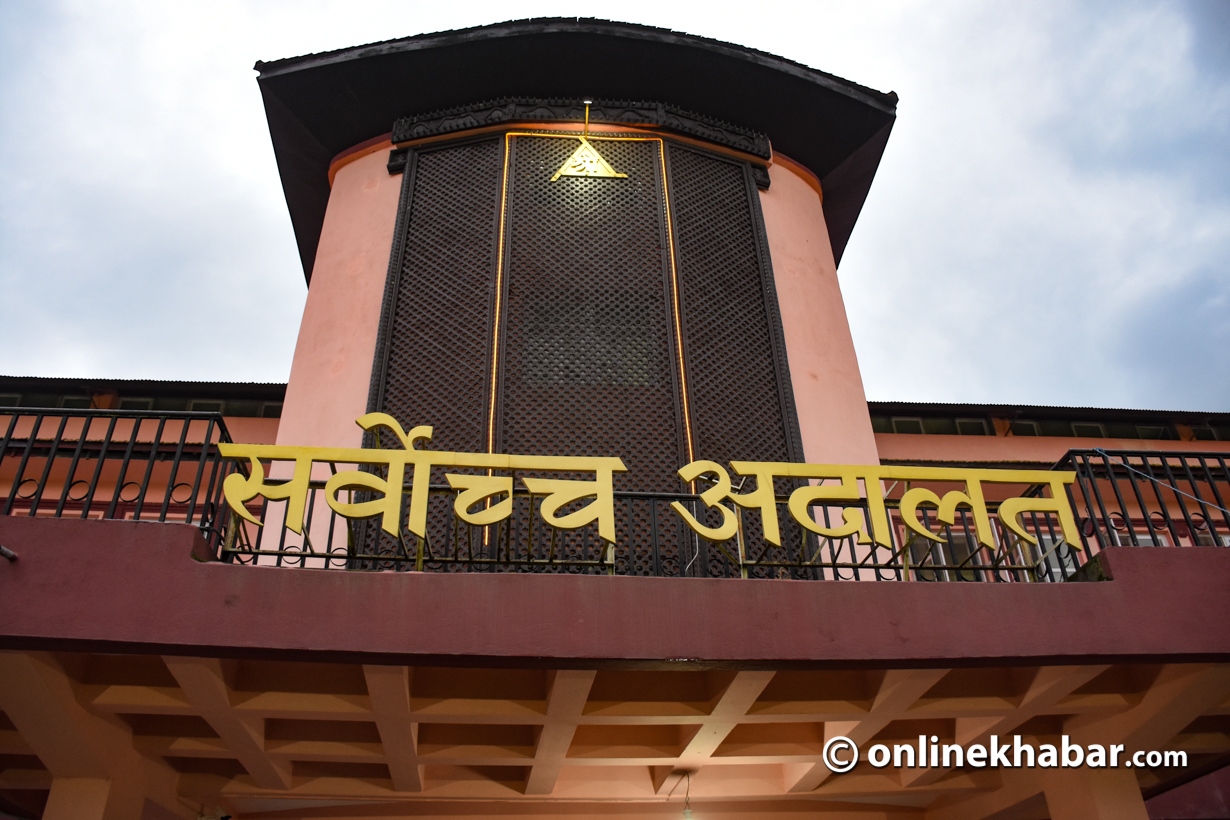
Kathmandu, November 23
The Supreme Court has ordered the registration of a writ petition filed against Tribhuvan University over its use of artificial intelligence (AI) detection software in academic assessments.
A bench of Justice Sunil Kumar Pokharel overturned an earlier order by the Supreme Court administration that had refused to register the petition.
The petition, filed by law students alleging that universities had been independently setting and enforcing rules on AI detection, was initially rejected by the court administration on the grounds that its claims were unclear.
The students argued that universities should not use plagiarism-detection software of their own choosing until the state introduces a clear policy and legal framework governing the use of AI.
They accused Tribhuvan University of rejecting research papers and other academic projects submitted by students based on software that they claim is unverified and produces unreliable results.
The writ petition was filed by law students including Roshan Auji and Bibek Chaudhary. After reviewing the petition, Justice Pokharel’s bench ruled that it raised issues concerning plagiarism that could affect law students and ordered its registration so that the matter could be adjudicated.
The petitioners have called for a detailed study into the actual need for and justification of AI detection in the academic sector. They have sought the formation of a study committee and demanded that policies and laws governing the use of AI in education be formulated only after considering the committee’s findings.
They proposed a high-level expert committee comprising specialists in law, information technology, computer science, cybersecurity, linguistics, education and research, along with academic representatives from universities and student representatives.
“Tribhuvan University has been imposing impractical rules under the pretext of international practices,” the petitioners stated in their writ.
They also argued that the Office of the Prime Minister and Council of Ministers had acknowledged that Nepal had yet to enact a separate law regulating AI, making the use of unauthorised software by academic institutions unlawful.
According to the petitioners, Tribhuvan University, Nepal Law Campus and other institutions have been using software developed by foreign companies that is not properly certified and produces only probabilistic results.
They claimed that such software has been rejecting or flagging students’ journal articles, reports, research papers and seminar papers.
Tribhuvan University has implemented the TU Anti-Plagiarism Software Management and Operation Regulations, 2023, under which it uses software to check research papers, academic projects and reports submitted by students, including for AI-generated content.
The petitioners have also raised concerns about students’ personal information and digital privacy, arguing that data is being transferred to foreign servers in violation of the Privacy Act, 2018.
They contend that the university’s regulations exceed the authority granted by the parent Act and existing rules, and that the resulting use of AI detection software has directly affected students.
The students say that even passages they have written independently are sometimes flagged by the software as “likely AI-generated”, forcing them to repeatedly rewrite, revise and resubmit seminar papers.
“The allocation of authority to regulate AI appears to fall under the jurisdiction of the Office of the Prime Minister and Council of Ministers under the Government of Nepal’s Rules of Business,” the petition states.
It further argues that universities, law campuses, the Press Council, the Nepal Bar Council or the Ministry of Defence cannot independently conduct AI detection and impose penalties in the absence of a national policy framework.