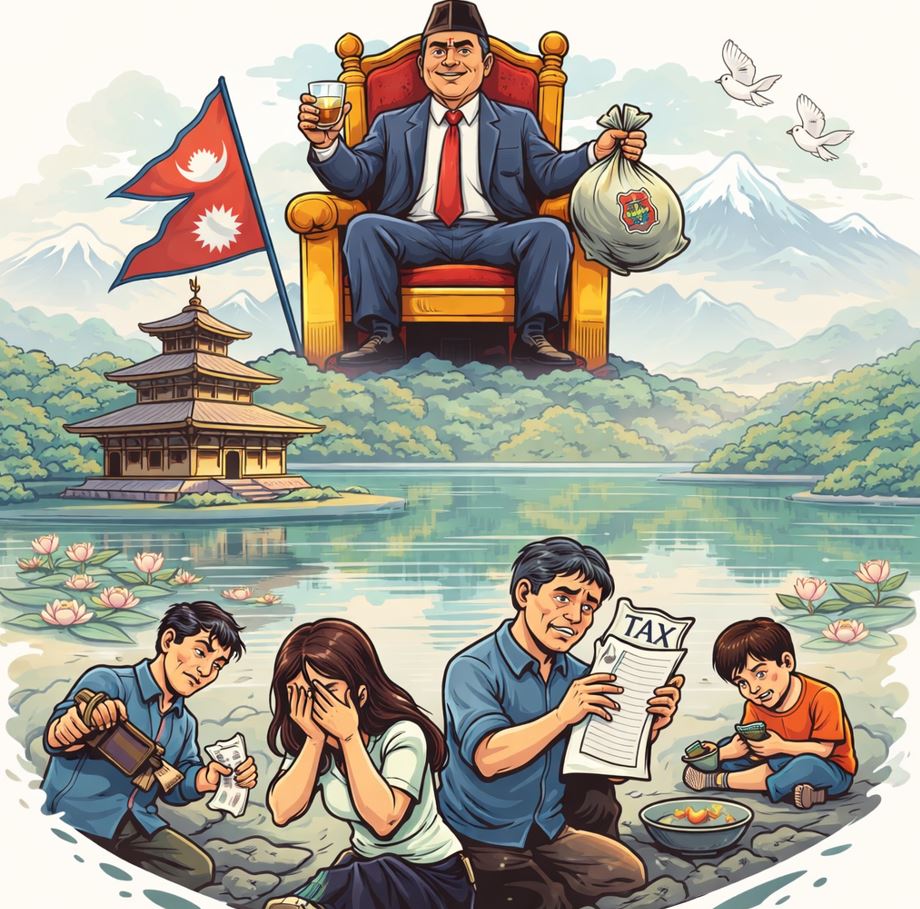
AI generated
Will politics ever serve humanity, or will we always be coerced (sāma) by carrot (dāna) and stick (danda), divided (bheda) into easy prey for Machiavellian deceit? A study of fifty-nine countries across the political spectrum found that fear—internal or external, real or contrived—pushes people towards authoritarianism. It is therefore unsurprising that rulers absolve themselves of failure by inciting loyalists against the weakest in society or a beleaguered neighbour, while simultaneously provoking stronger powers to invite interference and branding the opposition as foreign stooges.
As with ancient ganasanghas and the relatively recent Liglig marathon, democratic republican values repeatedly fell victim to dynastic usurpers. Caesar, who chose dictator perpetuo over a crown, was assassinated for monarchical ambition; yet his name became synonymous with emperor, evolving into Kaiser and Czar.
Murky politics is beyond my professional domain, but astronomical symbolism in art and architecture, from the Palaeolithic era to equinoctial and solstitial rituals spanning Göbekli Tepe, Stonehenge, and Kumbha Mela, draws me into social terrain.
As technological advances such as the plough, bronze armoury, cavalry, gunpowder, and naval warfare scaled village polities into cities and global complexity, humanity became ever more awed by celestial phenomena. One hopes that AI and quantum computing will now supersede weaponry and knit our global village into a synergistic neural network of cosmic proportions.
Observation: Politics without accountability
In gazing at the universe, scientists observe, model data, theorise cause and effect, verify predictions, and refine theories through feedback. Scientific theory survives only through real-time observational confirmation of increasing precision; a single contradiction can render it obsolete, as Galileo’s moons did to geocentrism. His legendary Pisa experiment continues today in the search for “new physics” through freely falling quanta.
Politics, however, follows the opposite culture. We admire haughty leaders who refuse to admit mistakes. Freed from responsibility, they invoke astral destiny to justify repeated failures from elevated seats of power and cling on through geriatric years, piping society into a vicious vortex. Geriatric tantrums are offered as an explanation for why a relatively young leader like Sunak, with little chance of political return, apologised and resigned immediately after electoral defeat.
The same triumvirate rotates power, thriving on a centuries-old practice of exporting dissenters to foreign lands to remit blood, sweat, and tears, while party intellectuals, derided as rats by their leaders, grovel in submission, prompting genuine minds to flee. With the opposition diluted, plunder of national coffers becomes effortless. Public anger erupted in Sri Lanka and Bangladesh, yet such lessons fail to penetrate minds hardened by a refusal to learn. Unable to read youthful aspirations or anticipate catastrophe, leaders abandon responsibility, only to cry foreign interference when rescued from collapse.
Mandela is revered for retiring at the height of popularity after enshrining rights in a new constitution, in contrast to Mugabe. Had one of our former prime ministers retired after steering the country through a devastating blockade following earthquakes, or even after passing the parliamentary resolution on Limpiyadhura, history would have hailed him as an astute leader. Instead, Bhupi’s blind man on a revolving chair required yet another example.
Systemic failure and institutional decay
Without a written constitution, the Westminster system evolved through hindsight, from the thousand-year-old Magna Carta to white papers scrutinised by an educated and forward-looking public. Even then, Brexit instability went unanticipated. Written emulations elsewhere often descend into chaos unless power is explicitly separated to institutionalise humanism. In the United States, federal judges hold lifetime appointments to prevent allegiance to nominators.
Our infatuation with the Constituent Assembly dissolved into four years of cacophony. A bloated second assembly similarly failed to reflect popular aspiration, dismissed academia, distrusted civil society, and quarrelled over non-issues before hastily passing a discordant, copy-pasted constitution at the eleventh hour. Its legacy, eight governments in eight years, cannot be undone by astrologers selecting auspicious oath-taking hours or sacrificial rituals. The singular pursuit of planting corrupt cronies at the heads of institutions repeatedly resets the system to square one.
Proposition: The middle path of governance
Globally, politics oscillates between rightists advocating individual freedom and leftists championing social justice. Multifaceted individuals like Einstein or Pelé cannot thrive in isolation, nor can ant-like collectives be socially engineered.
Human progress lies in a middle path, shaped by gentle swings of power—rightist encouragement of free enterprise to generate wealth, and leftist socialisation of health and education.
Nordic countries, both republics and monarchies, top happiness indices through social justice grounded in free enterprise. China rose as a global power by abandoning ideological rigidity in favour of pragmatic outcomes. India’s economy expanded as socialist stupor faded. As Nobel laureate Acemoglu laments the stagnation of new ideas from the right, and as tactics of minority-bashing and class division lose potency, youth increasingly feel excluded. Polarisation fractures families, while voters struggle to balance two extremes known to wreak havoc.
Decades were wasted forcing partyless conformity upon Nepalis. Now monocular socialism is mandated, erasing multidimensional vision. Every party claims socialism—even Rashtriya Samajwadi, whatever that implies. With debate absent, parties have mutated into panchayati-style class organisations centred on cult leaders, devoid of ideas or ideals. Nepotists breed criminality in their own progeny, forgetting that Ratnakar became Valmiki by choosing a different path. As in the Panchayat era, faces change through musical chairs, while the ghostly ultrasonic whistler remains perceptible only to the triumvirate.
Legislative farce and executive overreach
Mostly idle, sparsely attended, and unanimously lax on corruption, the legislature erupts only to pass government bills. Uproarious ayes from Tweedledum, who opposed the bill before gaining power, drowned out the nays of Tweedledee, who had originally tabled it.
All collude to pass drafts written by clerks. In crises, the executive chokes parliament into a coma, reviving it only to endorse rule by decree. At times, the triumvirate conspires to dissolve parliament and call costly elections merely to confuse the populace.
A way forward
A sovereign people can only be represented by a perpetual legislature that renews alternate halves through direct elections, operates on its own calendar, and remains free of executive control. Nominations or proportional representation should be confined to a separate assembly of independent elders, professionals, and social leaders—excluding political activists. Every bill, including the budget, must be transparently framed in parliament, informed by the executive and civil society, and rigorously analysed by academia. A budget should not merely rewrite tariffs to benefit party donors. Ministries and cabinet posts must be reduced to a bare minimum.
Where a prime minister accountable to parliament exhibits authoritarian tendencies, a directly elected chief executive would fare worse. Instead, a chief executive chosen from directly elected members, with strict term limits, removable only by impeachment for grave offences or incapacity, would be preferable. Conviction should disqualify a future office. Cabinet posts should be filled by independent experts; any inducted legislator must vacate their seat to preserve the separation of powers. All appointments should undergo public vetting, and confirmed officials are allowed to complete their terms unless removed through due process.
Provinces are artificial constructs lacking geopolitical, historical, or cultural coherence. Their assemblies serve little purpose beyond resource drain and mimicry of central authority. Districts, with deeper historical and cultural roots, are the natural units of federation, where the judiciary should be strong, governance nominal, and financial and administrative powers largely devolved to local councils. Judicial reform is delicate; it requires rigorous public scrutiny of past impartiality and confirmation by large majorities for long-term appointments. Judgeships must not serve as pre-retirement rewards for compliance.
A lasting constitution is concise and rooted solely in humanism, for all other isms are transient. It needs only enshrine fundamental rights, explicit separation of powers, and the structure of the three branches; the rest should evolve through legislation. Skilled human resources and equality under the rule of law are the only prerequisites for a high quality of life, as Singapore demonstrates.
There is no reason the resilient Nepali—shaped by millennia alongside the Himalayas—should languish in poverty, except for the stranglehold of inept and exploitative leadership across political, economic, social, cultural, and scientific spheres. Voters must demand concrete economic and social plans, not platitudes. Recent events confirm that the youth will no longer accept stale slogans.