

CPN-UML Chairman KP Sharma Oli has called for the restoration of Parliament.
And not casually. He has put the demand in writing in a document presented to the party’s Central Committee meeting. For a moment, it was hard to believe what we were hearing. Even after seeing the demand clearly stated on page 78 of the document, our eyes were reluctant to believe it.
How could they?
Oli is the very leader who, when he was prime minister, dissolved Parliament twice in what the Supreme Court later ruled were unconstitutional moves — in December 2020 and May 2021. Those who demanded the restoration of Parliament were denounced by Oli and his supporters.
Yet now the same Oli has accepted the Parliament that collapsed under the force of the Gen Z movement and has also accepted the results of the election held under a new political consensus.
A new government has been formed under Balen Shah.
Knowing, understanding and seeing all of this, why has Oli started talking about restoring Parliament again?
To understand Oli’s latest argument, perhaps it is no longer enough to look at political science. We have to enter the domain of psychology.
Oli himself knows that he is making a demand that is impossible in his lifetime. The new Parliament has already been functioning for more than six months. Is there really a UML member today who would dare take to the streets demanding its restoration?
Consider the Parliament that once had the Rastriya Swatantra Party with just 21 seats. Today, the RSP has not merely won close to a two-thirds majority; it has also secured almost half of all votes cast on its own.
In such circumstances, what would the narrative of restoring the old Parliament even mean? The Parliament itself would hardly survive the contradiction, let alone the streets.
Perhaps the argument will be made that restoring the old Parliament would make Oli prime minister again. But how much of that argument would even be acceptable to UML members themselves?
At the Onlinekhabar newsroom, we had discussed what the length, breadth, height or depth of Oli’s argument might be. At the time, we decided that perhaps it did not deserve much attention. So we remained silent.
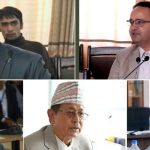
But after listening to Central Committee members such as Gokarna Bista, Raghuji Pant, Hikmat Karki, Yamlal Kandel, Binda Pandey, Rachana Khadka, Sarita Bhusal, Keshav Pandey, Gokul Baskota, Jhapata Rawal and Hemraj Rai, and then looking at Oli’s responses to them, it became clear that he appears to be seriously trying to revive the demand for Parliament’s restoration.
The reason is simple. The demand to restore the House of Representatives has been placed right at the top of the party’s two main tasks.
Speaking at the Central Committee meeting against this backdrop, Rachana Khadka remarked that the trust of ordinary people in the party had already been eroding since the dissolution of the House of Representatives on December 20, 2020, and that the demand for restoration now being pushed by Chairman Oli would only accelerate that downward journey.
But is Oli prepared to grasp the seriousness of what Rachana and other leaders are saying?
Because Oli now appears to be moving towards a line in which the dissolution of Parliament was good when he did it and bad when somebody else did it.
The Gen Z revolt swept away not only Parliament but many other things as well. The leadership of the UML and other political parties needs to understand that.
We too had wondered at the time what constitutional alternatives existed after the dissolution of the House of Representatives. That is why, when Parliament was dissolved on September 9, 2025, we published a special editorial proposing, among other options, the creation of a powerful civilian government followed by direct elections.
There could have been a constitutional route under which Parliament would have continued to exist until elections were held, while remaining politically inactive. There would have been no need to keep fighting over the remaining disputes.
But this is politics. It does not always follow the full grammar of constitutional theory.
A flood is not supposed to wash away a settlement. But sometimes it does. The Gen Z revolt was such a flood.
It swept away some of the deeply entrenched but mistaken assumptions in Nepali politics. There is still debate over who did what by entering the questions raised by young people.
But now that political parties — and the UML itself — are reviving the debate over restoring Parliament, what exactly are they trying to go back to?
Was the old Parliament really some kind of a utopia?
If it was not, then it is not enough for a dozen Central Committee members to raise questions.
The entire political course needs to be corrected.
The UML has been standing for some time on the foundation of mistaken assumptions.
UML leaders often say that politics requires an analysis of concrete circumstances.
So, when faced with a concrete situation, is it really a concrete analysis to fall back on arguments as insubstantial as restoring Parliament?
Parliament was swept away after a massive youth movement.
Before that, Oli himself had dissolved Parliament as part of the regular political course.
The real problem is that Oli continues to refuse to understand these simple truths. That is precisely why history is now moving forward without him.
The UML, more than anyone else, needs to understand this.
Had the UML fully understood it, Shankar Pokhrel would not have had to carry the political agenda of party reorganisation with such hesitation and fear. Bishnu Paudel would not have had to set aside his own convictions and rush into reconciliation with Oli.
At yesterday’s Central Committee meeting, Suhang Nembang invoked Mao Zedong and Che Guevara to make his point.
Just as dirt accumulates when you do not wash your face every day, he said, ideas decay when there is no self-reflection and no acceptance of mistakes. Hiding mistakes, he argued, is like hiding an illness — and ultimately leads to destruction.
Nembang also appeared to signal that it is time for the old leadership to step aside.
He said he wanted the arduous struggles and contributions of the older generation, as well as the glorious history of the communist movement, to be told and remembered for generations to come.
But Suhang and his generation may have to fight another battle within the party simply to get their turn.
Because Shankar Pokhrel and his generation have apparently failed to believe that there can be light for them beyond Oli.
They have failed to believe that they, too, can shine through their own personalities and abilities.
And so, even when Oli is left standing alone, he continues to keep everyone on edge.
He promises one person the chairmanship. Another gets the general secretary’s post. Someone else gets a chief ministerial position. Because he can no longer hand out the posts of prime minister or federal minister as he once could.
So one gets this. Another gets that.
Fear is not the greatest enemy of a person. Greed is. And it is through this greed that UML’s second generation is preparing to become corrupt.
A person does not become corrupt only by taking money. Is someone who is constantly abandoning their own convictions really any less corrupt?
The UML’s future depends on whether it is prepared to fight this form of corruption as well. And if anyone believes that Oli was right and that Parliament must be restored to reinstate him, they should understand one thing.
Oli is not Girija Prasad Koirala. Koirala stood with the people’s movement against an autocratic king.
Oli himself faced a large section of the population in opposition, and the dissolution of Parliament took place in the middle of that conflict.
Parliament is not going to come back simply because Oli wants it to.
So the question is not really for Oli. It is for the remaining members of the UML.
Do you genuinely want the old Parliament back? Do you really believe that this is possible? Or, even if you know it is impossible, are you pursuing some political manoeuvre that could make your own political revival easier?
When you leave the Central Committee meeting, do not leave without first finding answers to these questions.
Yes, the matter is apparently still before the court.
But when history has already put an issue away and the people have already delivered a fresh mandate, those who continue to raise expired political agendas should not expect public trust to return either.