Kathmandu, October 30
The government carried out a series of police operations at media houses on Friday, detaining journalists in a manner that evoked memories of the royal regime. While the ruling Rastriya Swatantra Party (RSP) strongly criticised the government’s actions, the incidents have raised questions about whether the party has lost control of the government or whether the operations were carried out with its knowledge.
On Friday, police entered the newsrooms of several media outlets and detained journalists, in a move that critics say runs counter to the constitutional guarantee of full press freedom.
Plainclothes officers deployed from the Cyber Bureau and the Crime Investigation Office took several journalists into custody, while police were also searching for others. Some journalists reportedly went out of contact after police began what media representatives described as unusual efforts to detain them.
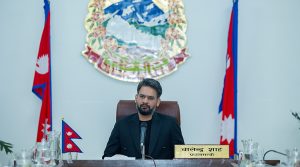
The Prime Minister’s Office said it had no prior knowledge of the operations. Sources close to Prime Minister Balen Shah, however, claimed that the initiative came from Inspector General of Police Dan Bahadur Karki, who had allegedly targeted journalists and media outlets that published reports critical of him.
However, sources familiar with the matter said Karki had issued instructions to subordinate officers after coordinating with members of the Prime Minister’s team. The alleged plan included detaining journalists, seizing their equipment and identifying the sources of news reports.
According to high-level sources, Karki explicitly referred to instructions from the prime minister and home minister while issuing directions to officers under his command. Information has also emerged that he coordinated with influential members of the Prime Minister’s Secretariat to prepare a list of media outlets and journalists to be targeted.
Although IGP Karki appeared to be leading the operations, sources suggest that some individuals actively involved in running the government were also aware of and involved in the process.
As the police operations intensified, the ruling RSP issued a strong statement criticising the government’s approach.
The party said that using the cover of law enforcement to intimidate the independent press, undermine the dignity of media institutions and restrict democratic institutions was incompatible with democratic conduct.
“Where institutions authorised to regulate the media are already functioning, bypassing established legal and institutional procedures to detain journalists is a blatant violation of the rule of law and cannot be justified under any circumstances,” RSP spokesperson and former communications minister Jagadish Kharel said in a statement issued on Friday evening.
“Attempts to intimidate, psychologically pressure or restrict media organisations under any pretext are unacceptable. In light of reports that some journalists have been detained simply for writing news stories and that others are being sought, we strongly urge the concerned authorities to conduct an impartial, transparent and factual investigation, make the truth public without delay, and immediately release journalists held unlawfully, with dignity and without conditions,” he added.
Kharel also expressed solidarity with the media sector, urging journalists to continue practising journalism with courage and commitment to truth, facts and integrity without yielding to fear, intimidation or undue pressure.
The Prime Minister’s Office, meanwhile, has denied responsibility for Friday’s operations. The incident has brought to the surface tensions between the government and the ruling party.
It has also raised a broader question: despite the Cabinet being formed under the leadership of a senior party figure, has the RSP leadership lost control over the government?
The issue goes beyond any differences between the party and the government. Nepal’s Constitution guarantees full press freedom in its preamble and recognises freedom of the press as a fundamental right. Yet journalists were detained from their newsrooms on Friday.
The police action has drawn criticism from lawyers and media rights advocates. Leaders of the main opposition Nepali Congress, the CPN-UML and other opposition parties have also condemned the crackdown.
“This incident is reminiscent of the royal regime. It is not appropriate for the government itself to engage in such acts of repression,” Bijay Prasad Mishra, president of the Nepal Bar Association, told Onlinekhabar. “There is no example anywhere in the world of a government succeeding by arresting and suppressing journalists. This is not a good sign.”
Article 19 of Nepal’s Constitution guarantees the right to communication. It states that no prior restriction shall be imposed on the publication, broadcasting or dissemination of news, editorials, articles, writings or other textual, audio or audiovisual material through electronic, print or any other medium.
Tikaram Bhattarai, former vice-president of the Nepal Bar Association and a senior advocate, described the raids on media houses as an incident that surpassed the excesses of King Gyanendra’s rule.
“The incident is unconstitutional, contrary to constitutional supremacy and the rule of law, and condemnable for undermining democracy,” Bhattarai wrote on Facebook. “The release of the arrested journalists is not the main question. Every conscious citizen must raise their voice against this kind of government, its conduct and its attitude, and in defence of democracy. The concern is not simply that a goat has gone missing, but that death itself has entered the neighbourhood.”
On February 1, 2005, after King Gyanendra assumed direct control of the state, armed soldiers were deployed to media houses and censorship was imposed on news publication and broadcasting. Equipment was also seized from some media organisations. The Supreme Court subsequently issued dozens of orders against the royal government’s actions. The conduct of the royal regime has since been a frequent point of comparison when discussing state repression of the media.
There is no legal provision allowing journalists to be arrested simply for writing news reports or having their equipment seized for investigation on that basis.
Referring to the constitutional and legal protections, Shiva Gaunle, former editor-in-chief of Onlinekhabar and former president of the Federation of Nepali Journalists, said police entering newsrooms to identify sources of news reports amounted to a fundamental breakdown of constitutional order.
“If the police have started entering newsrooms and arresting journalists in the name of identifying news sources, then the Constitution has effectively ceased to exist in this country,” Gaunle said. “We can continue fighting to protect press and freedom of expression, but first we now have to fight to save the Constitution.”
The Press Council Nepal has also condemned the police action against journalists over published reports.
“Against the backdrop of a statement issued by the Police Headquarters, this incident raises serious questions about press freedom and the professional security of journalists,” the council said in a statement. It urged the government, police administration and other concerned parties to resolve disputes over news reports through the council’s established procedures rather than directly deploying police.
Dr Kumar Sharma Acharya, former chairperson of the Press Council Nepal, said arresting journalists for their reporting was unconstitutional.
Acharya, who is also a senior advocate, said the Constitution guarantees press freedom and that legal remedies are available if a news report contains errors.
“There are procedures for correcting inaccurate news content. If that is not sufficient, there are separate mechanisms for taking action,” Acharya said. “But journalists cannot be arrested simply for writing news reports. Doing so would be unconstitutional. Our Constitution and laws do not envisage such a practice.”
Raman Karna, secretary of the Supreme Court Bar Association, described the police operations as an attempt to restrict freedom of expression and press freedom.
“When the government uses the police to take such action, it amounts to undermining the Constitution,” Karn said. “If journalists face raids and detention for bringing facts to light, what remains of the rule of law in the country? This is the height of authoritarian conduct.”